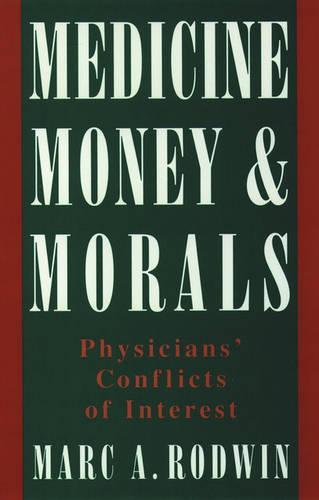
Full Product Details
Author: Rodwin
Publisher: Oxford University Press Inc
Imprint: Oxford University Press Inc
Dimensions:
Width: 22.00cm
, Height: 2.90cm
, Length: 13.60cm
Weight: 0.535kg
ISBN: 9780195096477
ISBN 10: 0195096479
Pages: 432
Publication Date: 11 May 1995
Audience:
General/trade
,
General
Format: Paperback
Publisher's Status: Active
Availability: To order

Stock availability from the supplier is unknown. We will order it for you and ship this item to you once it is received by us.
Reviews
a well documented closely argued book ... He makes clear and manageable recommendations for improvement, Scimed Publicity A convincing case for resolving financial conflicts of interest that compromise the judgment of doctors and that bias the clinical choices they make. A constructive contribution-featuring a well-presented analysis as well as concrete proposals for reform-to the ongoing discussion of our national health-care crisis. Kirkus Reviews admirably researched and cogently argued book. His findings and recommendations must be pondered by everyone concerned with quality in health care. Science Vol 262,15 October 1993. excellent book. If health care reform is to achieve the worthy goal of better ensuring the practice of cost-effective medicine and increasing public confidence in the health care system, it will have to come to terms with the persistent and ingrained conflicts of interest so splendidly articulated by Professor Rodwin. New England Journal of Medicine excellent book. probably the first systematic examination of financial conflicts of interest in the medical profession. If health care reform is to achieve the worthy goals of better ensuring the practice of cost-effective medicine and increasing public confidence in the health care system, it will have to come to terms with the persistent and ingrained conflicts of interest so splendidly articulated by Professor Rodwin. New England Journal of Medicine, Volume 329, September 16, 1993 Number 12 admirably researched and cogently argued book ... His findings and recommendations must be pondered by everyone concerned with quality in health care . David J. Rothman, Columbia University, Science, Vol. 262, 1993 Rodwin ... painstakingly scrutinises medical practice in the USA, giving a fascinating insight into the dilemmas facing patients when medical decisions can affect the doctor's economic wellbeing ... the success or otherwise of a practice, or the survival of a hospital ... for those familiar with US practice the detail will be compelling. Joe Collier, St George's Hospital Medical School, London, The Lancet, Vol. 343, June 1994 impressively documented and detailed book Francis H. Miller, Boston University, Indiana Law Review, Volume 27, Number 3, 1993 Rodwin's book is a must for anyone concerned with the organisation of the health service, as well as for any academic. The book presents an extraordinarily well-marshalled account of the types of conflict of interest to which physicians in the United States are prone. Times Higher Supplement Marc Rodwin's Medicine, Money and Morals provides a thorough, thoughtful, and practical analysis of this important problem. Rodwin - canvassed not only the academic, trade, and popular literature on the subject but also comments on providers on proposed federal rules, investment prospectuses for medical joint ventures, and kickback trial records to come up with the most exhaustive catalogue available of the scope of the conflict-of-interest problem. The analysis and recommendations that follow make this book a must-read for those seeking to understand the current health care crisis. The strength of Rodwin's book are many. It is well written and easily accessible to persons lacking expertise in fraud and abuse law. This is continued below as it is more than 1000 characters. The most important contribution of the book ... is the practical nature of the solutions it offers ... it is a major contribution to the legal, ethical, and health policy literature. One hopes that it will be read carefully by those currently seeking to redesign our health care system. Timothy Stoltzfus Jost, Ohio State Unievrsity, Journal of Health Politics, Policy and Law, 1994 (Spring) 19(1) Medicine. Money, and Morals is about the effects of financial incentives on medical practice. It is not the first work to address these questions ... But it is the best ... the book clearly will be of great use to whose who have professional reasons to be interested in, for example, the joint venture safe harbors under Medicare fraud and abuse regulations or the effects of physician risk sharing on the quality of care. It deserves an even broader audience. This book is an important start to understanding the fundamental implications that financial incentives and decisions about the shape of the financing system hold for the ties that bind doctors and patients. Anyone practicing medicine or studying the health care system would benefit from its description and its analysis. Henry T. Greely, Stanford Law School, JAMA, June 1994, Vol. 271, No. 24 This book should provoke critical reflection on the current reforms in health care. Malcolm K. Benson, Oxford Radcliffe Hospital, Journal of Medical Ethics
A convincing case for resolving financial conflicts of interest that compromise the judgment of doctors and that bias the clinical choices they make. Whereas lawyers, certain financial professionals, and government officials are considered by law to be fiduciaries - i.e., obligated to work for the benefit of those they represent - there's as yet no effective policy to hold doctors accountable in this way. The medical profession has never developed a framework to address this problem, and, according to Rodwin (Law and Public Policy/Indiana University-Bloomington), it's unlikely to cio so. Here, Rodwin examines seven activities that lead to significant conflicts of interest among physicians: kickbacks; referral to facilities in which physicians have a financial interest; the selling of medical products that they themselves prescribe; hospital purchases of private practices; payments by hospitals for patient referrals; gifts by pharmaceutical firms; and risk-sharing in health-maintenance organizations (HMOs). Disturbing examples of each of these activities dot the text and dramatize how patients can be adversely affected by them. Rodwin draws on the regulatory approaches of other professions to offer recommendations for solving the medical establishment's conflict-of-interest problems. He argues for setting up new institutions and rules to hold physicians to fiduciary standards, with legislatures taking the lead in laying down the ground rules, and with courts, regulatory agencies, third-party payers, and state attorneys general enforcing them. One interesting concept the author examines is the regulation of the medical industry by a federal commission, similar to the regulation of the securities business by the SEC. A constructive contribution - featuring a well-presented analysis as well as concrete proposals for reform - to the ongoing discussion of our national health-care crisis. (Kirkus Reviews)
Excellent...The first systematic examination of financial conflicts of interest in the medical profession. Rodwin's proposals for reform deserve very serious consideration. --The New England Journal of Medicine<br> Medicine, Money, and Morals is about the effects of financial incentives on medical practice. It is not the first work to address these questions...but it is the best...Clearly will be of great use to those who have professional reasons to be interested...An important start to understanding the fundamental implications that financial incentives and decisions about the shape of the financing system hold for the ties that bind doctors and patients. Anyone practicing medicine or studying the health care system would benefit from its description and its analysis. --Journal of the American Medical Association<br> Rodwin painstakingly scrutinizes medical practice in the USA, giving a fascinating insight into the dilemmas facing patients when medical decisions can affect the doctor's economic well being, the success or otherwise of a practice, or the survival of a hospital. --The Lancet<br> Provides thorough, thoughtful, and practical analysis of this important problem. Rodwin canvassed not only the academic, trade, and popular literature on the subject but also comments on providers of proposed federal rules, investment prospectuses for medical joint ventures, and kickback trial records to come up with the most exhaustive catalogue available of the scope of the conflict-of-interest problem. The analyses and recommendations that follow make this book a must-read for those seeking to understand the current health care crisis. --Journal of Health Politics, Policy and Law<br> A theoretically sophisticated, empirically detailed account of conflicts of interest and the physician's role....An impressive piece of work--broad in its scope, clear in its objectives, confident of its findings, certain of the policy implications. --The Journal of Legal Medicine<br>
<br> Excellent...The first systematic examination of financial conflicts of interest in the medical profession. Rodwin's proposals for reform deserve very serious consideration. --The New England Journal of Medicine<br> Medicine, Money, and Morals is about the effects of financial incentives on medical practice. It is not the first work to address these questions...but it is the best...Clearly will be of great use to those who have professional reasons to be interested...An important start to understanding the fundamental implications that financial incentives and decisions about the shape of the financing system hold for the ties that bind doctors and patients. Anyone practicing medicine or studying the health care system would benefit from its description and its analysis. --Journal of the American Medical Association<br> Rodwin painstakingly scrutinizes medical practice in the USA, giving a fascinating insight into the dilemmas facing patients when medical decisions can affect the d
Author Information
Marc A. Rodwin, Associate Professor of Law and Public Policy at Indiana University, Bloomington, has an M.A. from Oxford University, a J.D. from the University of Virginia Law School, and a Ph.D. from Brandeis University.