Full Product Details
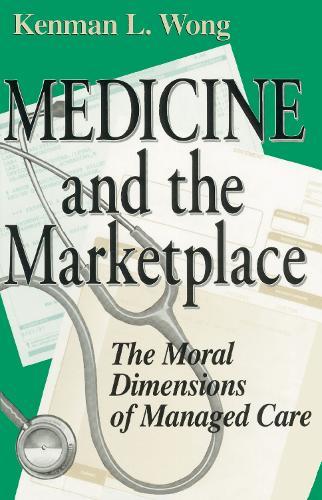
Author: Kenman L. Wong
Publisher: University of Notre Dame Press
Imprint: University of Notre Dame Press
Edition: New edition
Dimensions:
Width: 14.00cm
, Height: 1.30cm
, Length: 21.60cm
Weight: 0.301kg
ISBN: 9780268034559
ISBN 10: 0268034559
Pages: 232
Publication Date: 04 January 2000
Audience:
College/higher education
,
Professional and scholarly
,
Undergraduate
,
Postgraduate, Research & Scholarly
Format: Paperback
Publisher's Status: Active
Availability: Manufactured on demand

We will order this item for you from a manufactured on demand supplier.
Reviews
""Medicine and the Marketplace is thus a valuable contribution to the literature. Even if it does not provide fresh, startling insights, the book brings together a host of important ideas in the literature of business ethics, and makes them readily available to audiences who would not otherwise have them so easily, coherently, and powerfully available."" —Medical Humanities Review ""The tension between maximizing profits and caring for patients has been heightened by the growing prevalence of managed care systems. The author looks at these tensions with respect to organizational ethics and compares for-profit and not-for-profit managed care systems with fee-for-service, rationing, and medical savings account programs. An integration of medical, business, and organizational ethics, with an emphasis on Rawlsian justice, gives a value framework for ethical decision making in managed care."" —The Hastings Center Report ""Wong offers a very comprehensive discussion of what managed care represents to the U.S. health care system in terms of quality and quantity of patient care. Well-researched viewpoints arguing in favor of and against managed care are offered... An excellent book, which actually frames some solutions for the chaotic health care delivery system the U.S. is currently facing."" –Choice ""Wong's is a comprehensive analysis of the new ethical challenges raised by the concept of managed health care. Society is left to ask how physicians can properly honor their obligations to patients when the managed care organizations that employ them have an obligation to shareholders."" —Abstracts of Public Administration, Development, and Environment ""He (Wong) offers compelling reasons for health-care systems to adopt a capitalist business model in order to manage responsibly their delivery of medical care."" —Theological Studies ""Wong's book is a critical and important first step in the debate on managed care and the discussion of business ethics in health care. It should be read by anyone interested in medical ethics."" —Journal of Medical Ethics ""[A]n interesting attempt to group together supporters of various positions according to their location on two continua — the degree to which medical care should be managed by third parties external to the patient–physician relationship, and the degree to which accountability for cost and quality should rest with markets or individual professionals. It succeeds in... throwing light on the stance taken by different groups on managed care...."" —Social Science and Medicine
Medicine and the Marketplace is thus a valuable contribution to the literature. Even if it does not provide fresh, startling insights, the book brings together a host of important ideas in the literature of business ethics, and makes them readily available to audiences who would not otherwise have them so easily, coherently, and powerfully available. --Medical Humanities Review
“Medicine and the Marketplace is thus a valuable contribution to the literature. Even if it does not provide fresh, startling insights, the book brings together a host of important ideas in the literature of business ethics, and makes them readily available to audiences who would not otherwise have them so easily, coherently, and powerfully available.” —Medical Humanities Review “The tension between maximizing profits and caring for patients has been heightened by the growing prevalence of managed care systems. The author looks at these tensions with respect to organizational ethics and compares for-profit and not-for-profit managed care systems with fee-for-service, rationing, and medical savings account programs. An integration of medical, business, and organizational ethics, with an emphasis on Rawlsian justice, gives a value framework for ethical decision making in managed care.” —The Hastings Center Report “Wong offers a very comprehensive discussion of what managed care represents to the U.S. health care system in terms of quality and quantity of patient care. Well-researched viewpoints arguing in favor of and against managed care are offered... An excellent book, which actually frames some solutions for the chaotic health care delivery system the U.S. is currently facing.” –Choice “Wong’s is a comprehensive analysis of the new ethical challenges raised by the concept of managed health care. Society is left to ask how physicians can properly honor their obligations to patients when the managed care organizations that employ them have an obligation to shareholders.” —Abstracts of Public Administration, Development, and Environment “He (Wong) offers compelling reasons for health-care systems to adopt a capitalist business model in order to manage responsibly their delivery of medical care.” —Theological Studies “Wong’s book is a critical and important first step in the debate on managed care and the discussion of business ethics in health care. It should be read by anyone interested in medical ethics.” —Journal of Medical Ethics “[A]n interesting attempt to group together supporters of various positions according to their location on two continua — the degree to which medical care should be managed by third parties external to the patient–physician relationship, and the degree to which accountability for cost and quality should rest with markets or individual professionals. It succeeds in... throwing light on the stance taken by different groups on managed care....” —Social Science and Medicine
Author Information
Kenman L. Wong is Associate Professor of Business Ethics at Seattle Pacific University. He is co-author of Beyond Integrity: A Judeo-Christian Approach to Business Ethics (1996).