Overview
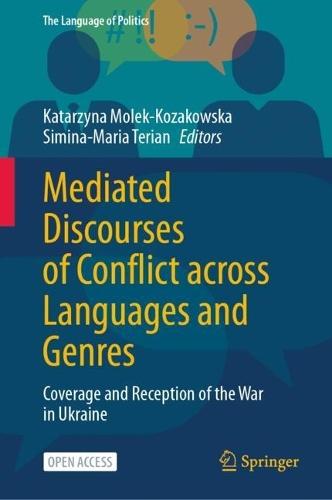
This open access edited book provides a unique entry point to the understanding of politicized journalistic practices as well as rhetorical and linguistic strategies recruited for the coverage of the full-scale war in Ukraine initiated by the Russian Federation in 2022. It consists of a comprehensive set of studies on mediated political discourses from countries neighboring Ukraine – Poland and Romania – presented against the backdrop of English-language reporting of the conflict. The individual studies in the collection explore conflict discourses using either corpus-assisted comparative approaches or interpretative case studies of specific phenomena across languages and genres, basing on a representative dataset from an international project (CORECON, 2024-2026). The authors document the dynamic nature of contemporary war coverage, given a variety of patterns of reception of the discourses of conflict. The collection also highlights a range of problematic journalistic practices in emerging media formats and inspires further research on mediated conflict discourses and war coverage. “In a carefully reasoned and methodologically transparent approach, the collection explores war media discourses in Romania and Poland, as well as in a comparative sample of English-language coverage. It offers a number of well-founded scientific studies of terminology, stance-making, narratives, visuals, news values, and representations of the Russian invasion of Ukraine. By systematically analyzing stylistic, discursive and rhetorical strategies, the authors also interrogate current editorial practices. They highlight critical issues with media outputs and ideologies co-produced by structural and technological affordances of online conflict coverage.” -- Prof. Valentyna Ushchyna, Chair of the English Philology Department, Lesya Ukrainka Volyn National University, Lutsk, Ukraine
Full Product Details
Author: Katarzyna Molek-Kozakowska ,
Simina-Maria Terian
Publisher: Springer Verlag, Singapore
Imprint: Springer Verlag, Singapore
ISBN: 9789819569915
ISBN 10: 9819569915
Pages: 250
Publication Date: 18 April 2026
Audience:
Professional and scholarly
,
Professional & Vocational
Format: Hardback
Publisher's Status: Active
Availability: Not yet available

This item is yet to be released. You can pre-order this item and we will dispatch it to you upon its release.
Author Information
KATARZYNA MOLEK-KOZAKOWSKA is Associate Professor of linguistics and communication and Head of the Department of English at the University of Opole, Poland, senior research fellow at Vilnius Gediminas Technical University, Lithuania, and the leader of the CORECON project at Lucian Blaga University, Sibiu, Romania. With a background in English language and literature, she has specialized in political discourse analysis, policy and science communication, multimodality studies, as well as popular media and journalism studies. Since 2014 she has co-edited Res Rhetorica, an international open-access quarterly journal focused on rhetoric and linguistics, published by the Polish Rhetoric Society. Apart from an extensive publishing record embedded in both (critical) discourse studies and media and communication studies, she has successfully managed international research collaborations that resulted in several co-edited volumes with Polish and international publishers and thematic issues of Res Rhetorica. She serves on the board of several journals and book series, including Springer Nature's series ""The Language of Politics"". SIMINA-MARIA TERIAN is Associate Professor with the Department of Romance Studies at the Faculty of Letters and Arts, Lucian Blaga University, Sibiu, Romania where she specializes in Romanian Syntax, Pragmatics, Digital Tools in Romanian Language Learning, and Romanian as a Foreign Language. She has published three books on discourse analysis, grammar theory and analysis, and a cognitive analysis of Romanian idiomatic expressions. She has been a member of several national research and institutional development projects, including The Fake News Phenomenon in Romanian. A Discursive-Computational Approach (FAKEROM), an interdisciplinary humanities and computer science project surveying a large-sized corpus and classifying news reports; and The Preservation, Transformation and Study of Romanian Linguistic Heritage in the Context of Globalization (PATLIRO), a research grant focusing on the use of digital tools in the study of Romanian as a foreign language.