Overview
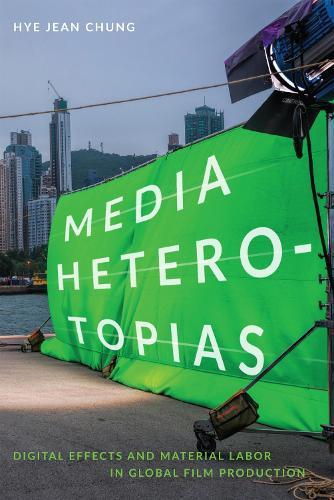
In Media Heterotopias Hye Jean Chung challenges the widespread tendency among audiences and critics to disregard the material conditions of digital film production. Drawing on interviews with directors, producers, special effects supervisors, and other film industry workers, Chung traces how the rhetorical and visual emphasis on seamlessness masks the social, political, and economic realities of global filmmaking and digital labor. In films such as Avatar (2009), Interstellar (2014), and The Host (2006)-which combine live action footage with CGI to create new hybrid environments-filmmaking techniques and ""seamless"" digital effects allow the globally dispersed labor involved to go unnoticed by audiences. Chung adapts Foucault's notion of heterotopic spaces to foreground this labor and to theorize cinematic space as a textured, multilayered assemblage in which filmmaking occurs in transnational collaborations that depend upon the global movement of bodies, resources, images, and commodities. Acknowledging cinema's increasingly digitized and globalized workflow, Chung reconnects digitally constructed and composited imagery with the reality of production spaces and laboring bodies to highlight the political, social, ethical, and aesthetic stakes in recognizing the materiality of collaborative filmmaking.
Full Product Details
Author: Hye Jean Chung
Publisher: Duke University Press
Imprint: Duke University Press
Weight: 0.340kg
ISBN: 9780822370239
ISBN 10: 0822370239
Pages: 240
Publication Date: 13 February 2018
Audience:
Professional and scholarly
,
Professional & Vocational
Format: Paperback
Publisher's Status: Active
Availability: In Print

This item will be ordered in for you from one of our suppliers. Upon receipt, we will promptly dispatch it out to you. For in store availability, please contact us.
Reviews
Chung's 'media heterotopias' could be of immense use as a strategic motivator of more work that is oriented toward activist, political stakes in the spatiotemporal mappings of yet unfolding digital age ecologies. -- Amy R. Wong * ASAP/Journal *
Hye Jean Chung's ambitious and provocative project provides a multilevel account that synthesizes issues of disruptive digital `workflows,' with Foucault's theory, and a prescient account of globalization in order to demonstrate how each works at the close-up level of the composited film text. This is the rare production studies book that avoids the traps of trade-speak, even as it makes theory and culture inextricable from our understanding of industry. -- John T. Caldwell, author of * Production Culture: Industrial Reflexivity and Critical Practice in Film and Television *
Hye Jean Chung's ambitious and provocative project provides a multilevel account that synthesizes issues of disruptive digital 'workflows, ' with Foucault's theory, and a prescient account of globalization in order to demonstrate how each works at the close-up level of the composited film text. This is the rare production studies book that avoids the traps of trade-speak, even as it makes theory and culture inextricable from our understanding of industry. --John T. Caldwell, author of Production Culture: Industrial Reflexivity and Critical Practice in Film and Television Following Foucault's notion of 'heterotopia, 'of topoi or even utopoi composed of multiple platforms layered and contested that are rendered into a single, phantasmatic whole, Hye Jean Chung proposes 'media heterotopias' as a way to understand the infusion of digital effects in contemporary cinema. At the heart of her analysis lies an affective paradox that transforms complexity, distortion, and incongruity in digital cinemas into the narcotic illusion of 'seamlessness.' At once erudite, rigorous, and highly speculative, Chung's contribution to the scholarship on digital cinemas suggests a frenzy of incoherence driving the soothing surfaces of digital effects and the labor that generates them. --Akira Mizuta Lippit, author of Cinema without Reflection: Jacques Derrida's Echopoiesis and Narcissism Adrift
Author Information
Hye Jean Chung is Assistant Professor in the School of Global Communication at Kyung Hee University.