Overview
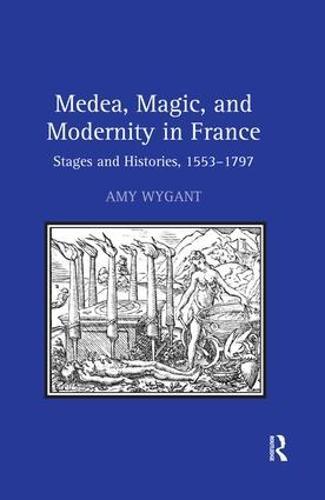
Bringing together the previously disparate fields of historical witchcraft, reception history, poetics, and psychoanalysis, this innovative study shows how the glamour of the historical witch, a spell that she cast, was set on a course, over a span of three hundred years from the sixteenth to the eighteenth centuries, to become a generally broadcast glamour of appearance. Something that a woman does, that is, became something that she has. The antique heroine Medea, witch and barbarian, infamous poisoner, infanticide, regicide, scourge of philanderers, and indefatigable traveller, serves as the vehicle of this development. Revived on the stage of modernity by La Péruse in the sixteenth century, Corneille in the seventeenth, and the operatic composer Cherubini in the eighteenth, her stagecraft and her witchcraft combine, author Amy Wygant argues, to stun her audience into identifying with her magic and making it their own. In contrast to previous studies which have relied upon contemporary printed sources in order to gauge audience participation in and reaction to early modern theater, Wygant argues that psychoanalytic thought about the behavior of groups can be brought to bear on the question of ""what happened"" when the early modern witch was staged. This cross-disciplinary study reveals the surprising early modern trajectory of our contemporary obsession with magic. Medea figures the movement of culture in history, and in the mirror of the witch on the stage, a mirror both appealing and appalling, our own cultural performances are reflected. It concludes with an analysis of Diderot's claim that the historical process itself is magical, and with the moment in Revolutionary France when the slight and fragile body of the golden-throated singer, Julie-Angélique Scio, became a Medea for modernity: not a witch or a child-murderess, but, as all the press reviews insist, a woman.
Full Product Details
Author: Amy Wygant
Publisher: Taylor & Francis Ltd
Imprint: Routledge
Edition: New edition
Dimensions:
Width: 15.60cm
, Height: 1.40cm
, Length: 23.40cm
Weight: 0.476kg
ISBN: 9780754659242
ISBN 10: 0754659240
Pages: 228
Publication Date: 28 September 2007
Audience:
College/higher education
,
General/trade
,
Tertiary & Higher Education
,
General
Format: Hardback
Publisher's Status: Active
Availability: In Print

This item will be ordered in for you from one of our suppliers. Upon receipt, we will promptly dispatch it out to you. For in store availability, please contact us.
Reviews
’Wygant’s writing is lively and clever. She converses with a dizzying variety of critics and generously references the contributions of colleagues in the field. ...Wygant’s book is of prime importance for scholars and students of early modern French theater, witchcraft theory, and mythological adaptations, while her methodology will stimulate those engaged in psychoanalytical approaches to early modern literature and culture.’ H-France
'Wygant's writing is lively and clever. She converses with a dizzying variety of critics and generously references the contributions of colleagues in the field. ...Wygant's book is of prime importance for scholars and students of early modern French theater, witchcraft theory, and mythological adaptations, while her methodology will stimulate those engaged in psychoanalytical approaches to early modern literature and culture.' H-France
Author Information
Amy Wygant teaches early modern French literature and culture at the University of Glasgow and publishes on tragedy, witchcraft, opera, and psychoanalysis. She is the editor of Seventeenth-Century French Studies and a co-founder of Women in French in Scotland (WIFIS).