Overview
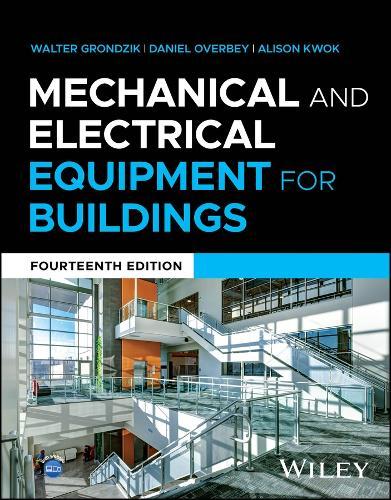
UPDATED EDITION OF THE LEADING AWARD-WINNING REFERENCE ON MECHANICAL AND ELECTRICAL SYSTEMS FOR BUILDINGS OF ALL SIZES Twice awarded the AIA’s Citation for Excellence in International Architecture Book Publishing, Mechanical and Electrical Equipment for Buildings comprehensively reviews mechanical and electrical systems for buildings of all sizes, providing design guidelines and detailed design procedures for each topic covered. To assist with learning, this book contains in-depth discussions of “why” and “how to,” which help the reader better understand concepts and applications. This 14th Edition features substantial revisions to core content reflecting the latest knowledge and advancements in the field, with coverage of topics including green buildings, zero energy, zero carbon, zero water, zero waste, healthy buildings, resiliency, electrification, and decarbonization, along with revised references to codes, standards, and rating systems from ASHRAE, NFPA, ICC, IES, USGBC (LEED), ILFI (Living Building Challenge), IWBI (the WELL Building Standard), and more. With this new edition, readers will also find an updated Learner’s Guide, new PowerPoint learning aids for each chapter, updated case studies, and an improved test bank of questions and answers. New illustrations are also included throughout. Mechanical and Electrical Equipment for Buildings explores topics including: Design resources covering energy performance, water efficiency, decarbonization, as well as a holistic overview of the impact of the built environment on environmental health and human wellbeing Passive environmental systems that support human thermal, visual, and acoustical comfort Factors for healthy buildings, biophilic design, and building system solutions that improve indoor environmental quality (IEQ) Considerations for efficient, effective, and durable building enclosures HVAC components including heating and cooling equipment, air and water delivery, air filters, and HVAC system taxonomy, anatomy, and controls Basic design criteria pertaining to fire protection, vertical transportation, telecommunications, and building automation systems Following in the footsteps of previous editions spanning the greater part of a century, Mechanical and Electrical Equipment for Buildings continues to be the leading resource on the subject for professionals and students in architecture, architectural engineering, and construction.
Full Product Details
Author: Walter Grondzik (Florida A&M University) ,
Daniel Overbey (USGBC Indiana) ,
Alison Kwok (University of Oregon)
Publisher: John Wiley & Sons Inc
Imprint: John Wiley & Sons Inc
Edition: 14th edition
Dimensions:
Width: 22.40cm
, Height: 6.90cm
, Length: 27.70cm
Weight: 3.878kg
ISBN: 9781394257119
ISBN 10: 1394257112
Pages: 1840
Publication Date: 01 July 2026
Audience:
College/higher education
,
Professional and scholarly
,
Tertiary & Higher Education
,
Professional & Vocational
Format: Hardback
Publisher's Status: Forthcoming
Availability: Available To Order

Limited stock is available. It will be ordered for you and shipped pending supplier's limited stock.
Author Information
WALTER GRONDZIK, PE, CPHC, ASHRAE FELLOW, is an architectural engineer, Professor Emeritus of Architecture at Ball State University, and a freelance consultant in Tallahassee, Florida. DANIEL OVERBEY, AIA, NCARB, LEED FELLOW, WELL AP is an Associate Professor at Ball State University, Muncie, Indiana, as well as a licensed architect with over two decades of sustainable design leadership. ALISON KWOK, PHD, FAIA, LFA, CPHC is an architect and Professor Emerita of Architecture at the University of Oregon with broad interests in mitigation strategies for changing climates, building performance, and curricular innovation.