Overview
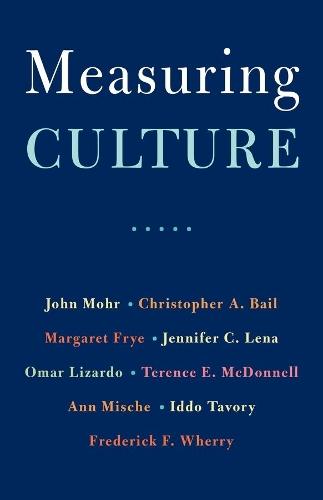
Social scientists seek to develop systematic ways to understand how people make meaning and how the meanings they make shape them and the world in which they live. But how do we measure such processes? Measuring Culture is an essential point of entry for both those new to the field and those who are deeply immersed in the measurement of meaning. Written collectively by a team of leading qualitative and quantitative sociologists of culture, the book considers three common subjects of measurement-people, objects, and relationships-and then discusses how to pivot effectively between subjects and methods. Measuring Culture takes the reader on a tour of the state of the art in measuring meaning, from discussions of neuroscience to computational social science. It provides both the definitive introduction to the sociological literature on culture as well as a critical set of case studies for methods courses across the social sciences.
Full Product Details
Author: John W. Mohr ,
Christopher A. Bail ,
Margaret Frye ,
Jennifer C. Lena
Publisher: Columbia University Press
Imprint: Columbia University Press
ISBN: 9780231180290
ISBN 10: 0231180292
Pages: 256
Publication Date: 11 August 2020
Audience:
Professional and scholarly
,
College/higher education
,
Professional & Vocational
,
Postgraduate, Research & Scholarly
Format: Paperback
Publisher's Status: Active
Availability: Manufactured on demand

We will order this item for you from a manufactured on demand supplier.
Reviews
Can culture be measured-and if so, how? This collectively authored volume develops a learned and critical response to these questions, describing myriad ways sociologists have measured culture at multiple levels. Taking its own full measure of cultural meaning, and managing to reflect intelligently on the meaning of measurement itself, Measuring Culture is astute, open-minded, and eminently readable. -- Robin Wagner-Pacifici, author of <i>What is an Event?</i> Nine coauthors have created one slim, graceful, exhilarating book. An analytic tour de force, Measuring Culture is a theoretical overview of what sociologists of culture might measure, culminating in engrossing narratives of three important research endeavors. We see creative scholars combining interpretation and innovative measurement strategies to deepen cultural analysis. If you've wondered whether innovations in measuring culture have a payoff, this book is your answer. Measuring Culture is a perfect tribute to John Mohr's brilliance, his sparkle, and his humanity. -- Ann Swidler, coauthor of <i>A Fraught Embrace: The Romance and Reality of AIDS Altruism in Africa</i> Destined to leave its mark on the social sciences, this wonderful book offers phenomenologically-inflected multi-level approaches to analyzing meanings, cultural objects, and relationships. The splendid cast of authors, each of them mid-career stars, combine their distinct strengths to produce a brilliant pluralistic state-of-the-art agenda that will appeal to many. -- Michele Lamont, Harvard University Although books that emerge from conferences often have little value beyond showing funders some 'product,' Measuring Culture is a brilliant exception. Some of the best and brightest twenty-first century cultural sociologists have both synthesized and extended the state-of-the-art in applying the rigor of scientific inquiry to the fluidity of culture. Measuring Culture is more than valuable; it is vital. -- Wendy Griswold, author of <i>American Guides: The Federal Writers' Program and the Casting of American Culture</i> Measuring Culture is the canonical text we have been waiting for in the sociology of culture. It is a massive achievement that will be the definitive account on the topic for a long time to come. I'll be thinking with it, teaching with it, and recommending it. -- Clayton Childress, author of <i>Under the Cover: The Creation, Production, and Reception of a Novel</i>
Can culture be measured-and if so, how? This collectively authored volume develops a learned and critical response to these questions, describing myriad ways sociologists have measured culture at multiple levels. Taking its own full measure of cultural meaning, and managing to reflect intelligently on the meaning of measurement itself, Measuring Culture is astute, open-minded, and eminently readable. -- Robin Wagner-Pacifici, author of <i>What Is an Event?</i> Nine coauthors have created one slim, graceful, exhilarating book. An analytic tour de force, Measuring Culture is a theoretical overview of what sociologists of culture might measure, culminating in engrossing narratives of three important research endeavors. We see creative scholars combining interpretation and innovative measurement strategies to deepen cultural analysis. If you've wondered whether innovations in measuring culture have a payoff, this book is your answer. Measuring Culture is a perfect tribute to John Mohr's brilliance, his sparkle, and his humanity. -- Ann Swidler, coauthor of <i>A Fraught Embrace: The Romance and Reality of AIDS Altruism in Africa</i> Destined to leave its mark on the social sciences, this wonderful book offers phenomenologically-inflected multilevel approaches to analyzing meanings, cultural objects, and relationships. The splendid cast of authors, each of them midcareer stars, combine their distinct strengths to offer an innovative pluralistic state-of-the-art agenda that will appeal to many. -- Michele Lamont, Harvard University Although books that emerge from conferences often have little value beyond showing funders some 'product,' Measuring Culture is a brilliant exception. Some of the best and brightest twenty-first century cultural sociologists have both synthesized and extended the state-of-the-art in applying the rigor of scientific inquiry to the fluidity of culture. Measuring Culture is more than valuable; it is vital. -- Wendy Griswold, author of <i>American Guides: The Federal Writers' Program and the Casting of American Culture</i> Measuring Culture is the canonical text we have been waiting for in the sociology of culture. It is a massive achievement that will be the definitive account on the topic for a long time to come. I'll be thinking with it, teaching with it, and recommending it. -- Clayton Childress, author of <i>Under the Cover: The Creation, Production, and Reception of a Novel</i>
Measuring Culture is the canonical text we have been waiting for in the sociology of culture. It is a massive achievement that will be the definitive account on the topic for a long time to come. I'll be thinking with it, teaching with it, and recommending it. -- Clayton Childress, author of <i>Under the Cover: The Creation, Production, and Reception of a Novel</i>
Author Information
John W. Mohr (1956–2019) was professor of sociology at the University of California, Santa Barbara. Christopher A. Bail is professor of sociology, public policy, and data science at Duke University. Margaret Frye is assistant professor of sociology at the University of Michigan. Jennifer C. Lena is associate professor of arts administration at Teachers College, Columbia University, where she also has a courtesy appointment in the Department of Sociology. Omar Lizardo is professor and LeRoy Neiman Term Chair of sociology at the University of California, Los Angeles. Terence E. McDonnell is associate professor of sociology at the University of Notre Dame. Ann Mische is associate professor of sociology and peace studies at the University of Notre Dame. Iddo Tavory is associate professor of sociology at New York University. Frederick F. Wherry is the Townsend Martin Class of 1917 professor of sociology at Princeton University.