Overview
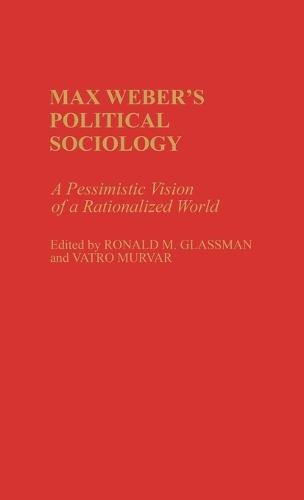
This collection of essays focuses on Weber's political ideology as well as his political sociology. This interdisciplinary work draws upon the expertise of a number of writers and challenges major schools of thought on Weber. In the first section on ideology, scholars question whether Weber's political predictions were based on a realistic appraisal of social development or if his objectivity was compromised by events in Weimar Germany. They then address Weber's attitudes toward socialism in light of contemporary sociology and his early writings. Part two examines Weber's theory: the concept of rationalization; ideas about charisma; and the decline of charisma in light of the growing role of the media. A study of Weber's analysis of the 1917 events in Russia concludes the volume.
Full Product Details
Author: Ronald Glassman ,
Vatro Murvar
Publisher: Bloomsbury Publishing Plc
Imprint: Praeger Publishers Inc
Dimensions:
Width: 14.00cm
, Height: 1.70cm
, Length: 21.60cm
Weight: 0.499kg
ISBN: 9780313236426
ISBN 10: 0313236429
Pages: 295
Publication Date: 24 January 1984
Recommended Age: From 7 to 17 years
Audience:
College/higher education
,
General/trade
,
Postgraduate, Research & Scholarly
,
General
Format: Hardback
Publisher's Status: Active
Availability: Manufactured on demand

We will order this item for you from a manufactured on demand supplier.
Reviews
?. . . Vatro Murvar's epilogue reexamines Weber's little known analyses of Russia's struggle for freedom from Czarist patrimonialism from 1905 to 1920. Like several of the other essays, it reveals a sound grasp of the historical situation during the time at which Weber was writing, and is highly informative. These essays constitute a genuine scholarly contribution to our understanding of Weber. They are essential reading for all serious students of his political sociology.?-International Social Science Review
?. . . Vatro Murvar's epilogue reexamines Weber's little known analyses of Russia's struggle for freedom from Czarist patrimonialism from 1905 to 1920. Like several of the other essays, it reveals a sound grasp of the historical situation during the time at which Weber was writing, and is highly informative. These essays constitute a genuine scholarly contribution to our understanding of Weber. They are essential reading for all serious students of his political sociology.?-International Social Science Review ."" . . Vatro Murvar's epilogue reexamines Weber's little known analyses of Russia's struggle for freedom from Czarist patrimonialism from 1905 to 1920. Like several of the other essays, it reveals a sound grasp of the historical situation during the time at which Weber was writing, and is highly informative. These essays constitute a genuine scholarly contribution to our understanding of Weber. They are essential reading for all serious students of his political sociology.""-International Social Science Review
?. . . Vatro Murvar's epilogue reexamines Weber's little known analyses of Russia's struggle for freedom from Czarist patrimonialism from 1905 to 1920. Like several of the other essays, it reveals a sound grasp of the historical situation during the time at which Weber was writing, and is highly informative. These essays constitute a genuine scholarly contribution to our understanding of Weber. They are essential reading for all serious students of his political sociology.?-International Social Science Review . . . Vatro Murvar's epilogue reexamines Weber's little known analyses of Russia's struggle for freedom from Czarist patrimonialism from 1905 to 1920. Like several of the other essays, it reveals a sound grasp of the historical situation during the time at which Weber was writing, and is highly informative. These essays constitute a genuine scholarly contribution to our understanding of Weber. They are essential reading for all serious students of his political sociology. -International Social Science Review
Author Information
RONALD M. GLASSMAN is currently executive director of New York City Americans for Democratic Action and has been actively involved in many political campaigns. He has written numerous volumes, including The Political History of Latin America, Democracy and Despotism in Primitive Societies, The New Middle Class and Democracy, and with Mark Green, A Democracy Agenda for the Year 2000.