Awards
- Winner of Winner of the 2014 Istvan Hont Memorial Prize.
Overview
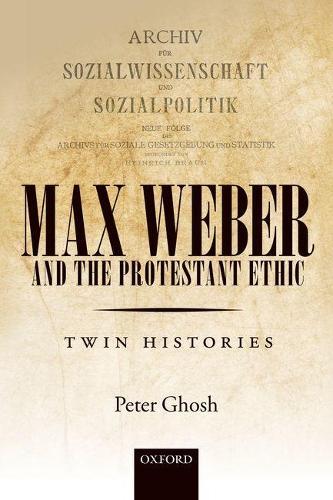
Max Weber and The Protestant Ethic: Twin Histories presents an entirely new portrait of Max Weber, one of the most prestigious social theorists in recent history, using his most famous work, The Protestant Ethic and the ""Spirit"" of Capitalism, as its central point of reference. It offers an intellectual biography of Weber framed along historical lines - something which has never been done before. It re-evaluates The Protestant Ethic -- a text surprisingly neglected by scholars -- supplying a missing intellectual and chronological centre to Weber's life and work. Peter Ghosh suggests that The Protestant Ethic is the link which unites the earlier (pre-1900) and later (post-1910) phases of his career. He offers a series of fresh perspectives on Weber's thought in various areas -- charisma, capitalism, law, politics, rationality, bourgeois life, and (not least) Weber's unusual religious thinking, which was 'remote from god' yet based on close dialogue with Christian theology. This approach produces a convincing view of Max Weber as a whole; while previously the sheer breadth of his intellectual interests has caused him to be read in a fragmentary way according to a series of specialized viewpoints, this volume seeks to put him back together again as a real individual.
Full Product Details
Author: Peter Ghosh (Fellow in History, Fellow in History, St. Anne's College, Oxford)
Publisher: Oxford University Press
Imprint: Oxford University Press
Dimensions:
Width: 15.60cm
, Height: 2.40cm
, Length: 23.40cm
Weight: 0.640kg
ISBN: 9780198807667
ISBN 10: 019880766
Pages: 422
Publication Date: 22 June 2017
Audience:
College/higher education
,
Professional and scholarly
,
Postgraduate, Research & Scholarly
,
Professional & Vocational
Format: Paperback
Publisher's Status: Active
Availability: To order

Stock availability from the supplier is unknown. We will order it for you and ship this item to you once it is received by us.
Reviews
... in this stylish and extraordinarily detailed new intellectual history ... Ghosh's answer to Weber's uniqueness is beguilingly simple, and gloriously revisionist in overturning most established scholarship Duncan Kelly, The Times Literary Supplement Let it be said at once: this breath-taking book is a really great success - rewarding and obligatory reading not only for anyone who is interested in the Protestant Ethic or Max Weber, but for everyone who grapples with the theory of the project of (Western) modernity ... It is already clear that in future there can be no avoiding Ghosh's brilliant twin history , both because of its exact textual labour and also because of its truly Teutonic erudition ... Yet this book is not only extraordinary because of the overwhelming wealth of the material it draws upon. In the exactitude of the textual analysis, which lays bare [Weber's] anticipations and backward glances, allusions and references, intellectual dependency and cross-connections, it is a brilliant achievement in terms of method, while at the same time taking us into the deepest strata of intellectual development. Thomas Sokoll, H-Soz-u-Kult [translated] superb and eminently scholarly Johannes Zachhuber, Marginalia the most comprehensive and illuminating work on Max Weber ever published. Keith Tribe, History A review like this cannot sum up the wealth of food for thought and for debate Ghosh offers. His book's final words about Weber make an excellent case for studying him: 'Never was there anyone more present on the page, on the screen, and above all in our minds, than he is today'. Hans-Jurgen Wolff, Theologische Literaturzeitung
in this stylish and extraordinarily detailed new intellectual history ... Ghosh's answer to Weber's uniqueness is beguilingly simple, and gloriously revisionist in overturning most established scholarship Duncan Kelly, The Times Literary Supplement Let it be said at once: this breath-taking book is a really great success - rewarding and obligatory reading not only for anyone who is interested in the Protestant Ethic or Max Weber, but for everyone who grapples with the theory of the project of (Western) modernity ... It is already clear that in future there can be no avoiding Ghosh's brilliant twin history , both because of its exact textual labour and also because of its truly Teutonic erudition ... Yet this book is not only extraordinary because of the overwhelming wealth of the material it draws upon. In the exactitude of the textual analysis, which lays bare [Weber's] anticipations and backward glances, allusions and references, intellectual dependency and cross-connections, it is a brilliant achievement in terms of method, while at the same time taking us into the deepest strata of intellectual development. Thomas Sokoll, H-Soz-u-Kult [translated] superb and eminently scholarly Johannes Zachhuber, Marginalia the most comprehensive and illuminating work on Max Weber ever published. Keith Tribe, History A review like this cannot sum up the wealth of food for thought and for debate Ghosh offers. His book's final words about Weber make an excellent case for studying him: 'Never was there anyone more present on the page, on the screen, and above all in our minds, than he is today'. Hans-Jurgen Wolff, Theologische Literaturzeitung [a] stunning work of intellectual archaeology Dina Gusejnova, English Historical Review
Author Information
Peter Ghosh was a Junior Research Fellow at Nuffield College, Oxford (1980-1), and has been a Fellow in History at St. Anne's College, Oxford since 1981.