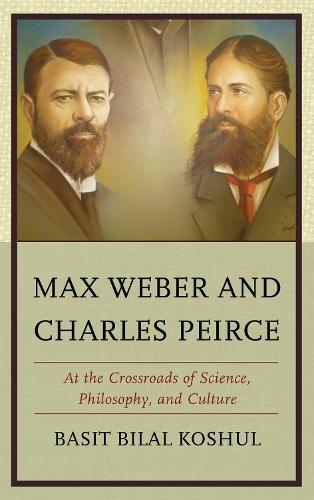
Full Product Details
Author: Basit Bilal Koshul
Publisher: Bloomsbury Publishing Plc
Imprint: Lexington Books
Dimensions:
Width: 15.10cm
, Height: 1.70cm
, Length: 23.00cm
Weight: 0.358kg
ISBN: 9781498550840
ISBN 10: 1498550843
Pages: 240
Publication Date: 14 November 2016
Audience:
Professional and scholarly
,
Professional & Vocational
Format: Paperback
Publisher's Status: Active
Availability: Manufactured on demand

We will order this item for you from a manufactured on demand supplier.
Reviews
"Basit Bilal Koshul's analysis of Max Weber's work makes significant contributions to the Weberian scholarship and dispels many prior unilateral readings of the Weberian corpus in at least these three areas: (1) Showing how much Max Weber was a post-modernist before post-modernism, a critic of Western modern cultural biases who didn't succumb to either an easy evolutionist bias or a simplistic optimism—including in relation to capitalism; (2) Demonstrating the depth and complexity of the Weberian epistemology, including a critique of old assumptions regarding Weber's concept of science as ""value free""; and (3) Dissecting the Weberian concept of disenchantment of the world in a way that allows, on the one hand, for a novel, more optimistic approach to the relations between science and religious faith, and, on the other hand, for a rather pessimistic probe of the relations between religion and modern Western capitalism. -- Otto Maduro, Drew University"
Basit Bilal Koshul's analysis of Max Weber's work makes significant contributions to the Weberian scholarship and dispels many prior unilateral readings of the Weberian corpus in at least these three areas: (1) Showing how much Max Weber was a post-modernist before post-modernism, a critic of Western modern cultural biases who didn't succumb to either an easy evolutionist bias or a simplistic optimism—including in relation to capitalism; (2) Demonstrating the depth and complexity of the Weberian epistemology, including a critique of old assumptions regarding Weber's concept of science as ""value free""; and (3) Dissecting the Weberian concept of disenchantment of the world in a way that allows, on the one hand, for a novel, more optimistic approach to the relations between science and religious faith, and, on the other hand, for a rather pessimistic probe of the relations between religion and modern Western capitalism. -- Otto Maduro, Drew University
Basit Bilal Koshul's analysis of Max Weber's work makes significant contributions to the Weberian scholarship and dispels many prior unilateral readings of the Weberian corpus in at least these three areas: (1) Showing how much Max Weber was a post-modernist before post-modernism, a critic of Western modern cultural biases who didn't succumb to either an easy evolutionist bias or a simplistic optimism-including in relation to capitalism; (2) Demonstrating the depth and complexity of the Weberian epistemology, including a critique of old assumptions regarding Weber's concept of science as value free ; and (3) Dissecting the Weberian concept of disenchantment of the world in a way that allows, on the one hand, for a novel, more optimistic approach to the relations between science and religious faith, and, on the other hand, for a rather pessimistic probe of the relations between religion and modern Western capitalism. -- Otto Maduro, Drew University
Author Information
Basit Bilal Koshul is associate professor at the Lahore University of Management Sciences (LUMS) in Lahore, Pakistan. After teaching at Concordia College in Moorhead, MN for four years, he joined the Department of Humanities and Social Sciences at LUMS in 2006. The focus of his research is to recover the neglected resources in modern thought and religious tradition (especially scripture) that can help to transform the mutually debilitating dichotomies of religion/science, North/South, West/Islam, economics/ethics, security/rights etc. into mutually enriching relationships. He sees the work of Muhammad Iqbal, Charles Peirce, and Max Weber, individually but much more so collectively, as a promising starting point for initiating the transformation of divides into relationships.