Overview
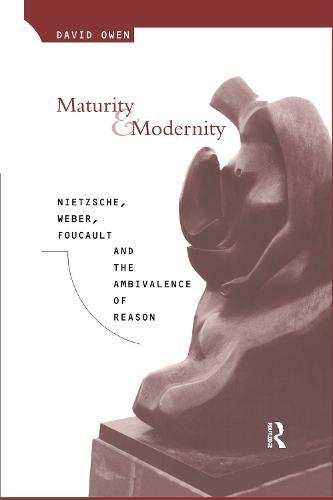
This text examines Nietzsche, Weber and Foucalut as a distinct trajectory of critical thinking within modern thought which traces the emergence and development of genealogy in the form of immanent critique. The book aims to clarify the relations between these thinkers and to respond to Habermas' (and Dews') charge that these thinkers are nihilists and that their approach is philosophically incoherent and practically irresponsible by showing how genealogy as a practical activity is directed towards the achievements of human autonomy. The scope of the book covers the critical methodolgies developed by these thinkers with respect to the analysis of how we have become what we are, their substantive reconstructions of how we have become what we are and the implication which they draw for the possiblity of human autonomy in the present. It proceeds by detailed analysis of each thinker in turn showing the structure of their approach, their historical account of the emergence of modernity, and the politics of their attempts to facilitate the achievement of human autonomy. This is the first book to analyze these three thinkers as a tradition of theorising and to chart the development of genealogy as a mode of critique. It provides clear accounts of the main ideas of Nietzsche, Weber and Foucault (as well as a useful Glossary) and illustrates the relation between these thinkers at methodological, substantive and political levels.
Full Product Details
Author: David Owen
Publisher: Taylor & Francis Ltd
Imprint: Routledge
Dimensions:
Width: 15.60cm
, Height: 1.70cm
, Length: 23.40cm
Weight: 0.498kg
ISBN: 9780415053983
ISBN 10: 0415053986
Pages: 268
Publication Date: 02 June 1994
Audience:
College/higher education
,
Tertiary & Higher Education
,
Postgraduate, Research & Scholarly
Format: Hardback
Publisher's Status: Active
Availability: In Print

This item will be ordered in for you from one of our suppliers. Upon receipt, we will promptly dispatch it out to you. For in store availability, please contact us.
Reviews
... an impressive account of a (postmodern) alternative to modernity. Anyone with an interest...in the development of postmodern thought...would benefit from this work. <br>- Philosophy in Review/Comptes Rendus Philosophiques <br> I know of no work which examines the intellectual trajectory of Nietzsche, Weber and Foucault in such an imaginative and instructive way . . . The work is thorough and thoughtful, yielding many important insights. <br>-Keith Ansell-Pearson, Queen Mary College <br>
... an impressive account of a (postmodern) alternative to modernity. Anyone with an interest...in the development of postmodern thought...would benefit from this work. - Philosophy in Review/Comptes Rendus Philosophiques I know of no work which examines the intellectual trajectory of Nietzsche, Weber and Foucault in such an imaginative and instructive way . . . The work is thorough and thoughtful, yielding many important insights. -Keith Ansell-Pearson, Queen Mary College
"...""an impressive account of a (postmodern) alternative to modernity. Anyone with an interest...in the development of postmodern thought...would benefit from this work."" -""Philosophy in Review/Comptes Rendus Philosophiques ""I know of no work which examines the intellectual trajectory of Nietzsche, Weber and Foucault in such an imaginative and instructive way . . . The work is thorough and thoughtful, yielding many important insights."" -Keith Ansell-Pearson, Queen Mary College"