Overview
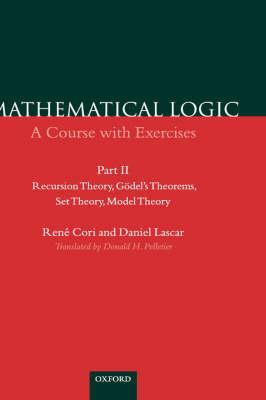
Logic forms the basis of mathematics, and is hence a fundamental part of any mathematics course. It is a major element in theoretical computer science and has undergone a huge revival with the every- growing importance of computer science. This text is based on a course to undergraduates and provides a clear and accessible introduction to mathematical logic. The concept of model provides the underlying theme, giving the text a theoretical coherence whilst still covering a wide area of logic. The foundations having been laid in Part I, this book starts with recursion theory, a topic essential for the complete scientist. Then follows Godel's incompleteness theorems and axiomatic set theory. Chapter 8 provides an introduction to model theory. There are examples throughout each section, and varied selection of exercises at the end. Answers to the exercises are given in the appendix.
Full Product Details
Author: René Cori (, Université Paris VII) ,
Daniel Lascar (, Université Paris VII) ,
Donald Pelletier (, York University, Toronto and Université Paris VII)
Publisher: Oxford University Press
Imprint: Oxford University Press
Dimensions:
Width: 16.00cm
, Height: 2.30cm
, Length: 24.20cm
Weight: 0.626kg
ISBN: 9780198500513
ISBN 10: 0198500513
Pages: 352
Publication Date: 12 April 2001
Audience:
College/higher education
,
Tertiary & Higher Education
Format: Hardback
Publisher's Status: Active
Availability: Manufactured on demand

We will order this item for you from a manufactured on demand supplier.
Reviews
An undergraduate course text for students who have acquired the practice and knowledge of classical mathematics as taught in high school and the first year of college, but no specialized knowledge. Introducing the logic underlying mathematics and theoretical computer science, Cori and Lascar (both U. Paris VII) use the concept of model as their underlying theme. Pelletier (York U. Toronto) has clarified some of the terminology in English for beginning students. --SciTech Book News<br> I have always been especially fond of logic. The two-volume Mathematical Logic: A Course with Exercises is a comprehensive introductory course that is distinguished by clarity of exposition and a large number of exercises with thorough solutions. Each volume is about 330 pages long, 80 of which are solutions! The Bulletin of Mathematics Books<br>
<br> An undergraduate course text for students who have acquired the practice and knowledge of classical mathematics as taught in high school and the first year of college, but no specialized knowledge. Introducing the logic underlying mathematics and theoretical computer science, Cori and Lascar (both U. Paris VII) use the concept of model as their underlying theme. Pelletier (York U. Toronto) has clarified some of the terminology in English for beginning students. --SciTech Book News<br> I have always been especially fond of logic. The two-volume Mathematical Logic: A Course with Exercises is a comprehensive introductory course that is distinguished by clarity of exposition and a large number of exercises with thorough solutions. Each volume is about 330 pages long, 80 of which are solutions! The Bulletin of Mathematics Books<br>