Awards
- Commended for Choice Magazine Outstanding Reference/Academic Book Award 2013.
- Short-listed for Choice 's Outstanding Academic Titles for 2013 2013
- Short-listed for Choice Magazine Outstanding Reference/Academic Book Award 2013
- Shortlisted for Choice Magazine Outstanding Reference/Academic Book Award 2013.
- Winner of PROSE Awards: Archeology & Anthropology 2012
- Winner of PROSE Awards: Archeology & Anthropology 2012.
- Winner of Winner of the 2012 PROSE Award, Architecture & Anthropology 2012
Overview
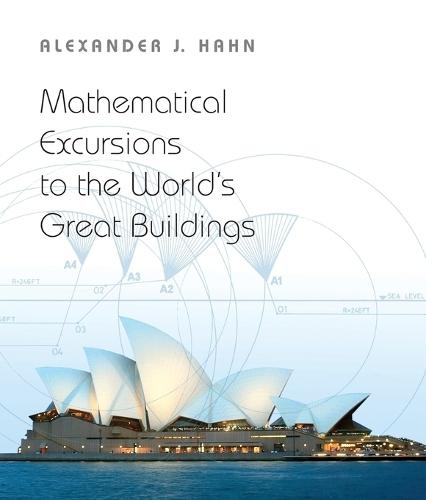
From the pyramids and the Parthenon to the Sydney Opera House and the Bilbao Guggenheim, this book takes readers on an eye-opening tour of the mathematics behind some of the world's most spectacular buildings. Beautifully illustrated, the book explores the milestones in elementary mathematics that enliven the understanding of these buildings and combines this with an in-depth look at their aesthetics, history, and structure. Whether using trigonometry and vectors to explain why Gothic arches are structurally superior to Roman arches, or showing how simple ruler and compass constructions can produce sophisticated architectural details, Alexander Hahn describes the points at which elementary mathematics and architecture intersect. Beginning in prehistoric times, Hahn proceeds to guide readers through the Greek, Roman, Islamic, Romanesque, Gothic, Renaissance, and modern styles. He explores the unique features of the Pantheon, the Hagia Sophia, the Great Mosque of Cordoba, the Duomo in Florence, Palladio's villas, and Saint Peter's Basilica, as well as the U.S. Capitol Building. Hahn celebrates the forms and structures of architecture made possible by mathematical achievements from Greek geometry, the Hindu-Arabic number system, two- and three-dimensional coordinate geometry, and calculus. Along the way, Hahn introduces groundbreaking architects, including Brunelleschi, Alberti, da Vinci, Bramante, Michelangelo, della Porta, Wren, Gaudi, Saarinen, Utzon, and Gehry. Rich in detail, this book takes readers on an expedition around the globe, providing a deeper understanding of the mathematical forces at play in the world's most elegant buildings.
Full Product Details
Author: Alexander J. Hahn
Publisher: Princeton University Press
Imprint: Princeton University Press
Dimensions:
Width: 21.60cm
, Height: 2.50cm
, Length: 24.10cm
Weight: 1.021kg
ISBN: 9780691145204
ISBN 10: 0691145202
Pages: 344
Publication Date: 22 July 2012
Audience:
General/trade
,
Professional and scholarly
,
General
,
Professional & Vocational
Format: Hardback
Publisher's Status: Active
Availability: In Print

This item will be ordered in for you from one of our suppliers. Upon receipt, we will promptly dispatch it out to you. For in store availability, please contact us.
Language: English
Reviews
[H]andsomely produced and lavishly illustrated. . . . Hahn tends to avoid discussing some of the aesthetic versus engineering limitations in favor of explaining how things work. And in that area he can be very helpful to the experienced architecture fan and the novice as well. . . . The mathematical sections are well illustrated and pictures of buildings abound. . . . No effort has been spared to make this an informative and aesthetically pleasing book. And the problems are fun too.--Gerald L. Alexanderson MAA Reviews
Author Information
Alexander J. Hahn is professor of mathematics at the University of Notre Dame. His books include ""Basic Calculus: From Archimedes to Newton to Its Role in Science.""