Overview
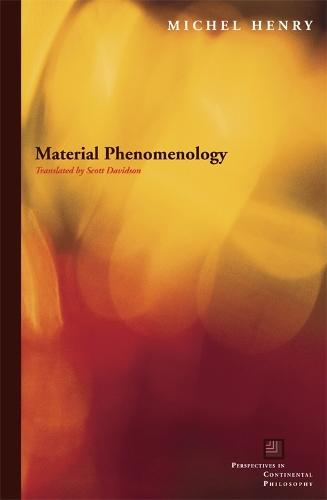
This book is Michel Henry's most sustained investigation of Husserlian phenomenology. With painstaking detail and precision, Henry reveals the decisive methodological assumptions that led Husserlian phenomenology in the direction of Idealism. Returning to the materiality of life, Henry's material phenomenology situates central phenomenological themes-intentionality, temporality, embodiment, and intersubjectivity-within the full concreteness of life. One of the most accessible of Henry's books, Material Phenomenology is essential reading for those interested in the future of phenomenology or in a philosophy of life in the truest sense.
Full Product Details
Author: Michel Henry ,
Scott Davidson
Publisher: Fordham University Press
Imprint: Fordham University Press
Dimensions:
Width: 15.20cm
, Height: 1.30cm
, Length: 22.90cm
Weight: 0.249kg
ISBN: 9780823229444
ISBN 10: 0823229440
Pages: 160
Publication Date: 15 September 2008
Audience:
College/higher education
,
Undergraduate
,
Postgraduate, Research & Scholarly
Format: Paperback
Publisher's Status: Active
Availability: In Print

This item will be ordered in for you from one of our suppliers. Upon receipt, we will promptly dispatch it out to you. For in store availability, please contact us.
Reviews
A very important contribution to the foundation and the method of philosophy. - Adriaan T. Peperzak, Loyola University, Chicago One of the most accessible introductions to the thought of one of 20th-century France's most important phenomenologists. - Jeffrey Kosky, Washington & Lee University
A very important contribution to the foundation and the method of philosophy.----Adriaan Peperzak, Loyola University, Chicago . . . Henry's book is a powerful advocate for life and affectivity, showing repeatedly that the dominant mode of phenomenology (and Western philosophy in general) priviledges ek-stasis and objectification at the expense of absolute subjectivity. * -Christianity and Literature * Michel Henry's re-definition of Husserl's phenomenology can be compared only with that of Levinas. He was able to uncover some possibilities actually reached by Husserl, but kept hidden by his idealist turn, as in the primacy of Leib, the originarity of the self-affection of the self, and the limits of intentionality. This led him to reach one of the very few rigorous concepts of life ever achieved in philosophy. It is time to pay serious attention to one of the most important philosophers of the last century. ----Jean-Luc Marion, Universite Paris-Sorbonne, University of Chicago This book will be of great value and interest to those interested in Henry's philosophy of life, Husserlian scholars, ad for thos interested in the future of phenomenology. * -Kinesis * Translation of a 1990 work by the French philosopher (1922-2002). * -The Chronicle of Higher Education * Published originally in French in 1990, this book is an important contribution to phenomenology. Henry (1922-2002; formerly, Univ. Paul Valery) argues that phenomenology must be grounded in the radical immanence of life. He elaborates on this argument through a careful, detailed analysis of Husserlian conceptions of hyle (matter), the method of phenomenological reductions, and intersubjectivity in chapters 1, 2, and 3, respectively. Henry consistently responds to phenomenological claims of transcendence with his own claims of immanence focusing on the pathos of life. He defines the substance of the material phenomenology of the title as the pathetic immediacy in which life experiences itself. So where Husserl speaks of reduction to a sphere of pure phenomenological seeing, Henry counters that such a reduction focuses too much on what is outside, visible, and at a distance, rather than on the materiality and self-affectivity of life. The analysis presumes significant knowledge of Husserlian phenomenology, but is an original and creative contribution to phenomenological research. Davidson (Oklahoma City Univ.) provides a clear translation of this work and an elucidating introduction. Summing Up: Recommended. Advanced undergraduates through faculty/researchers. * -Choice *
A very important contribution to the foundation and the method of philosophy. GCoAdriaan Peperzak, Loyola University, Chicago ... Henry's book is a powerful advocate for life and affectivity, showing repeatedly that the dominant mode of phenomenology (and Western philosophy in general) priviledges ek-stasis and objectification at the expense of absolute subjectivity.-Adam Wells This book will be of great value and interest to those interested in Henry's philosophy of life, Husserlian scholars, ad for thos interested in the future of phenomenology.Luna Dolezal Published originally in French in 1990, this book is an important contribution to phenomenology. Henry (1922-2002; formerly, Univ. Paul Valry) argues that phenomenology must be grounded in the radical immanence of life. He elaborates on this argument through a careful, detailed analysis of Husserlian conceptions of hyle (matter), the method of phenomenological reductions, and intersubjectivity in chapters 1, 2, and 3, respectively. Henry consistently responds to phenomenological claims of transcendence with his own claims of immanence focusing on the pathos of life. He defines the substance of the material phenomenology of the title as the pathetic immediacy in which life experiences itself. So where Husserl speaks of reduction to a sphere of pure phenomenological seeing, Henry counters that such a reduction focuses too much on what is outside, visible, and at a distance, rather than on the materiality and self-affectivity of life.
... The analysis presumes significant knowledge of Husserlian phenomenology, but is an original and creative contribution to phenomenological research. Davidson provides a clear translation of this work and an elucidating introduction. Summing Up: Recommended. --Choice ... Henry's book is a powerful advocate for life and affectivity, showing repeatedly that the dominant mode of phenomenology (and Western philosophy in general) priviledges ek-stasis and objectification at the expense of absolute subjectivity.-Adam Wells This book will be of great value and interest to those interested in Henry's philosophy of life, Husserlian scholars, ad for thos interested in the future of phenomenology.Luna Dolezal Published originally in French in 1990, this book is an important contribution to phenomenology. Henry (1922-2002; formerly, Univ. Paul Valry) argues that phenomenology must be grounded in the radical immanence of life. He elaborates on this argument through a careful, detailed analysis of Husserlian conceptions of hyle (matter), the method of phenomenological reductions, and intersubjectivity in chapters 1, 2, and 3, respectively. Henry consistently responds to phenomenological claims of transcendence with his own claims of immanence focusing on the pathos of life. He defines the substance of the material phenomenology of the title as the pathetic immediacy in which life experiences itself. So where Husserl speaks of reduction to a sphere of pure phenomenological seeing, Henry counters that such a reduction focuses too much on what is outside, visible, and at a distance, rather than on the materiality and self-affectivity of life.
Author Information
Michel Henry (1922-2002) was Professor of Philosophy at the Universite Paul Valery, Montpelier. Among his many works are The Essence of Manifestation (Nijhoff , 1973), Incarnation. Une philosophie de la chair (Seuil, 2000), I Am the Truth (2002), Material Phenomenology (2008), Seeing the Invisible: On Kandinsky (Bloomsbury, 2009), and From Communism to Capitalism (Bloomsbury, 2014). Scott Davidson is Chair of the Philosophy Department at Oklahoma City University.