Overview
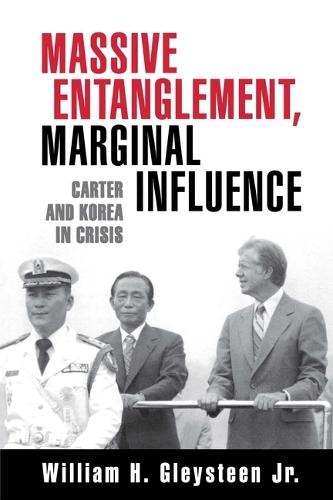
In 1979-80, Korean president Park Chung Hee was assassinated, a new strongman seized power, student protests were crushed, and military brutality in Kwangju City provoked a massive uprising. This text examines how President Jimmy Carter's troop withdrawal and human rights policies contributed to Park's demise. It reviews US behaviour in the subsequent crisis, discussing such problems as inadequate intelligence, the dilemma of military and economic leverage too powerful to use and the constraints of constitutional authority.
Full Product Details
Author: William H. Gleysteen, Jr.
Publisher: Bloomsbury Publishing Plc
Imprint: Brookings Institution
Dimensions:
Width: 15.20cm
, Height: 2.40cm
, Length: 22.90cm
Weight: 0.029kg
ISBN: 9780815731702
ISBN 10: 0815731701
Pages: 248
Publication Date: 01 December 1999
Audience:
Professional and scholarly
,
Professional and scholarly
,
Professional & Vocational
,
Postgraduate, Research & Scholarly
Format: Hardback
Publisher's Status: Out of Print
Availability: Out of stock

Reviews
Gleysteen, Carter's ambassador to South Korea, has now written a concise and lucid account that is rich with lessons about U.S. relations with imperfect partners... A valuable memoir, written with care. --Philip Zelikow, Foreign Affairs, 10/1/2000 an extraordinary record of the situation in Seoul and the American response... well-written and well-reasoned --Don Oberdorfer, Joint Force Quarterly, 3/21/2001 The book is of obvious importance to specialists in U.S.-Korea relations. --William Douglas, Georgetown University, Perspectives on Political Science, 3/27/2001 essential for understanding why the Kwangju tragedy occurred. --Don Baker, Journal of Asian Studies, 4/18/2001 Former Ambassador William Gleysteen's book shines a clear and revealing light on one of the most difficult and chaotic periods in Korea's recent history... Gleysteen's book exemplifies the Foreign Service at its best. He is generous to his associates, appropriately self-critical of his own judgements, and honest in reflecting on issues that might have been handled better. --Donald P. Gregg, former Ambassador to Korea, Korea Society Quarterly, 7/1/2000 Gleysteen skillfully employs narrative and analytic text- backed by declassified cables- to demonstrate the sound judgement he used to promote stability and democratization in the face of enormous challenges... With his adroit use of cables, and his polished, lawyerly prose, Gleysteen has presented a credible defense against his critics, and has left analysts with an important document on a tumultuous phase in North Korean relations. --Victor Fic, Seoul, South Korea, The Fletcher Forum of World Affairs, 7/1/2001
Author Information
William H. Gleysteen Jr., a nonresident senior fellow at the Brookings Institution, served as U.S. Ambassador to Korea during the Carter administration. Born and raised in Beijing, China, he spent three decades as a career foreign service officer assigned to Taipei, Tokyo, Hong Kong, and Seoul. Among his Washington assignments, he served as deputy assistant secretary for East Asian affairs as well as senior staff member for East Asia in the National Security Council. After leaving government service, he was president of the Japan Society in New York (1989-95).