Overview
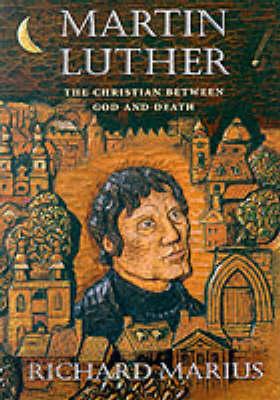
Few figures in history have defined their time as dramatically as Martin Luther. And few books have captured the spirit of such a figure as truly as this robust and eloquent life of Luther. A highly regarded historian and biographer and a gifted novelist and playwright, Richard Marius gives us a dazzling portrait of the German reformer--his inner compulsions, his struggle with himself and his God, the gestation of his theology, his relations with contemporaries, and his responses to opponents. Focusing in particular on the productive years 1516-1525, Marius' detailed account of Luther's writings yields a rich picture of the development of Luther's thought on the great questions that came to define the Reformation. Marius follows Luther from his birth in Saxony in 1483, during the reign of Frederick III, through his schooling in Erfurt, his flight to an Augustinian monastery and ordination to the outbreak of his revolt against Rome in 1517, the Wittenberg years, his progress to Worms, his exile in the Wartburg, and his triumphant return to Wittenberg. Throughout, Marius pauses to acquaint us with pertinent issues: the question of authority in the church, the theology of penance, the timing of Luther's ""Reformation breakthrough,"" the German peasantry in 1525, Müntzer's revolutionaries, the whys and hows of Luther's attack on Erasmus. In this personal, occasionally irreverent, always humane reconstruction, Luther emerges as a skeptic who hated skepticism and whose titanic wrestling with the dilemma of the desire for faith and the omnipresence of doubt and fear became an augury for the development of the modern religious consciousness of the West. In all of this, he also represents tragedy, with the goodness of his works overmatched by their calamitous effects on religion and society.
Full Product Details
Author: Richard Marius
Publisher: Harvard University Press
Imprint: The Belknap Press
Edition: New edition
Dimensions:
Width: 14.80cm
, Height: 3.80cm
, Length: 22.70cm
Weight: 0.567kg
ISBN: 9780674003873
ISBN 10: 067400387
Pages: 576
Publication Date: 01 November 2000
Audience:
Professional and scholarly
,
Professional and scholarly
,
Professional & Vocational
,
Postgraduate, Research & Scholarly
Format: Paperback
Publisher's Status: Active
Availability: In Print

This item will be ordered in for you from one of our suppliers. Upon receipt, we will promptly dispatch it out to you. For in store availability, please contact us.
Reviews
Marius's searching and thoughtful biography of the German monk largely responsible for the Protestant Reformation is a marvelously engrossing, in some ways surprisingly empathetic, attempt to fathom the mind and heart of this remarkable man...There can be no doubt that this book is destined to become a classic. It is an exemplary work of scholarship written with the kind of verve that will appeal to the ordinary reader...Pithy, urbane, even witty, this is one of those extraordinary biographies that really brings its subject to life. -- Merle Rubin Christian Science Monitor [A] splendid new life of Martin Luther...Working impressively from primary sources and writing principally about the first two-thirds of Luther's life, Marius offers what he calls a 'nonreligious' approach to Luther's revolution...In effect, he sees the Protestant Reformation as a counter-Renaissance, aborting the gentler tempering of Christiandom that the revival of classical learning and classical moral philosophy had begun in Italy...The originality of the book lies...in Marius's nuanced and persuasive reconstruction of the death-obsession that underlay an extraordinary character's world-historical career. -- Jack Mile Boston Globe This vibrant and well-researched study brings us face to face with the mysterious depths and difficulties of belief as it took shape in one of Christianity's most fascinating figures. Its shows us how rich, and how fraught with doubt and struggle, Christian belief can be. Marius acknowledges his as an 'essentially nonreligious' approach to his subject, but he nonetheless addresses the theological, liturgical, and biblical elements of Luther's thought with sympathy and admirable nuance. At the same time--in part through refreshingly uncompromising translations of Luther's pervasively scatological language--Marius allows us to see and reflect on Luther the person, a man who combined the most powerful theological mind of his time with an unforgiving and vulgar temperament, an astonishing capacity for work, and a 'raging melancholy'...[Marius] is not afraid to poke some holes in the Luther legend..., but this historical detective work, however interesting, is ultimately a side-note. Far more central to the book--and far more impressive--is Marius's ability to communicate the power and the paradox of Luther's theological vision...Marius's book is an important achievement for the way it forces us to ask ourselves about different forms of religious doubt, and to read Luther with these differences in mind...Marius's book has much to teach us about Luther and about complexes of belief and doubt in the Christian heart. -- Tyler T. Roberts, Boston Book Review Richard Marius's fine new biography of Luther resumes that traditional focus of interest in a life first prepared for in 'years of silence' to 1517 (when Luther was thirty-four), and then lived at centre stage in the period down to the 1520s. The early years, which are relatively well documented, at least by Luther's own often highly coloured reminiscences, are illuminatingly covered, Professor Marius having some particularly imaginative speculations about parental...influences on Luther...Richard Marius writes vividly and clarifies complex matters for students. -- Michael Mullett Times Literary Supplement Richard Marius has written a biography of Luther from which all readers--believers and unbelievers--will profit...It is a masterpiece: a lifetime's study turned into a panoramic consideration of what the whole Christian story implies. If anyone seeks to understand Luther, here he is, in one of the best English portraits of the 20th century. -- Diarmaid MacCulloch The Times Richard Marius stands aside from the theological polemics to re-examine Luther's life and work and to explicate afresh the nature and evolution of his beliefs. In following his life and works from childhood to 1526, when Luther was 43, Marius retraces the key moments in Luther's biography...[and] debunks many myths along the way...As he looks outward from the man to the Reformation moment and movement, Marius comes close to a social psychology of an age in which anxiety and fear easily became displaced into fundamentalism...This is a careful, scholarly appraisal for our own, more secular, time. -- Kevin Sharpe Sunday Times [Martin Luther is] admirably scholarly, thoroughly researched and helpful to the reader who may find much of this terrain inaccessible. -- Patrick Collinson London Review of Books Marius presents Luther as a complex, tortured figure, driven more by a desire to escape his personal demons than by a disinterested quest for truth...Marius writes as a detached secularist, and this is one of the strengths of his books. He has no sectarian axe to grind, and is fair to Luther, showing sympathy with his suffering and pointing out that, despite his defects, he was impelled by distress to do what good he could...The reader limps away from this fine biography, reeling under the distressing impact of Luther's ire. He was consumed by loathing, attacking, in the basest terms, all his theological opponents, Jews, witches, Turks, popes, peasants, his fellow reformers and his hapless congregation. In this respect, his personal theology must be one of the most monumental religious failures of all time. -- Karen Armstrong The Independent [Marius] makes a persuasive case for treating Luther as a depressive genius, driven by the dread of death into an uncompromising absolutism. This is the fairest and most powerful account so far of this enigmatic titan, leaving him standing squarely in the mystical, existentialist tradition that stretches from Eckhart to Heidegger. -- Daniel Johnson Daily Telegraph Martin Luther has come down to us in two guises, says [Richard Marius], one black, one white. Such deep division about the hero/bogeyman who died 450 years ago is as much a tribute to the force of his strange personality as a reflection of the lasting damage he inflicted on western Christiandom. The polarity is hardly surprising. For, like the scriptures he claimed so certainly to understand, Luther displayed an ambiguity of temperament and an inconsistency of doctrine that alarmed his friends and delighted his enemies. Richard Marius, who says his own approach here is essentially 'non-religious', has done critical justice to both sides of Luther's infuriating, impressive nature...This is a scholarly book with a lively narrative style. -- Christian Tyler Financial Times Marius concentrates his attention in what Luther wrote and did in the fertile decade that began 1515 with his lectures on the Psalms and ended in his great quarrel with Erasmus over the issue of freedom of the will in 1525...By focusing on the writings of the years when Luther's views underwent their most profound development, Marius provides a brilliant literary analysis of the compulsions, struggles, relationships and responses to others that made Luther so original and overpowering a reformer...Without Luther, many of us wouldn't be standing here unable to do other than lament his violent language and its tragic consequences, and learn from it the utter necessity of civility and of embracing the humanistic alternatives represented by Erasmus and Thomas More. It's his heightening of this perception rather than his more general judgements on Luther's Reformation that makes Marius well worth the close attention Martin Luther demands. -- T. F. Rigelhof Globe and Mail A remarkable work of scholarship and literary style, the biography unfolds with a subplot--posing a 'what if?' worthy of a historical novel...Luther's relationship to his time is sharply drawn in ways that will trouble the heirs of the Wittenberg Revolution...[Marius] draws startling conclusions about what drove Luther spiritually. [He] contends that Luther's driving fear was not Satan, but death; and, for Luther, that very fear was a sign of his own weak faith. -- Charles Austin Hackensack, New Jersey Record [Marius's] last and best book...It's said that more books are written every year about Luther than about Jesus. Few can be as pertinent as Marius's...To follow Marius following Luther following his own unique sense of the mystery of scripture is a rare and profitable exercise of the spirit. [Martin Luther] will remain a monument to Marius's passionate life-long devotion to thinking prose. -- Tom D'Evelyn Providence Sunday Journal A book of vivid images, strong narrative, occasional irreverence, and keen insights into minor and major Reformation personalities--especially of the subject, Martin Luther. Focusing on Luther's formative years (1516 to 1525), Marius looks at Luther's theological development (in the context of the larger intellectual scene), as well as his compulsions, especially his seemingly persistent fear of death. -- Mark Galli, Christianity Today Marius has written an unusual biography that makes important contributions on several levels. The crucial events of Luther's life are carefully explored here, as well as Luther's theology and its impact on the society and Roman Catholic Church of the time. What makes this book special, however, is the way Marius characterizes Luther's inner being by demonstrating the emotional and psychological impact those events and Luther's beliefs had on him. Marius accomplishes this by exploring relevant writings and correspondence from Luther's friends and enemies as well as Luther's own writings. Marius's attention to detail and his thoroughness make his characterizations fascinating...As [he] explores areas such as Luther's early years, his lectures on the Psalms, the controversy over indulgences, his discovery of the Gospel, his marriage, and his attack on Erasmus, a powerful engaging profile emerges. An important contribution to scholarship on Luther; highly recommended. -- David Bourquin Library Journal More than 450 years after his death, Martin Luther continues to be a figure of controversy...Protestant theologians and historians exalt him...while Catholics demonize him as the one who irreparably divided the Christian world. In a meticulously researched and annotated biography, the late Richard Marius sides with the latter...[He] probes for answers within [Luther] to explain why he became the flash point for the schism that was to shake the Western world. -- Joseph Bakes Newark Star-Ledger 20001105 Perhaps the greatest compliment to be paid to Richard Marius's biography of Luther's career up until 1525 is that it's as passionate, readable and confident as the great man himself. Never afraid to venture unusual and intriguing opinions, it presents a vivid critique of Luther, depicting with ruthless accuracy his many flaws, including his vituperative style, the yawning gap between the initial reforming agenda and what he was prepared to countenance in practice and his steadily narrowing horizons after 1521. -- Graham Tomlin Journal of Ecclesiastical History
The darkest biography yet of the irascible Luther, by Harvard professor emeritus and novelist Marius (Thomas More: A Biography, 1984, etc.). Marius claims that Luther's profound fear of death drove him to the extremes of the Reformation - extremes that, in Marius's view, were largely unnecessary to achieve lasting change. Marius may have overstepped the biographer's boundaries by concluding that history without Luther would have been far much more peaceful: for more than a century after Luther's death, Europe was strewn with the slaughtered corpses of people who would have lived normal lives if Luther had never lived at all. Marius places the blame for much of modern ontological uncertainty squarely on the monk's shoulders, and also saddles him with responsibility for desacralizing communion, contributing to the decline of biblical authority, and plunging Europe into religious intolerance. These charges may be harsh, but Marius does show where Luther's writings degenerated into virulent anti-Semitism (a topic universally glossed over by previous biographers) and superstition. Marius also surpasses other biographers in tortuously documenting the reformer's dark side; here we see Luther as an unstable individual whose depths of despair were truly frightening. Yet Marius's book tends too far in this direction and almost completely ignores the joy that also, paradoxically, suffused Luther's copious writing and his personal life. Marius chooses to end Luther's story in 1527, almost two full decades before his death, saying that the later Luther is not as interesting as the man who sparked the Reformation. But by neglecting the last two decades of Luther's life Marius also ignores his transformation into a family man and, at times, a mellower creature. Marius's book should be read in tandem with Heiko Oberman's similarly titled Luther: Man Between God and the Devil for a more balanced portrait. Valuable for its depiction of Luther's mad wrestling with doubt and despair, but too one-sided to capture the contradictions in its complex subject. (Kirkus Reviews)
This vibrant and well-researched study brings us face to face with the mysterious depths and difficulties of belief as it took shape in one of Christianity's most fascinating figures. Its shows us how rich, and how fraught with doubt and struggle, Christian belief can be. Marius acknowledges his as an 'essentially nonreligious' approach to his subject, but he nonetheless addresses the theological, liturgical, and biblical elements of Luther's thought with sympathy and admirable nuance. At the same time--in part through refreshingly uncompromising translations of Luther's pervasively scatological language--Marius allows us to see and reflect on Luther the person, a man who combined the most powerful theological mind of his time with an unforgiving and vulgar temperament, an astonishing capacity for work, and a 'raging melancholy'...[Marius] is not afraid to poke some holes in the Luther legend..., but this historical detective work, however interesting, is ultimately a side-note. Far more central to the book--and far more impressive--is Marius's ability to communicate the power and the paradox of Luther's theological vision...Marius's book is an important achievement for the way it forces us to ask ourselves about different forms of religious doubt, and to read Luther with these differences in mind...Marius's book has much to teach us about Luther and about complexes of belief and doubt in the Christian heart. -- Tyler T. Roberts, Boston Book Review
Author Information
Richard Marius was a historian, novelist, playwright, and a member of the Harvard faculty.