Overview
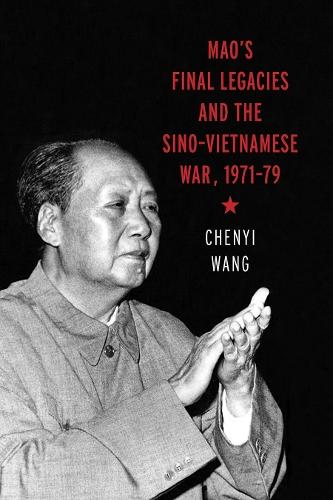
While official Chinese history hails Mao's diplomatic and strategic policy-making in his last five years as successful, Mao's Final Legacies and the Sino–Vietnamese War offers a convincing reassessment: Mao hijacked national security and manipulated ideology to serve his political needs. Following a failed military coup (the Lin Biao Incident) in 1971, Mao crippled the People's Liberation Army and established anti-Soviet, pro–Khmer Rouge policies. The last years of Mao Zedong's life and leadership were filled with high-stakes action and diplomatic manoeuvring. Drawing on previously untapped Chinese archival documents, internal documents, and insiders' memoirs, Chenyi Wang investigates how Mao's policies sowed the seeds for the catastrophic war against Vietnam in 1979. This compelling narrative shows how Mao's preoccupation with power ultimately bequeathed an approach to diplomatic and strategic decision-making that led his successors to failure.
Full Product Details
Author: Chenyi Wang
Publisher: University of British Columbia Press
Imprint: University of British Columbia Press
Weight: 0.454kg
ISBN: 9780774872546
ISBN 10: 0774872543
Pages: 286
Publication Date: 16 February 2026
Audience:
College/higher education
,
Postgraduate, Research & Scholarly
Format: Hardback
Publisher's Status: Active
Availability: In Print

This item will be ordered in for you from one of our suppliers. Upon receipt, we will promptly dispatch it out to you. For in store availability, please contact us.
Reviews
""Mao's Final Legacies and the Sino-Vietnamese War, 1971-79 offers a groundbreaking re-examination of China's foreign policy during Mao Zedong's final years and the early post-Mao era, culminating in the 1979 Sino-Vietnamese War. Drawing on meticulous research, this work challenges prevailing narratives by revealing the intricate interplay between Mao's personal political ambitions, strategic decision making, and the shifting power dynamics among four communist regimes: the Soviet Union, China, Vietnam, and the Khmer Rouge.""-- ""David Cheng Chang, Division of Humanities, Hong Kong University of Science and Technology""
Author Information
Chenyi Wang is a postdoctoral research fellow in the History Department at East China Normal University and an assistant research fellow in its Academy of History and Documentation of Socialism. He has been a visiting lecturer at the University of Hong Kong and a postdoctoral research fellow at the Hong Kong University of Science and Technology, as well as an ECNU–Wilson Center Cold War Studies Initiative Scholar at the Woodrow Wilson International Center for Scholars. His work has been published in the Journal of Cold War Studies and with the Cold War International History Project.