Awards
- Winner of Awarded the 2016 North American Kant Society Book Prize.
Overview
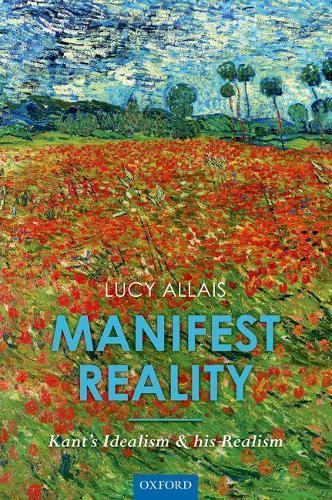
At the heart of Immanuel Kant's critical philosophy is an epistemological and metaphysical position he calls transcendental idealism; the aim of this book is to understand this position. Despite the centrality of transcendental idealism in Kant's thinking, in over two hundred years since the publication of the first Critique there is still no agreement on how to interpret the position, or even on whether, and in what sense, it is a metaphysical position. Lucy Allais argue that Kant's distinction between things in themselves and things as they appear to us has both epistemological and metaphysical components. He is committed to a genuine idealism about things as they appear to us, but this is not a phenomenalist idealism. He is committed to the claim that there is an aspect of reality that grounds mind-dependent spatio-temporal objects, and which we cannot cognize, but he does not assert the existence of distinct non-spatio-temporal objects. A central part of Allais's reading involves paying detailed attention to Kant's notion of intuition, and its role in cognition. She understands Kantian intuitions as representations that give us acquaintance with the objects of thought. Kant's idealism can be understood as limiting empirical reality to that with which we can have acquaintance. He thinks that this empirical reality is mind-dependent in the sense that it is not experience-transcendent, rather than holding that it exists literally in our minds. Reading intuition in this way enables us to make sense of Kant's central argument for his idealism in the Transcendental Aesthetic, and to see why he takes the complete idealist position to be established there. This shows that reading a central part of his argument in the Transcendental Deduction as epistemological is compatible with a metaphysical, idealist reading of transcendental idealism.
Full Product Details
Author: Lucy Allais (University of the Witwatersrand, Johannesburg / University of California, San Diego)
Publisher: Oxford University Press
Imprint: Oxford University Press
Dimensions:
Width: 15.50cm
, Height: 1.90cm
, Length: 23.10cm
Weight: 0.514kg
ISBN: 9780198801337
ISBN 10: 0198801335
Pages: 352
Publication Date: 05 October 2017
Audience:
College/higher education
,
Undergraduate
,
Postgraduate, Research & Scholarly
Format: Paperback
Publisher's Status: Active
Availability: To order

Stock availability from the supplier is unknown. We will order it for you and ship this item to you once it is received by us.
Reviews
It is hard to imagine an interpretation of Kant's Critical theory that is new, informative, charitable and persuasive, but Lucy Allais has pulled it off. In Manifest Reality she offers a 'moderate metaphysical interpretation' of transcendental idealism ... exceptionally clear ... she has succeeded in presenting a strong, coherent and well-argued defence of Kant's idealism. Jill Vance Buroker, Kantian Review This eagerly awaited book is an important addition to the literature on Kant's transcendental idealism and is sure to generate a lot of discussion. Drawing together her influential previous work alongside substantial new material, Allais presents a comprehensive and novel account of Kant's signature doctrine, its structure, nature, and purpose, as well as Kantas master argument for the view. Allais's interpretation is textually well supported and philosophically sophisticated. Andrew Stephenson, British Journal for the History of Philosophy This book is terrific. In it one finds a plausible account of transcendental idealism, supported by arguments that are refreshingly clear yet powerful. It provides an excellent overview of a wide range of competing interpretations, each of which is sympathetically presented but also subjected to serious objections ... Finally, it is a pleasure to read, and how often does one say this about a work on Kant? If you are interested in Kant's transcendental idealism, this book is not to be missed. Kris McDaniel, Notre Dame Philosophical Reviews
In her book Manifest Reality, Lucy Allais articulates a series of compelling criticisms of both epistemological and phenomenalist readings of Kant, while advancing a new 'moderate' metaphysical interpretation of Kant's transcendental idealism. Along the way, Allais provides a substantive elaboration of Kant's theory of cognition, and in particular, on the nature of, and relation between, the cognitive faculties of sensibility and understanding, and their characteristic representational output of intuitions and concepts. * Colin McLear, Critique * Lucy Allais's Manifest Reality is a terrific book, comparable in importance to landmark works like Henry Allison's Kant's Transcendental Idealism and Rae Langton's Kantian Humility. In my view, the interpretation of Kant's idealism Allais offers is significantly more plausible than either Allison's or Langton's. Not just that, but Allais's presentation of the issues is thorough and exciting. Both students and seasoned Kant scholars have much to gain from Manifest Reality ... Allais's book promises to significantly elevate the discussion of Kant's idealism on all fronts ... Not only does it offer an important and powerfully-motivated interpretation, it also provides deep and thorough discussions of the competing factors every interpreter must face. In my view, Manifest Reality should be a focal point for the discussion of Kant's idealism for years to come. * Colin Marshall, Critique * This book is terrific. In it one finds a plausible account of transcendental idealism, supported by arguments that are refreshingly clear yet powerful. It provides an excellent overview of a wide range of competing interpretations, each of which is sympathetically presented but also subjected to serious objections . . . Finally, it is a pleasure to read, and how often does one say this about a work on Kant? If you are interested in Kant's transcendental idealism, this book is not to be missed. * Kris McDaniel, Notre Dame Philosophical Reviews * This eagerly awaited book is an important addition to the literature on Kant's transcendental idealism and is sure to generate a lot of discussion. Drawing together her influential previous work alongside substantial new material, Allais presents a comprehensive and novel account of Kant's signature doctrine, its structure, nature, and purpose, as well as Kantas master argument for the view. Allais's interpretation is textually well supported and philosophically sophisticated. * Andrew Stephenson, British Journal for the History of Philosophy * It is hard to imagine an interpretation of Kant's Critical theory that is new, informative, charitable and persuasive, but Lucy Allais has pulled it off. In Manifest Reality she offers a 'moderate metaphysical interpretation' of transcendental idealism . . . exceptionally clear . . . she has succeeded in presenting a strong, coherent and well-argued defence of Kant's idealism. * Jill Vance Buroker, Kantian Review * the book is a first-rate example of Kant scholarship. It makes for an exciting reading and offers many insights and openings for new avenues of approach to various aspects of Kant's philosophy. It is also probably one of the very few books on Kant which will be referenced and consulted many years hence; in that sense it is comparable to Henry Allison's classic Kant's Transcendental Idealism: An Interpretation and Defense. * Dennis Schulting, Studi Kantiani *
This book is terrific. In it one finds a plausible account of transcendental idealism, supported by arguments that are refreshingly clear yet powerful. It provides an excellent overview of a wide range of competing interpretations, each of which is sympathetically presented but also subjected to serious objections . . . Finally, it is a pleasure to read, and how often does one say this about a work on Kant? If you are interested in Kant's transcendental idealism, this book is not to be missed. * Kris McDaniel, Notre Dame Philosophical Reviews * This eagerly awaited book is an important addition to the literature on Kant's transcendental idealism and is sure to generate a lot of discussion. Drawing together her influential previous work alongside substantial new material, Allais presents a comprehensive and novel account of Kant's signature doctrine, its structure, nature, and purpose, as well as Kantas master argument for the view. Allais's interpretation is textually well supported and philosophically sophisticated. * Andrew Stephenson, British Journal for the History of Philosophy * It is hard to imagine an interpretation of Kant's Critical theory that is new, informative, charitable and persuasive, but Lucy Allais has pulled it off. In Manifest Reality she offers a 'moderate metaphysical interpretation' of transcendental idealism . . . exceptionally clear . . . she has succeeded in presenting a strong, coherent and well-argued defence of Kant's idealism. * Jill Vance Buroker, Kantian Review *
Author Information
Lucy Allais completed her BA degree at , Johannesburg, before going to Oxford to study a BPhil and DPhil. She worked for a number of years at Sussex University, and is currently jointly appointed as a Professor in Philosophy at the University of Witwatersrand and as Henry Allison Chair of the History of Philosophy at the University of California, San Diego.