|
|
|||
|
||||
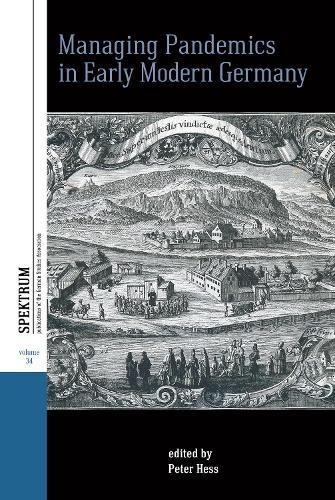
OverviewAdvances our understanding of the various responses to pandemics in Early Modern Germany. Points to similarities between Covid-19 and past pandemics. Provides an answer to the question: What can we learn from history? Full Product DetailsAuthor: Peter HessPublisher: Berghahn Books Imprint: Berghahn Books Volume: 34 ISBN: 9781836954255ISBN 10: 1836954255 Pages: 368 Publication Date: 01 March 2026 Audience: Professional and scholarly , Professional & Vocational Format: Hardback Publisher's Status: Active Availability: Available To Order We have confirmation that this item is in stock with the supplier. It will be ordered in for you and dispatched immediately. Table of ContentsList of Figures and Tables Introduction Hannah Murphy Part I: Textual Strategies: Plague and Print Chapter 1. Plague for a Popular Audience: Suspicions of Print in Late Fifteenth-Century Germany Christopher Hutchinson Chapter 2. The Ethics of Surviving Plague: Political, Social, and Moral Considerations in Sixteenth-Century German Plague Texts Peter Hess Chapter 3. Fighting Plague and Heresy in Early Modern Bavaria: The Confessionalization of Bavarian Plague Literature, 1521–1650 Erik A. Heinrichs Part II: Political Strategies: Rulers and City Councils Responding to Plague Chapter 4. Contagion and Control: City Ccouncils and the French Ppox in Frankfurt am Main and Nuremberg, 1495–1510 Monica C. O’Brien Chapter 5. Tracing Sixteenth-Century Infection Chains in Central Germany Thomas Wozniak Chapter 6. Handling Pestilence During the Thirty Years’ War Sigrun Haude Chapter 7. Plague Control in the Absolutist Territorial State. Ideal and Reality in Electoral Hanover 1709–1716 Ulf Wendler Part III: Broader Academic and Social Responses to Plague Chapter 8. About What is Right in Times of Plague. Contagious Debates in Natural Philosophy, Medicine, Law, and Theology at the Academia Julia inUniversity of Helmstedt, 1681‒83 Benjamin Wallura Chapter 9. Diseases as Threat to the Human and Animal World. Interdependencies of Early Modern Contagion Discourses in Central Europe Ansgar Schanbacher, Philip Knäble, and Malte de Vries Chapter 10. Plague Cemeteries in Early Modern German Towns Martin Christ Pandemics—Theirs and Ours. An Afterword Peter Hess Bibliography IndexReviews""The aim here is not to draw continuities between the early modern period and the 21st century, but to denaturalize epidemics and understand them in their specific historicity. In this way, the manuscript provides an answer to the question: What can we learn from history?"" - Dr. Leander Diener, Max-Planck Institute for the History of Science “The aim here is not to draw continuities between the early modern period and the 21st century, but to denaturalize epidemics and understand them in their specific historicity. In this way, the manuscript provides an answer to the question: What can we learn from history?” • Dr. Leander Diener, Max-Planck Institute for the History of Science Author InformationPeter Hess is professor emeritus of German and European Studies at the University of Texas at Austin. From 2009 to 2018, he served as department chair. Recent publications are Resisting Pluralization and Globalization in German Culture, 1490-1540: Visions of Nation in Decline (De Gruyter, 2020) and Violent First Contact in Venezuela: Nikolaus Federmann's Indian History (Penn State UP, 2021). His current project is a book on Ulrich Schmidel's service as mercenary in the Río de la Plata region, 1534-1554. Tab Content 6Author Website:Countries AvailableAll regions |
||||