Overview
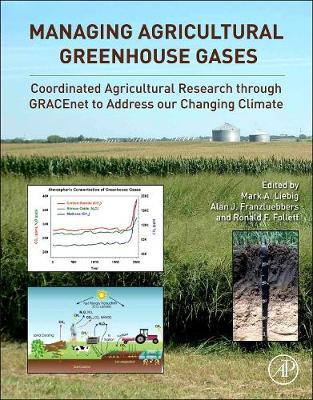
Global climate change is a natural process that currently appears to be strongly influenced by human activities, which increase atmospheric concentrations of greenhouse gases (GHG). Agriculture contributes about 20% of the world’s global radiation forcing from carbon dioxide, methane and nitrous oxide, and produces 50% of the methane and 70% of the nitrous oxide of the human-induced emission. Managing Agricultural Greenhouse Gases synthesizes the wealth of information generated from the GRACEnet (Greenhouse gas Reduction through Agricultural Carbon Enhancement network) effort with contributors from a variety of backgrounds, and reports findings with important international applications.
Full Product Details
Author: Mark Liebig (USDA‐ARS Northern Great Plains Research Laboratory, Mandan, ND, USA) , A.J. Franzluebbers (USDA-ARS, Watkinsville, GA, USA) , Ronald F Follett (USDA-ARS Soil-Plant-Nutrient Research Unit, Fort Collins, CO, USA)
Publisher: Elsevier Science & Technology
Imprint: Academic Press Inc
Weight: 0.450kg
ISBN: 9781493301263
ISBN 10: 1493301268
Pages: 536
Publication Date: 06 June 2011
Audience:
Professional and scholarly
,
Professional & Vocational
Format: Paperback
Publisher's Status: Active
Availability: Manufactured on demand 
We will order this item for you from a manufactured on demand supplier.
Table of Contents
Section One: Agricultural Research for a Carbon-Constrained World Agriculture and climate change: Mitigation opportunities and adaptation imperatives (Mark A. Liebig, Alan J. Franzluebbers, and Ron F. Follett) GRACEnet: Addressing policy needs through coordinated cross-location research (Charles L. Walthall, Steven R. Shafer, and Michael D. Jawson) Section Two: Agricultural Management and Soil Carbon Dynamics Cropland management in the eastern United States for improved soil organic C sequestration (Curtis J. Dell and Jeffrey M. Novak) Soil carbon sequestration in central USA agroecosystems (Cynthia A. Cambardella, Jane M. F. Johnson, and Gary E. Varvel Agricultural management and soil carbon dynamics: Western U.S. croplands (Harold P. Collins, Maysoon M. Mikha, Tabitha T. Brown, Jeffrey L. Smith, David Huggins, and Upendra M. Sainju) Soil carbon dynamics and rangeland management (Justin D. Derner and Virginia L. Jin) Soil organic carbon under pasture management (Alan J. Franzluebbers, Lloyd B. Owens, Gilbert C. Sigua, Cynthia A. Cambardella, and Richard L. Haney) Sustainable bioenergy feedstock production systems: Integrating C dynamics, erosion, water quality and greenhouse gas production (Jane M. F. Johnson and Jeffrey M. Novak) Section Three: Agricultural Management and Greenhouse Gas Flux Cropland management contributions to GHG flux: Central and eastern U.S. (Michel A. Cavigelli and Timothy B. Parkin) Management to reduce greenhouse gas emissions in western U.S. croplands (Ardell D. Halvorson, Kerri L. Steenwerth, Emma C. Suddick, Mark A. Liebig, Jeffery L. Smith, Kevin F. Bronson, and Harold P. Collins) Greenhouse gas flux from managed grasslands in the U.S. (Mark A. Liebig, Xuejun Dong, Jean E.T. McLain, and Curtis J. Dell) Mitigation opportunities for life cycle greenhouse gas emissions during feedstock production across heterogeneous landscapes (Paul R. Adler, Stephen J. Del Grosso, Daniel Inman, Robin E. Jenkins, Sabrina Spatari, and Yimin Zhang) Greenhouse gas fluxes of drained organic and flooded mineral agricultural soils in the United States (Leon Hartwell Allen, Jr.) Section Four: Model Simulations for Estimating Soil Carbon Dynamics and Greenhouse Gas Flux from Agricultural Production Systems DayCent model simulations for estimating soil carbon dynamics and greenhouse gas fluxes from agricultural production systems (Stephen J. Del Grosso, William J. Parton, Paul R. Adler, Sarah C. Davis, Cindy Keough, and Ernest Marx) COMET2.0 – Decision support system for agricultural greenhouse gas accounting (Keith Paustian, Jill Schuler, Kendrick Killian, Adam Chambers, Steven DelGrosso, Mark Easter, Jorge Alvaro-Fuentes, Ram Gurung, Greg Johnson, Miles Merwin, Stephen Ogle, Carolyn Olson, Amy Swan, Steve Williams, and Roel Vining) CQESTR simulations of soil organic carbon dynamics (H.T. Gollany, R. F. Follett, and Y. Liang) Development and application of the EPIC model for carbon cycle, greenhouse-gas mitigation, and biofuel studies (R.C. Izaurralde, W.B. McGill, and J.R. Williams) The general ensemble biogeochemical modeling system (GEMS) and its applications to agricultural systems in the United States (Shuguang Liu, Zhengxi Tan, Mingshi Chen, Jinxun Liu, Anne Wein, Zhengpeng Li, Shengli Huang, Jennifer Oeding, Claudia Young, Shashi B. Verma, Andrew E. Suyker, Stephen Faulkner, and Gregory W. McCarty) Section Five: Measurements and Monitoring: Improving Estimates of Soil Carbon Dynamics and Greenhouse Gas Flux Quantifying biases in non-steady state chamber measurements of soil-atmosphere gas exchange (Rodney T. Venterea and Timothy B. Parkin) Advances in spectroscopic methods for quantifying soil carbon (James B Reeves, III, Gregory W. McCarty, Francisco Calderon, and W. Dean Hively) Micrometeorological methods for assessing greenhouse gas flux (R. Howard Skinner and Claudia Wagner-Riddle) Remote sensing of soil carbon and greenhouse gas dynamics across agricultural landscapes (C.S.T. Daughtry, E.R. Hunt Jr., P.C. Beeson, S. Milak, M.W. Lang, G. Serbin, J.G. Alfieri, G.W. McCarty, and A.M. Sadeghi) Section Six: Economic and Policy Considerations Associated with Reducing Net Greenhouse Gas Emissions from Agriculture Economic outcomes of greenhouse gas mitigation options (David W. Archer and Lyubov A. Kurkalova) Agricultural greenhouse gas trading markets in North America (D.C. Reicosky, T. Goddard, D. Enerson, A.S.K. Chan, and M.A. Liebig) Eligibility criteria affecting landowner participation in greenhouse gas programs (Robert Johansson, Greg Latta, Eric White, Jan Lewandrowski, and Ralph Alig) Section Seven: Looking Ahead: Opportunities for Future Research and Collaboration Potential GRACEnet linkages with other greenhouse gas and soil carbon research and monitoring programs (John M. Baker and Ronald F. Follett) Elevated CO2 and warming effects on soil carbon sequestration and greenhouse gas exchange in agroecosystems: A review (Feike A. Dijkstra and Jack A. Morgan) Mitigation opportunities from land management practices in a warming world: Increasing potential sinks (J.L. Hatfield, T.B. Parkin, T.J. Sauer, and J.H. Prueger) Beyond mitigation: Adaptation of agricultural strategies to overcome projected climate change (Ronald F. Follett)
Reviews
For researchers, industry professionals, and regulators, Liebig et al., who are associated with the US Department of Agriculture-Agricultural Research Service (USDA-ARS), synthesize research findings from about 30 ARS locations participating in the GRACEnet (Greenhouse gas Reduction through Agricultural Carbon Enhancement network) project. Contributed by USDA and other agricultural researchers mostly from the US, the 29 chapters describe the evaluation of agricultural carbon sequestration and greenhouse gas management, measurement, and modeling; economic and policy considerations for the short-term future; and long-term opportunities and the need for research collaborations. They discuss current trends in greenhouse gas emissions, agricultural contributions to those emissions, and risks associated with global climate change; background on the GRACEnet initiative; soil organic carbon dynamics for prevalent agroecosystmes in the US (cropland, rangeland, pasture, and biofeedstock production systems); the responses of carbon dioxide, methane, and nitrous oxide fluxes to management; five common ecosystem models for estimating SOC dynamics and greenhouse gas flux; key attributes of analytical methods used to estimate carbon change in soil and greenhouse gas flux; economic outcomes, incentive programs, and policy scenarios associated with reducing greenhouse gas emissions; and networks worldwide involved in climate change-related research. --Reference & Research Book News October 2012
...extremely well written and should be of interest to professionals as well as to advanced graduate students interested in agricultural GHG dynamics. --Journal of Environmental Quality Whichever discipline the reader may originate from, this book will provide a more holistic viewpoint of managing greenhouse gas emissions and carbon sequestration in agriculture. For researchers, industry professionals, and regulators, Liebig et al., who are associated with the US Department of Agriculture-Agricultural Research Service (USDA-ARS), synthesize research findings from about 30 ARS locations participating in the GRACEnet (Greenhouse gas Reduction through Agricultural Carbon Enhancement network) project. Contributed by USDA and other agricultural researchers mostly from the US, the 29 chapters describe the evaluation of agricultural carbon sequestration and greenhouse gas management, measurement, and modeling; economic and policy considerations for the short-term future; and long-term opportunities and the need for research collaborations. They discuss current trends in greenhouse gas emissions, agricultural contributions to those emissions, and risks associated with global climate change; background on the GRACEnet initiative; soil organic carbon dynamics for prevalent agroecosystmes in the US (cropland, rangeland, pasture, and biofeedstock production systems); the responses of carbon dioxide, methane, and nitrous oxide fluxes to management; five common ecosystem models for estimating SOC dynamics and greenhouse gas flux; key attributes of analytical methods used to estimate carbon change in soil and greenhouse gas flux; economic outcomes, incentive programs, and policy scenarios associated with reducing greenhouse gas emissions; and networks worldwide involved in climate change-related research. --Reference & Research Book News
Author Information
Tab Content 6
Author Website:
Countries Available
All regions
|