Overview
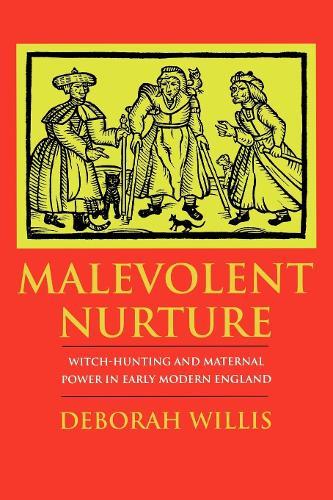
Why were women far more likely than men to be executed for witchcraft in the early modern period? Questioning approaches that focus narrowly on the male role in witch-hunting in England and Scotland, Deborah Willis examines the fact that women were also frequently the accusers. Willis draws on the strengths of feminist, new historicist, and psychoanalytic criticism and on such primary sources as legal documents, pamphlet literature, religious tracts, and stage plays. Both the witch and her female accuser, Willis concludes, were engaged in a complex, intricate struggle for survival and empowerment in a patriarchal culture, and they stood in uneasy relation to definitions of female identity that rewarded nurturing behavior. Malevolent Nurture disentangles popular images of the witch from those endorsed by male elites. Among villagers, the witch was most typically imagined as a malevolent mother, while elites preferred to view her as a betraying servant of Satan. Analyzing King James VI and I's involvement in the North Berwick witchcraft trials, Willis shows how his elite atittudes were nevertheless influenced by his relationships with his brith mother, Mary Queen of Scots, and another maternal figure, Queen Elizabeth I. Willis also shows that Shakespeare, in Richard III, Macbeth, and Henry VI, and other middle-class playwrights incorporated the beliefs of the ruling class and villagers alike in their representations of witches.
Full Product Details
Author: Deborah Willis
Publisher: Cornell University Press
Imprint: Cornell University Press
Dimensions:
Width: 15.20cm
, Height: 2.50cm
, Length: 22.90cm
Weight: 0.907kg
ISBN: 9780801430046
ISBN 10: 0801430046
Pages: 280
Publication Date: 02 November 1995
Audience:
College/higher education
,
General/trade
,
Undergraduate
,
General
Format: Hardback
Publisher's Status: Active
Availability: Awaiting stock

The supplier is currently out of stock of this item. It will be ordered for you and placed on backorder. Once it does come back in stock, we will ship it out for you.
Reviews
Another issue insufficiently considered in the intersection of witch-hunting and gender is that women were more likely than men to be accusers. Literary historian Deborah Willis seeks to redress this oversight... Willis is critical of studies that represent witch-hunts as 'all-male' and 'univocally misogynist'; she takes issue with the 'widely held feminist view that assigns the women accused of witchcraft the role of rebellious proto-feminists and the female accusers to that of patriarchal conformists'... She examines the threat of the witch to order on several social levels: peasent, gentry, and aristocratic. -Kenneth P. Minkema, Religious Studies Review Very well and clearly written and thoroughly researched. -Carole Levin, Medieval and Renaissance Drama in England
""Another issue insufficiently considered in the intersection of witch-hunting and gender is that women were more likely than men to be accusers. Literary historian Deborah Willis seeks to redress this oversight... Willis is critical of studies that represent witch-hunts as 'all-male' and 'univocally misogynist'; she takes issue with the 'widely held feminist view that assigns the women accused of witchcraft the role of rebellious proto-feminists and the female accusers to that of patriarchal conformists'... She examines the threat of the witch to order on several social levels: peasent, gentry, and aristocratic.""-Kenneth P. Minkema, Religious Studies Review ""Very well and clearly written and thoroughly researched.""-Carole Levin, Medieval and Renaissance Drama in England
Very well and clearly written and thoroughly researched. -Carole Levin, Medieval and Renaissance Drama in England
Author Information
Deborah Willis is Associate Professor of English at University of California, Riverside