Awards
- Winner of Phi Kappa Phi Faculty Recognition Award 2014
Overview
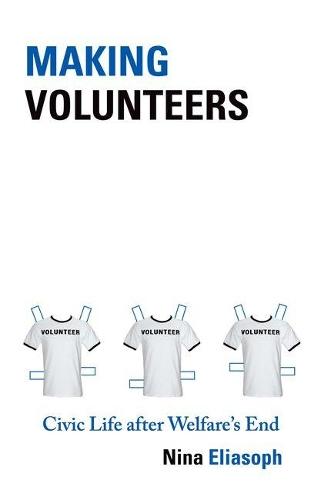
Volunteering improves inner character, builds community, cures poverty, and prevents crime. We've all heard this kind of empowerment talk from nonprofit and government-sponsored civic programs. But what do these programs really accomplish? In Making Volunteers, Nina Eliasoph offers an in-depth, humorous, wrenching, and at times uplifting look inside youth and adult civic programs. She reveals an urgent need for policy reforms in order to improve these organizations and shows that while volunteers learn important lessons, they are not always the lessons that empowerment programs aim to teach. With short-term funding and a dizzy mix of mandates from multiple sponsors, community programs develop a complex web of intimacy, governance, and civic life. Eliasoph describes the at-risk youth served by such programs, the college-bound volunteers who hope to feel selfless inspiration and plump up their resumes, and what happens when the two groups are expected to bond instantly through short-term projects. She looks at adult ""plug-in"" volunteers who, working in after-school programs and limited by time, hope to become like beloved aunties to youth.Eliasoph indicates that adult volunteers can provide grassroots support but they can also undermine the family-like warmth created by paid organizers. Exploring contradictions between the democratic rhetoric of empowerment programs and the bureaucratic hurdles that volunteers learn to navigate, the book demonstrates that empowerment projects work best with less precarious funding, more careful planning, and mandatory training, reflection, and long-term commitments from volunteers. Based on participant research inside civic and community organizations, Making Volunteers illustrates what these programs can and cannot achieve, and how to make them more effective.
Full Product Details
Author: Nina Eliasoph
Publisher: Princeton University Press
Imprint: Princeton University Press
Volume: 50
Dimensions:
Width: 15.20cm
, Height: 2.60cm
, Length: 23.50cm
Weight: 0.567kg
ISBN: 9780691147093
ISBN 10: 0691147094
Pages: 336
Publication Date: 20 March 2011
Audience:
College/higher education
,
Professional and scholarly
,
Tertiary & Higher Education
,
Professional & Vocational
Format: Hardback
Publisher's Status: Active
Availability: Temporarily unavailable

The supplier advises that this item is temporarily unavailable. It will be ordered for you and placed on backorder. Once it does come back in stock, we will ship it out to you.
Language: English
Reviews
Sociologist Eliasoph reports on her participant-as-observer study focusing on the use of volunteers in empowerment programs for disadvantaged youth. The work is a critical analysis of government and privately funded empowerment programs... Eliasoph writes well, and the text is within the reach of most adult readers. Choice The book is written to appeal to a general audience but should be of particular interest to many organizational scholars and practitioners. It is especially relevant to those studying or leading organizations that seek to blend multiple missions, to integrate participants across racial, ethnic, or class boundaries, or to empower their participants in some way. For these readers, the book provides many valuable interpretive nuggets, as well as exhibiting a keen eye for detecting empty talk and gesture. -- Tim Bartley Administrative Science Quarterly
Sociologist Eliasoph reports on her participant-as-observer study focusing on the use of volunteers in empowerment programs for disadvantaged youth. The work is a critical analysis of government and privately funded empowerment programs... Eliasoph writes well, and the text is within the reach of most adult readers. -- Choice
Sociologist Eliasoph reports on her participant-as-observer study focusing on the use of volunteers in empowerment programs for disadvantaged youth. The work is a critical analysis of government and privately funded empowerment programs... Eliasoph writes well, and the text is within the reach of most adult readers. -- Choice
Winner of a 2014 Phi Kappa Phi Faculty Recognition Award Sociologist Eliasoph reports on her participant-as-observer study focusing on the use of volunteers in empowerment programs for disadvantaged youth. The work is a critical analysis of government and privately funded empowerment programs... Eliasoph writes well, and the text is within the reach of most adult readers. --Choice The book is written to appeal to a general audience but should be of particular interest to many organizational scholars and practitioners. It is especially relevant to those studying or leading organizations that seek to blend multiple missions, to integrate participants across racial, ethnic, or class boundaries, or to empower their participants in some way. For these readers, the book provides many valuable interpretive nuggets, as well as exhibiting a keen eye for detecting empty talk and gesture. --Tim Bartley, Administrative Science Quarterly I find a lot to recommend in Making Volunteers. The writing is engaging, and Eliasoph makes several valuable contributions to the study of non-profits, organizations, volunteering, and civic culture. Beyond scholars in these and related areas, faculty whose courses include service learning projects, as well as funders, paid organizers, and potential volunteers for Empowerment Programs would be well served to read Making Volunteers and heed its lessons. --Jennifer L. Glanville, Political Science Quarterly Ethnographic research on volunteering is thin on the ground. This is surprising considering that the nature of charitable work, which is the lifeblood of so many communities, has proved so elusive to pin down in official statistics. Nina Eliasoph's new book, Making Volunteers: Civic Life after Welfare's End, therefore, is an important addition to the canon of literature which explains how people live the experience of voluntary action. --Jon Dean, Voluntas Eliasoph ... concludes the book with an excellent (if difficult) series of recommendations for stakeholders involved in the world of empowerment projects as they currently exist. Project organizers, external funders, and government administrators should heed them. Projects with fewer contradiction-laden, empowerment-talk-driven, mega-events and more frank recognition of real needs and structural differences could avoid current harms and perhaps even reach some positive outcomes. --Matthew Baggetta, Public Administration
Author Information
Nina Eliasoph is associate professor of sociology at the University of Southern California. She is the author of Avoiding Politics.