Overview
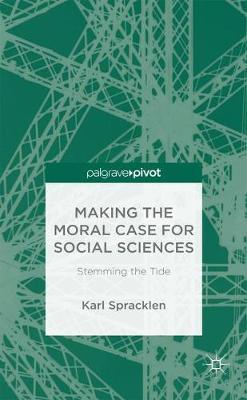
The social sciences have a legitimacy problem in the modern world. The natural sciences are viewed as 'proper science' by journalists and policy-makers because they discover 'truths', make money, and help governments solve problems. In turn, defenders of the social sciences borrow the language of instrumentality, profit and policy impact. Karl Spracklen, by contrast, makes the moral case for the social sciences, arguing that they are a necessary social good capable of fighting inequality and revealing the workings of hegemonic power.
Full Product Details
Author: K. Spracklen
Publisher: Palgrave Macmillan
Imprint: Palgrave Pivot
Edition: 1st ed. 2015
Dimensions:
Width: 14.00cm
, Height: 1.00cm
, Length: 21.60cm
Weight: 0.454kg
ISBN: 9781137577900
ISBN 10: 1137577908
Pages: 90
Publication Date: 03 December 2015
Audience:
Professional and scholarly
,
Professional & Vocational
Format: Hardback
Publisher's Status: Active
Availability: In Print

This item will be ordered in for you from one of our suppliers. Upon receipt, we will promptly dispatch it out to you. For in store availability, please contact us.
Reviews
Karl Spracklen issues a clarion call for critical thinkers in all the social sciences to unite and fight. He argues that the social sciences inevitably lose when they accept the impact agenda that more easily fits the natural sciences and their associated technologies. This book shows that there is an alternative case for the social sciences. It is called critical thinking that has a lineage which runs from Ancient Greece and Rome, through Europe's renaissance and enlightenment, into modern social theories. The clarion call will certainly rouse many sociologists, but Spracklen also addresses economists and,psychologists; indeed students and scholars in all the arts and humanities. - Ken Roberts, University of Liverpool, UK Professor Spracklen has written a trenchant critique of modern social science that everyone in this field must read. Masterfully grounded in the relevant history and philosophy from ancient Greece to the present, unlike most other such critiques, he ends by highlighting the moral strengths of the social sciences. We pursue them, he says, for the pleasure of doing and discovering, for the fact that they enable us to flourish as humans and develop as happier and equal individuals, and for their capacity to help us resist the instrumentality, injustice and inequality presently plaguing modern society. This is our moral basis. - Robert Stebbins, University of Calgary, Canada
""Karl Spracklen issues a clarion call for critical thinkers in all the social sciences to unite and fight. He argues that the social sciences inevitably lose when they accept the impact agenda that more easily fits the natural sciences and their associated technologies. This book shows that there is an alternative case for the social sciences. It is called critical thinking that has a lineage which runs from Ancient Greece and Rome, through Europe's renaissance and enlightenment, into modern social theories. The clarion call will certainly rouse many sociologists, but Spracklen also addresses economists and,psychologists; indeed students and scholars in all the arts and humanities."" - Ken Roberts, University of Liverpool, UK ""Professor Spracklen has written a trenchant critique of modern social science that everyone in this field must read. Masterfully grounded in the relevant history and philosophy from ancient Greece to the present, unlike most other such critiques, heends by highlighting the moral strengths of the social sciences. We pursue them, he says, for the pleasure of doing and discovering, for the fact that they enable us to flourish as humans and develop as happier and equal individuals, and for their capacity to help us resist the instrumentality, injustice and inequality presently plaguing modern society. This is our moral basis."" - Robert Stebbins, University of Calgary, Canada
Karl Spracklen issues a clarion call for critical thinkers in all the social sciences to unite and fight. He argues that the social sciences inevitably lose when they accept the impact agenda that more easily fits the natural sciences and their associated technologies. This book shows that there is an alternative case for the social sciences. It is called critical thinking that has a lineage which runs from Ancient Greece and Rome, through Europe's renaissance and enlightenment, into modern social theories. The clarion call will certainly rouse many sociologists, but Spracklen also addresses economists and,psychologists; indeed students and scholars in all the arts and humanities. - Ken Roberts, University of Liverpool, UK Professor Spracklen has written a trenchant critique of modern social science that everyone in this field must read. Masterfully grounded in the relevant history and philosophy from ancient Greece to the present, unlike most other such critiques, he ends by highlighting the moral strengths of the social sciences. We pursue them, he says, for the pleasure of doing and discovering, for the fact that they enable us to flourish as humans and develop as happier and equal individuals, and for their capacity to help us resist the instrumentality, injustice and inequality presently plaguing modern society. This is our moral basis. - Robert Stebbins, University of Calgary, Canada
Author Information
Karl Spracklen is a Professor of Leisure Studies at Leeds Beckett University, UK. He is an active scholar in leisure studies, sociology and music studies. He was Chair of the Leisure Studies Association, and is the author of over seventy publications, including Whiteness and Leisure (2013), and Digital Leisure (2015).