|
|
|||
|
||||
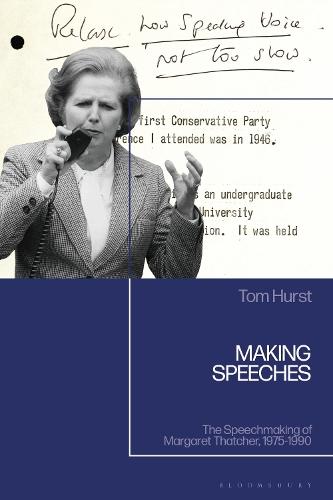
OverviewHaving recently passed the 40th anniversary of Margaret Thatcher’s entry into Number 10 Downing Street, the burgeoning field of Thatcher studies continues to attract the attention of scholars and students alike. The dense array of literature has thus far comprehensively covered Thatcher’s politics, personal life and famous speeches, but the approaches she took to her speech writing have hitherto been overlooked. By consulting a variety of primary sources such as the Churchill archives which house Thatcher’s papers Tom Hurst deftly presents a comprehensive account of Margaret Thatcher’s Speechmaking. By encompassing the creation, delivery and dissemination of the speeches before concluding with a focus on the reception of these speeches in an unprecedented digital age, Hurst fills an existing gap. By focusing on the oft-overlooked staff who helped Thatcher draft her speeches – and in so doing, shaped Thatcherism from behind the scenes – Hurst promotes an entirely original work that unveils the Iron Lady’s reliance on her speechmakers, which has previously been unexplored. Full Product DetailsAuthor: Tom HurstPublisher: Bloomsbury Publishing PLC Imprint: Bloomsbury Academic Dimensions: Width: 16.20cm , Height: 1.80cm , Length: 23.60cm Weight: 0.480kg ISBN: 9781350158573ISBN 10: 1350158577 Pages: 216 Publication Date: 20 March 2025 Audience: College/higher education , Tertiary & Higher Education Format: Hardback Publisher's Status: Active Availability: Manufactured on demand We will order this item for you from a manufactured on demand supplier. Table of ContentsIntroduction 1.‘Defy[ing] analysis’? Thatcher’s speechwriting process. 2. ‘Policy hostages’. The political significance of Thatcher’s set-piece speeches. 3. ‘Local colour’. The platform in decline? 4.‘We are playing to our geographical strengths.’ Prime Ministerial speechmaking and general election campaigns. 5. ‘We have issued a speech text which does not relate to the one spoken by the Prime Minister, in every respect.’ The press and post-delivery speechwriting. 6. ‘Tell me… how many people do you think are watching television?’ The set-piece speech in a televisual age. 7. A ‘third-class citizen’? Radio and the speechmaking of Mrs Thatcher. 8. The political effectiveness of Thatcher’s set-piece speeches. ConclusionReviewsThis important and accomplished work will make historians rethink Thatcherism and indeed their approach to political rhetoric more generally. It will be of interest to all who study late twentieth-century Britain. * Richard Vinen, Professor of History, King’s College London, UK * This important and accomplished work will make historians rethink Thatcherism and indeed their approach to political rhetoric more generally. It will be of interest to all who study late twentieth-century Britain. * Richard Vinen, Professor of History, King’s College London, UK * From “The Lady’s not for turning” to “There’s no such thing as society”, Thatcher’s words were as powerful as her deeds. Tom Hurst’s book, the first on Thatcher’s speech-writing, shows how Thatcher and her co-writers spoke “Thatcherism” into life, and found the words for a new political era. * Robert Saunders, Reader in British History, Queen Mary University of London, UK * Author InformationDr Tom Hurst is an Archival By-Fellow at Churchill College, Cambridge, and an Assistant Headteacher of a secondary school in North London. Tab Content 6Author Website:Countries AvailableAll regions |
||||