Overview
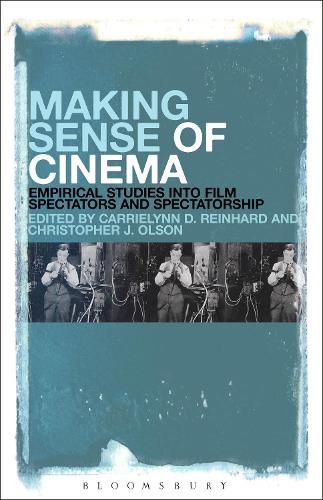
There are a variety of theoretical and methodological approaches to researching how film spectators make sense of film texts, from the film text itself, the psychological traits and sociocultural group memberships of the viewer, or even the location and surroundings of the viewer. However, we can only understand the agency of film spectators in situations of film spectatorship by studying actual spectators’ interactions with specific film texts in specific contexts of engagement. Making Sense of Cinema: Empirical Studies into Film Spectators and Spectatorship uses a number of empirical approaches (ethnography, focus groups, interviews, historical, qualitative experiment and physiological experiment) to consider how the film spectator makes sense of the text itself or the ways in which the text fits into his or her everyday life. With case studies ranging from preoccupations of queer and ageing men in Spanish and French cinema and comparative eye-tracking studies based on the two completely different soundscapes of Monsters Inc. and Saving Private Ryan to cult fanbase of the Lord of the Rings Trilogy and attachment theory to its fictional characters, Making Sense of Cinema aligns this subset of film studies with the larger fields of media reception studies, allowing for dialogue with the broader audience and reception studies field.
Full Product Details
Author: CarrieLynn D. Reinhard (Dominican University, USA) ,
Christopher J. Olson (University of Wisconsin - Milwaukee, USA)
Publisher: Bloomsbury Publishing Plc
Imprint: Bloomsbury Academic
Dimensions:
Width: 15.20cm
, Height: 1.90cm
, Length: 22.90cm
Weight: 0.590kg
ISBN: 9781501302947
ISBN 10: 1501302949
Pages: 320
Publication Date: 25 February 2016
Audience:
College/higher education
,
Tertiary & Higher Education
Format: Hardback
Publisher's Status: Active
Availability: Manufactured on demand

We will order this item for you from a manufactured on demand supplier.
Reviews
An important contribution to film spectatorship studies. What is unique about this collection is the focus on empirical analysis to analyze how actual (as opposed to implied) spectators construct meaning from their viewing experience. The essays included here employ a variety of methodologies and cover a broad array of genres and geographical areas, both past and present. A fascinating work of scholarship of interest to anyone seeking to understand better the global spectator’s viewing experience. * David N. Coury, Professor of Humanistic Studies and Global Studies, University of Wisconsin-Green Bay, USA * Reading Making Sense of Cinema I was totally baffled to see the film spectator arise brightly, high-res and three-dimensional, from the dark, cross-lit by manifold complementary color spots cast by specialists in disciplines as diverse as linguistics, acoustics, art history, cultural studies, cultural analysis, audience research, communication research, cinematography, critical (genre) studies, visual perception, neuroinformatics, cognitive film studies, and screen writing. And all it seemed to take is a shared conviction that direct observation makes for the brighter picture. * Ed Tan, Professor of Media Psychology, University of Amsterdam, The Netherlands *
An important contribution to film spectatorship studies. What is unique about this collection is the focus on empirical analysis to analyze how actual (as opposed to implied) spectators construct meaning from their viewing experience. The essays included here employ a variety of methodologies and cover a broad array of genres and geographical areas, both past and present. A fascinating work of scholarship of interest to anyone seeking to understand better the global spectator's viewing experience. David N. Coury, Professor of Humanistic Studies and Global Studies, University of Wisconsin-Green Bay, USA
An important contribution to film spectatorship studies. What is unique about this collection is the focus on empirical analysis to analyze how actual (as opposed to implied) spectators construct meaning from their viewing experience. The essays included here employ a variety of methodologies and cover a broad array of genres and geographical areas, both past and present. A fascinating work of scholarship of interest to anyone seeking to understand better the global spectator's viewing experience. David N. Coury, Professor of Humanistic Studies and Global Studies, University of Wisconsin-Green Bay, USA Reading Making Sense of Cinema I was totally baffled to see the film spectator arise brightly, high-res and three-dimensional, from the dark, cross-lit by manifold complementary color spots cast by specialists in disciplines as diverse as linguistics, acoustics, art history, cultural studies, cultural analysis, audience research, communication research, cinematography, critical (genre) studies, visual perception, neuroinformatics, cognitive film studies, and screen writing. And all it seemed to take is a shared conviction that direct observation makes for the brighter picture. Ed Tan, Professor of Media Psychology, University of Amsterdam, The Netherlands
Author Information
CarrieLynn D. Reinhard is an Associate Professor in Communication Arts and Sciences at Dominican University, Illinois, USA, where her research focuses on sense-making in media reception. She completed her Ph.D. in Communication at Ohio State University, USA, and was a post-doctoral research fellow for the Virtual World Research Group at Roskilde University in Denmark. Christopher J. Olson is a PhD student enrolled in the Media, Cinema, and Digital Studies program of the English Department at the University of Wisconsin - Milwaukee, USA.