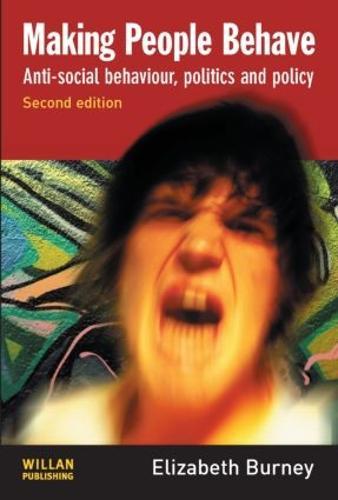
Full Product Details
Author: Elizabeth Burney (University of Cambridge, UK)
Publisher: Taylor & Francis Ltd
Imprint: Willan Publishing
Edition: 2nd edition
Dimensions:
Width: 15.60cm
, Height: 1.30cm
, Length: 23.40cm
Weight: 0.453kg
ISBN: 9781843926993
ISBN 10: 1843926997
Pages: 256
Publication Date: 26 June 2009
Audience:
College/higher education
,
General/trade
,
Tertiary & Higher Education
,
General
Format: Paperback
Publisher's Status: Active
Availability: In Print

This item will be ordered in for you from one of our suppliers. Upon receipt, we will promptly dispatch it out to you. For in store availability, please contact us.
Reviews
One of the most useful studies of 'antisocial behaviour, politics and policy' is Making People Behave written by Elizabeth Burney. Burney attempts to understand the rise of the antisocial behavior framework within the wider political and policy developments in the UK. To do this she initially explores the 'intervention' of antisocial behaviour by the Labour party, not as a conspiracy but through Labour's engagement with the anxieties of their working class constituents-anxieties that at a policy level became reformulated around a particular understanding of the social problem 'antisocial behaviour'. -Stuart Waiton, Springer Science & Business Media B.V. 2010
One of the most useful studies of 'antisocial behaviour, politics and policy' is Making People Behave written by Elizabeth Burney. Burney attempts to understand the rise of the antisocial behavior framework within the wider political and policy developments in the UK. To do this she initially explores the `intervention' of antisocial behaviour by the Labour party, not as a conspiracy but through Labour's engagement with the anxieties of their working class constituents-anxieties that at a policy level became reformulated around a particular understanding of the social problem `antisocial behaviour'. -Stuart Waiton, Springer Science & Business Media B.V. 2010
One of the most useful studies of 'antisocial behaviour, politics and policy' is Making People Behave written by Elizabeth Burney. Burney attempts to understand the rise of the antisocial behavior framework within the wider political and policy developments in the UK. To do this she initially explores the 'intervention' of antisocial behaviour by the Labour party, not as a conspiracy but through Labour's engagement with the anxieties of their working class constituents-anxieties that at a policy level became reformulated around a particular understanding of the social problem 'antisocial behaviour'. -Stuart Waiton, Springer Science & Business Media B.V. 2010
'offers a valuable insight into undoubtedly important developments with wide implications for the present and future directions of housing, education and social policy... a vital resource for all those interested in understanding the shifting culture of control and the regulation of conduct' - Adam Crawford, in Social Policy 'The book is a beautifully written and researched piece... an excellent aid to both teaching and research in the area.' - Katherine S. Williams, in Punishment and Society 'a persuasive page-turner of an account of the rise to prominence of ASB in Britain and offers critical insights on successive attempts by New Labour to do something about it .' - Layla Skinns in Howard Journal of Criminal Justice
Author Information
Elizabeth Burney is based at the Cambridge Institute of Criminology.