Overview
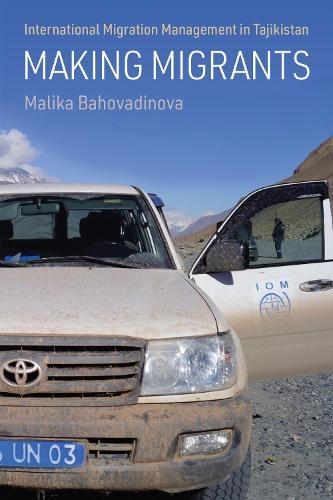
How officials in bureaucratic institutions in Tajikistan, though well-meaning, create a postcolonial, problematic ""migrant"" Making Migrants explores the postcolonial life of institutions and law in Tajikistan, finding that bureaucratic spaces render people who seek to work abroad into the subjective construct of a ""migrant."" Anthropologist Malika Bahovadinova argues that this category describes not an individual, but a broader process of government regulation and control. Both structural and literal violence is entrenched in the bureaucratic process, which, in our increasingly mobile world, unfolds in a hostile global context where nation-states seek to make the figure of the ""migrant"" an ""illegal"" one. Through an examination of migration officials' day-to-day work facilitating migration from Tajikistan to Russia, Bahovadinova reveals how 10 percent of Tajikistan's population has moved to Russia in search of stronger economic opportunities. She finds that officials face steep challenges in this work as they grapple with deeply unequal and asymmetrical relationships with Russia, donor states, and international experts, while coming face-to-face with postcolonial legacies from the Soviet past. By exploring relationships between history, pedagogy, and law in migration bureaucracy, Bahovadinova highlights the limited possibilities available to officials in global migration management, asks how governmental ideas and practices develop, and uncovers the challenges that transnational citizens face when they leave their countries to work without forfeiting their original citizenship. This case shows how postcolonial countries that export workers introduce and replicate colonial rationalities that understand laborers as ""migrants"" or ""illegals"" in receiving states. By attaching the term ""illegal"" to people from a former colony, Russia shapes representations of Tajikistan's citizens as inherently potentially criminal and dangerous ""others,"" while benefitting from their temporary labor. Ultimately, Making Migrants uncovers how introducing and performing ""migration management"" in a postcolonial environment aligns with and reinforces colonial rationalities about people, labor, economic opportunity, and bureaucratic authority.
Full Product Details
Author: Malika Bahovadinova
Publisher: University of Pennsylvania Press
Imprint: University of Pennsylvania Press
ISBN: 9781512829044
ISBN 10: 1512829048
Pages: 240
Publication Date: 28 April 2026
Audience:
College/higher education
,
Postgraduate, Research & Scholarly
Format: Hardback
Publisher's Status: Active
Availability: Not yet available

This item is yet to be released. You can pre-order this item and we will dispatch it to you upon its release.
Reviews
""Making Migrants is a clear and compelling ethnography of migration governance in postcolonial Tajikistan. Drawing on a decade of research with migration management bureaucracy, Malika Bahovadinova demonstrates how local officials simultaneously resist and reproduce the figures of 'the migrant' and 'the illegal' as they seek to assert sovereignty under conditions of constraint. The book reveals the troubling convergence of migration advocacy and discriminatory enforcement, demonstrating how, together, they generate illegality—even when unintentional—as Tajik officials grapple with Russia's criminalization of mobility. By centering Central Asia and its entanglements with Russia, Making Migrants makes a vital contribution to postcolonial and migration scholarship, illuminating enduring dependencies, powerful imaginaries of past and future, and the everyday bureaucratic practices through which migration takes place. Essential reading for scholars and students of migration, the book exemplifies the power of ethnography to render complexity visible."" - Lauren Woodard, Syracuse University
Author Information
Malika Bahovadinova is a political anthropologist working on state-society relations in Central Asia.