Overview
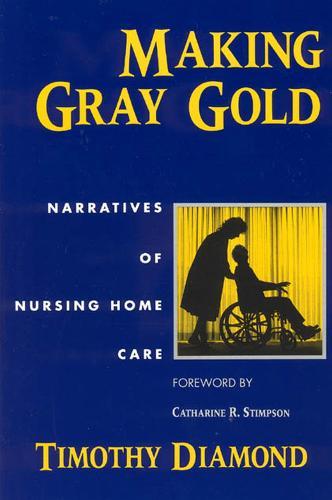
This first hand report on the work of nurses and other caregivers in a nursing home is set powerfully in the context of wider political, economic, and cultural forces that shape and constrain the quality of care for America's elderly. Diamond demonstrates in a compelling way the price that business-as-usual policies extract from the elderly as well as those whose work it is to care for them. In a society in which some two million people live in 16,000 nursing homes, with their numbers escalating daily, this thought-provoking work demands immediate and widespread attention. ""[An] unnerving portrait of what it's like to work and live in a nursing home. . . . By giving voice to so many unheard residents and workers Diamond has performed an important service for us all.""—Diane Cole, New York Newsday ""With Making Gray Gold, Timothy Diamond describes the commodification of long-term care in the most vivid representation in a decade of round-the-clock institutional life. . . . A personal addition to the troublingly impersonal national debate over healthcare reform.""—Madonna Harrington Meyer, Contemporary Sociology
Full Product Details
Author: Timothy Diamond ,
Catherine R. Stimpson
Publisher: The University of Chicago Press
Imprint: University of Chicago Press
Edition: New edition
Dimensions:
Width: 1.60cm
, Height: 0.20cm
, Length: 2.40cm
Weight: 0.454kg
ISBN: 9780226144740
ISBN 10: 0226144747
Pages: 296
Publication Date: 15 May 1995
Audience:
College/higher education
,
Professional and scholarly
,
Undergraduate
,
Postgraduate, Research & Scholarly
Format: Paperback
Publisher's Status: Active
Availability: Manufactured on demand

We will order this item for you from a manufactured on demand supplier.
Reviews
Another strong plea for change in America's health-care system, this time with nursing homes under the spotlight. The graying of America has provided a gold-making opportunity to some, according to Diamond (Sociology/California State Univ.), who says that caretaking is a nationally subsidized business in which governments dispense enormous sums of Social Security, Medicare, and Medicaid moneys to corporations that pay workers sub-poverty-level wages and dehumanize patients into units called beds. To get the inside story, Diamond became a certified nursing assistant and for over a year worked in three Chicago-area nursing homes, with both private-pay and Medicaid patients. An astute observer, he describes how vocational schools prepare - or rather fail to prepare - nursing assistants for the firing line of health care, and how this care is administered in nursing homes. His fellow workers were almost entirely women of color from Third World countries, forced to hold down two jobs to survive. Diamond reports on how patients, 80 percent of whom are women, arc gradually pauperized under the government's spend-down policy, whereby individuals must exhaust their own resources before becoming eligible for Medicaid. By inspecting and certifying nursing homes, the state, Diamond says, implicitly endorses poverty wages for workers and the pauperization of patients. In such a dynamic, he contends, quality care is unlikely if not impossible. The picture Diamond paints is not a pleasant one, but there is a note of optimism in his final I-have-a-dream chapter, where he sees the road to change through unionization of nursing-home workers and greater input into care issues by residents and their families. Revelatory eyewitness descriptions, plus sobering analysis, add up to a commendable addition to the growing literature on what's wrong with our health-care system. (Kirkus Reviews)