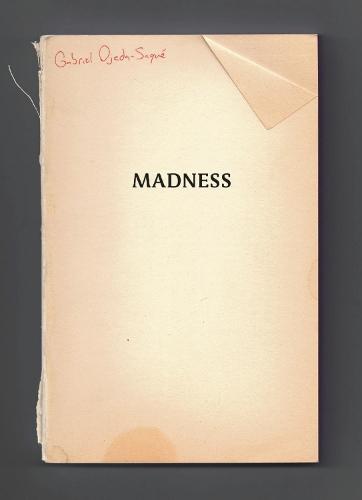
Full Product Details
Author: Gabriel Ojeda-Sague
Publisher: Nightboat Books
Imprint: Nightboat Books
ISBN: 9781643621173
ISBN 10: 1643621173
Pages: 96
Publication Date: 28 April 2022
Audience:
General/trade
,
General
Format: Paperback
Publisher's Status: Active
Availability: Available To Order

We have confirmation that this item is in stock with the supplier. It will be ordered in for you and dispatched immediately.
Reviews
Gabriel Ojeda-Sague's grand confection in Madness is the fictional poet Luis Montes-Torres. Through his selected poems and biographical mini-essays by fictional coeditors, Ojeda-Sague constitutes a meditation on a poet's life, the life of a queer Cuban immigrant, the life of hermetic sweetness and depression, with a yearning love for nature, boyfriend and dogs. Montes-Torres's body of work is all assertion and retreat, formally adventurous, traditionally lyrical, obscure and combative. He inhabits the kind of poetry world that Roberto Bolano lovingly described, of idealism, ambition, obscure prizes, and editions of three hundred, that happens to be ours. Looking back from 2055, Montes-Torres is presented as a minor poet, and that may be Ojeda-Sague's biggest ruse because, Reader, these poems will ravish you with beauty, idealism and ambition. -Robert Gluck Sprung from the wildly inventive mind of Gabriel Ojeda-Sague, Madness represents the selected poems of fictional poet Luis Montes-Torres (1976-2035). The book flows luxuriously between poetry, biography, and what I'm tempted to call speculative fiction. Ojeda-Sague displays a dexterity with a wide range of forms, from short lyrics to long poems to diary entries. As this imagined poet's biography unfolds, the book shifts and slips and curls, and throughout we remain captivated and intrigued as travel companions. What a pleasure to be invited into the life and poems of an extraordinary person-after all, aren't we all ordinary and extra, 'nervous and breathing,' trying to find 'a measure arranged into tenderness'? -Alli Warren Literary heir to Fernando Pessoa, Jack Spicer, Reinaldo Arenas, John Weiners, and Benno von Archimboldi, once and future poet Luis Montes-Torres (1976-2035) endures in poems of enabling welcome into 'someone's hallucination.' Gabriel Ojeda-Sague's desire for desdoblamiento engenders a poetry of self-possession that wonders, with ear attuned to attachment and mood, who is anybody writing for? His fictional coeditors have expertly selected from nine books Montes-Torres bequeathed us in small press editions-lifetimes yet to come that speak the twin language of good-natured cubist intimacy and exile culture shock. In Ojeda-Sague's self-fable-a tribute to immigrant dwelling and descent-'every repetition is / a little ghost of me waving / from an echo.' -Roberto Tejada
Sprung from the wildly inventive mind of Gabriel Ojeda-Sague, Madness represents the selected poems of fictional poet Luis Montes-Torres (1976-2035). The book flows luxuriously between poetry, biography, and what I'm tempted to call speculative fiction. Ojeda-Sague displays a dexterity with a wide range of forms, from short lyrics to long poems to diary entries. As this imagined poet's biography unfolds, the book shifts and slips and curls, and throughout we remain captivated and intrigued as travel companions. What a pleasure to be invited into the life and poems of an extraordinary person-after all, aren't we all ordinary and extra, 'nervous and breathing,' trying to find 'a measure arranged into tenderness'? -Alli Warren
In Losing Miami, Gabriel Ojeda-Sague longs for a city he is losing, has lost, which has been built of, in, and through loss. Its language is both and neither, a language singular to Miami and Ojeda-Sague's playful refusal to authenticate. Here we have a yearning that veers between nostalgia and el brillito of a queer utopianism. It is too much and definitely too little. It is shameless and maybe a little deliciously ashamed. It doesn't care if there is no return, if there is no closure, if all the roads lead to other roads. This book has no better home than far from home, where se goza como nunca while running on empty into the sea. -Raquel Salas Rivera Let the wise, prodigious embrace of these poems get ahold of you. Gabriel Ojeda-Sague has given us an American poetry where English is no longer the great white hallucination of literature, but something that is finally more egalitarian as only a poet could sincerely DEMAND! Losing Miami breaks and mends the heart in the poet's bottles of messages thrown into the Atlantic to reach his familial home of Cuba. This book is addictive brilliance, the way I yearn for all books of poetry to be. -CAConrad In these poems, blood is imagined multivalently as kinship and as exploitation, as heritage and racial violence, as inclusion and exclusion, as slaughter and as self-sacrifice. Poets and poetry occupy highly contested space as Ojeda-Sague offers: 'limpias of communist poets who forget who killed my family/limpias of the market poets who forget who killed everybody else.' -Emily Anderson, Full Stop
In his innovative fourth poetry collection, Madness, Gabriel Ojeda-Sague imagines the life and work of a fictional 'minor' poet named Luis Montes-Torres, who is said to have been born in 1976 and to have died of complications from brain cancer at the age of 58, in 2035... Madness pays homage to all poets whose work goes underappreciated. -Christopher Soto, The New York Times Under the guise of reclaiming an imaginary, unsung poet, Ojeda-Sague moves between biographical notes and poetry in a thoughtfully orchestrated contrapuntal exploration of mental health and its effects on human creativity. -Layla Benitez-James, Harriet Clever and captivating, Madness explodes the boundaries of what poetry can be, what it can look like, and what work it can do. It's a poetry collection that reads like a novel, grappling with topics of temporality, reality, identity, and belonging. -Willem Finn Harling, Lambda Literary Through the creation of Montes-Torres, there is something very freeing in the way Ojeda-Sague composes this range of a life's work, and this range of a life, offering the ebbs and flows of biography across an array of literary forms, from short lyrics to diary entries to longer stretches of prose. Ojeda-Sague offers how writing is constructed, and a character as well, and how it all might begin to slowly unravel. -rob mclennan's blog Gabriel Ojeda-Sague's grand confection in Madness is the fictional poet Luis Montes-Torres. Through his selected poems and biographical mini-essays by fictional coeditors, Ojeda-Sague constitutes a meditation on a poet's life, the life of a queer Cuban immigrant, the life of hermetic sweetness and depression, with a yearning love for nature, boyfriend and dogs. Montes-Torres's body of work is all assertion and retreat, formally adventurous, traditionally lyrical, obscure and combative. He inhabits the kind of poetry world that Roberto Bolano lovingly described, of idealism, ambition, obscure prizes, and editions of three hundred, that happens to be ours. Looking back from 2055, Montes-Torres is presented as a minor poet, and that may be Ojeda-Sague's biggest ruse because, Reader, these poems will ravish you with beauty, idealism and ambition. -Robert Gluck Sprung from the wildly inventive mind of Gabriel Ojeda-Sague, Madness represents the selected poems of fictional poet Luis Montes-Torres (1976-2035). The book flows luxuriously between poetry, biography, and what I'm tempted to call speculative fiction. Ojeda-Sague displays a dexterity with a wide range of forms, from short lyrics to long poems to diary entries. As this imagined poet's biography unfolds, the book shifts and slips and curls, and throughout we remain captivated and intrigued as travel companions. What a pleasure to be invited into the life and poems of an extraordinary person-after all, aren't we all ordinary and extra, 'nervous and breathing,' trying to find 'a measure arranged into tenderness'? -Alli Warren Literary heir to Fernando Pessoa, Jack Spicer, Reinaldo Arenas, John Weiners, and Benno von Archimboldi, once and future poet Luis Montes-Torres (1976-2035) endures in poems of enabling welcome into 'someone's hallucination.' Gabriel Ojeda-Sague's desire for desdoblamiento engenders a poetry of self-possession that wonders, with ear attuned to attachment and mood, who is anybody writing for? His fictional coeditors have expertly selected from nine books Montes-Torres bequeathed us in small press editions-lifetimes yet to come that speak the twin language of good-natured cubist intimacy and exile culture shock. In Ojeda-Sague's self-fable-a tribute to immigrant dwelling and descent-'every repetition is / a little ghost of me waving / from an echo.' -Roberto Tejada
Author Information
Gabriel Ojeda-Sague is a gay, Latino Leo living in Chicago. He is the author of three books of poetry, most recently including Losing Miami (The Accomplices, 2019) which was nominated for the 2020 Lambda Literary Award in Gay Poetry. He is also the co-editor of a book of selected sketches by the artist Gustavo Ojeda, published by Soberscove Press in November 2020. He is also the author of chapbooks on Cher, the Legend of Zelda, and anxious bilingualism. His fourth poetry book, Madness, is forthcoming from Nightboat Books. He is currently a PhD student in English at the University of Chicago where he works in the study of sexuality.