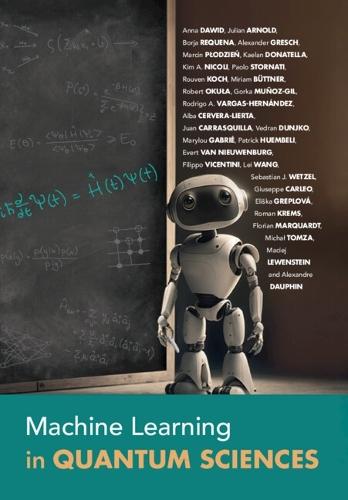
Full Product Details
Author: Anna Dawid (Uniwersytet Warszawski, Poland) ,
Julian Arnold (Universität Basel, Switzerland) ,
Borja Requena (ICFO - The Institute of Photonic Sciences) ,
Alexander Gresch (Heinrich-Heine-Universität Düsseldorf)
Publisher: Cambridge University Press
Imprint: Cambridge University Press
Weight: 0.837kg
ISBN: 9781009504935
ISBN 10: 1009504932
Pages: 330
Publication Date: 12 June 2025
Audience:
College/higher education
,
Undergraduate
,
Postgraduate, Research & Scholarly
Format: Hardback
Publisher's Status: Active
Availability: Manufactured on demand

We will order this item for you from a manufactured on demand supplier.
Reviews
'The book gives a fantastic overview of an emerging research landscape where quantum sciences and machine learning meet. A good place to start for young researchers who want to help shape this exciting intersection.' Maria Schuld, Xanadu, Canada 'Imagine trying to learn quantum mechanics without knowing differential equations and linear algebra. A daunting task, since these are the mathematical languages behind the Schrödinger and Heisenberg pictures! Now imagine trying to do cutting-edge research in the quantum sciences without knowing artificial intelligence (AI) and machine learning (ML). Similarly daunting, since AI/ML is fast becoming the language of scientific discovery! This book will teach you the pillars of AI/ML through the lens of the quantum sciences, offering insights to novices and experts alike about how you can apply AI/ML in a scientifically rigorous way to various quantum systems.' Jesse Thaler, Massachusetts Institute of Technology, USA
Author Information
Anna Dawid is a research fellow at the Flatiron Institute, New York, with the Ph.D. in quantum physics awarded by the University of Warsaw and ICFO, Barcelona. Her research spans interpretable machine learning for scientific discovery, quantum simulations, and foundations of deep learning. Alexandre Dauphin is VP quantum simulation at PASQAL, a neutral-atom quantum computing company. During his career, he has worked on a broad range of topics going from quantum simulation of many-body phases of matter to ML applied to physics and QML. He received the NJP early career award 2019, has been a member of the editorial board of NJP since 2020, and a member of ELLIS since 2021. Julian Arnold is a theoretical physicist working at the interface between the quantum sciences, information theory, and machine learning. His research includes the design of methods for the automated detection of phase transitions and the application of differentiable programming to solve inverse design problems in quantum many-body physics. Borja Requena develops machine learning algorithms for scientific applications. His contributions span multiple fields, from quantum to statistical and biophysics. Additionally, Borja has worked in high-tech companies such as Xanadu Quantum Technologies or Telefonica R&D, and he has been high ranked in machine learning and quantum computing competitions. Alexander Gresch (Ph.D. Student at the universities of Düsseldorf and Hamburg) is a theoretical physicist specializing in mathematical and machine learning methods in the context of quantum technologies. This includes, in particular, the efficient and accurate read-out of hybrid quantum algorithms and the role of quantum data for machine learning. Marcin Płodzień (Ph.D. 2014, Jagiellonian University, Poland) is a theoretical physicist specializing in many-body quantum systems, quantum computations, and machine learning. He focuses on digital and analog quantum simulators, quantum algorithms in NISQ-era devices and the applications of deep neural networks to problems in quantum mechanics. Kaelan Donatella is a Franco-Irish physicist trained at Ecole Normale Supérieure and the University of Paris. His interests range from quantum computing to the history and philosophy of science, with recent work being focused on analog computing for artificial intelligence. Kim A. Nicoli is a postdoc at the Helmholtz Institute for Radiation and Nuclear Physics and the University of Bonn. He got his Ph.D. in Machine Learning from TU Berlin in 2023. His research interests extend across Probabilistic Modelling, Quantum Computing, Generative Models, Lattice Quantum Field Theory, and Neuromorphic Computing. Paolo Stornati is a Postdoctoral Researcher in Quantum Simulation and Quantum many body theory. Paolo has a deep interest in the development of novel numerical tools to study exotic phases of matter and lattice Gauge theories. Rouven Koch is a Doctoral Researcher at Aalto University working in the intersection of condensed matter theory and machine learning. His research focuses on the combination of theory and experiments with the help of AI. Personally, he is interested in daily-life applications of AI. Miriam Büttner earned an M.Sc. in Molecular Science at the FAU Erlangen-Nuremberg. In 2017, she went to Shenzhen, China for an elective Master's project on Machine Learning in Quantum Chem and has since then been growing her ML knowledge. She is currently doing her PhD in many-body physics. Robert Okuła is a Ph.D. student interested in all things quantum, especially quantum cryptography and quantum Darwinism. Machine learning is a useful tool in that regard.