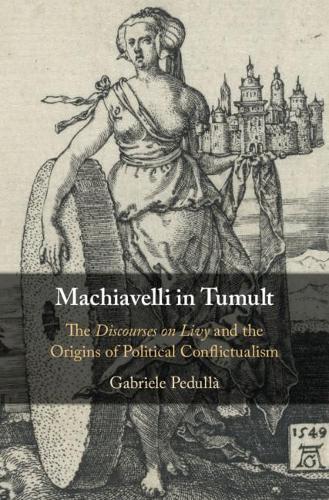
Full Product Details
Author: Gabriele Pedullà
Publisher: Cambridge University Press
Imprint: Cambridge University Press
Dimensions:
Width: 15.80cm
, Height: 2.10cm
, Length: 23.60cm
Weight: 0.570kg
ISBN: 9781107177277
ISBN 10: 1107177278
Pages: 298
Publication Date: 30 August 2018
Audience:
Professional and scholarly
,
College/higher education
,
Professional & Vocational
,
Postgraduate, Research & Scholarly
Format: Hardback
Publisher's Status: Active
Availability: Manufactured on demand

We will order this item for you from a manufactured on demand supplier.
Reviews
Gabriele Pedull... has written a masterful book. [...] A short review cannot begin to do justice to the author's astonishing command of two millennia of primary sources and a vast array of modern scholarship or to the new light these essays shed on both Machiavelli and the long history of the questions he addressed. In deepening the understanding of Machiavelli's polemical engagement with assumptions inherited from antiquity and fifteenth-century humanists, this book merits comparison with the magisterial studies of Gennaro Sasso; and in analyzing the complex responses, positive and negative, to Machiavelli's ideas over the next several centuries, it similarly deserves comparison with the overarching narratives of the history of political thought of Quentin Skinner and JGA Pocock. [...] Pedull...'s stimulating book opens new vistas and enriches familiar questions. In a time of immense vitality in Machiavelli studies, it should top the reading lists of all scholars in the field. John M. Najemy, Renaissance Quarterly A brilliant, original work by one of the most learned and creative scholars in the humanities today. Ronald G. Watt, Duke University Gabriele Pedull...'s Machiavelli in Tumult stands as a monumental contribution to both Machiavelli studies and the history of political thought. Through exhaustive historical research and with remarkable textual facility, Pedull... demonstrates just how radically Machiavelli's Discourses repudiated two thousand years of Greek, Roman and humanistic reflections on the value of civic concord. Pedull... emphasizes Machiavelli's resolute commitment to the political efficacy of social discord and class conflict, especially the salutary effects of tumults for civic liberty. A model of scholarly erudition and analytic perspicacity, Machiavelli in tumult is mandatory reading for anyone, within the academy or among the general public, interested in political theory or intellectual history. John P. McCormick, Chicago University Pedull...'s book shows that the theory of conflict not only lies at the very heart of Machiavelli's work, but also marked the decisive turning point at which Western political thought changed its course by adopting a new conceptual language. The author's outstanding expertise in both early-modern and contemporary culture grants his interpretation the critical insight and analytic richness of a true classic. Roberto Exposito, Scuola Normale Superiore of Pisa Deep, sharp and wide-ranging, Machiavelli in Tumult offers a rich and insightful exploration of Machiavelli's treatment of the causes, dynamics, consequences, and uses of mass political conflict. A must-read for those interested in the intellectual history of conflict, as well as those trying to make sense of where conflict fits in contemporary society. Stathis N. Kalyvas, Yale University
Review of Italian edition: 'Gabriele Pedulla has written a masterful book. ... A short review cannot begin to do justice to the author's astonishing command of two millennia of primary sources and a vast array of modern scholarship or to the new light these essays shed on both Machiavelli and the long history of the questions he addressed. In deepening the understanding of Machiavelli's polemical engagement with assumptions inherited from antiquity and fifteenth-century humanists, this book merits comparison with the magisterial studies of Gennaro Sasso; and in analyzing the complex responses, positive and negative, to Machiavelli's ideas over the next several centuries, it similarly deserves comparison with the overarching narratives of the history of political thought of Quentin Skinner and JGA Pocock. ... Pedulla's stimulating book opens new vistas and enriches familiar questions. In a time of immense vitality in Machiavelli studies, it should top the reading lists of all scholars in the field.' John M. Najemy, Renaissance Quarterly Advance praise: 'A brilliant, original work by one of the most learned and creative scholars in the humanities today.' Ronald G. Watt, Duke University, North Carolina Advance praise: 'Gabriele Pedulla's Machiavelli in Tumult stands as a monumental contribution to both Machiavelli studies and the history of political thought. Through exhaustive historical research and with remarkable textual facility, Pedulla demonstrates just how radically Machiavelli's Discourses repudiated two thousand years of Greek, Roman and humanistic reflections on the value of civic concord. Pedulla emphasizes Machiavelli's resolute commitment to the political efficacy of social discord and class conflict, especially the salutary effects of tumults for civic liberty. A model of scholarly erudition and analytic perspicacity, Machiavelli in tumult is mandatory reading for anyone, within the academy or among the general public, interested in political theory or intellectual history.' John P. McCormick, Chicago University Advance praise: 'Pedulla's book shows that the theory of conflict not only lies at the very heart of Machiavelli's work, but also marked the decisive turning point at which Western political thought changed its course by adopting a new conceptual language. The author's outstanding expertise in both early-modern and contemporary culture grants his interpretation the critical insight and analytic richness of a true classic.' Roberto Exposito, Scuola Normale Superiore of Pisa Advance praise: 'Deep, sharp and wide-ranging, Machiavelli in Tumult offers a rich and insightful exploration of Machiavelli's treatment of the causes, dynamics, consequences, and uses of mass political conflict. A must-read for those interested in the intellectual history of conflict, as well as those trying to make sense of where conflict fits in contemporary society.' Stathis N. Kalyvas, Yale University, Connecticut Review of Italian edition: `Gabriele Pedulla has written a masterful book. ... A short review cannot begin to do justice to the author's astonishing command of two millennia of primary sources and a vast array of modern scholarship or to the new light these essays shed on both Machiavelli and the long history of the questions he addressed. In deepening the understanding of Machiavelli's polemical engagement with assumptions inherited from antiquity and fifteenth-century humanists, this book merits comparison with the magisterial studies of Gennaro Sasso; and in analyzing the complex responses, positive and negative, to Machiavelli's ideas over the next several centuries, it similarly deserves comparison with the overarching narratives of the history of political thought of Quentin Skinner and JGA Pocock. ... Pedulla's stimulating book opens new vistas and enriches familiar questions. In a time of immense vitality in Machiavelli studies, it should top the reading lists of all scholars in the field.' John M. Najemy, Renaissance Quarterly Advance praise: `A brilliant, original work by one of the most learned and creative scholars in the humanities today.' Ronald G. Watt, Duke University, North Carolina Advance praise: `Gabriele Pedulla's Machiavelli in Tumult stands as a monumental contribution to both Machiavelli studies and the history of political thought. Through exhaustive historical research and with remarkable textual facility, Pedulla demonstrates just how radically Machiavelli's Discourses repudiated two thousand years of Greek, Roman and humanistic reflections on the value of civic concord. Pedulla emphasizes Machiavelli's resolute commitment to the political efficacy of social discord and class conflict, especially the salutary effects of tumults for civic liberty. A model of scholarly erudition and analytic perspicacity, Machiavelli in tumult is mandatory reading for anyone, within the academy or among the general public, interested in political theory or intellectual history.' John P. McCormick, Chicago University Advance praise: `Pedulla's book shows that the theory of conflict not only lies at the very heart of Machiavelli's work, but also marked the decisive turning point at which Western political thought changed its course by adopting a new conceptual language. The author's outstanding expertise in both early-modern and contemporary culture grants his interpretation the critical insight and analytic richness of a true classic.' Roberto Exposito, Scuola Normale Superiore of Pisa Advance praise: `Deep, sharp and wide-ranging, Machiavelli in Tumult offers a rich and insightful exploration of Machiavelli's treatment of the causes, dynamics, consequences, and uses of mass political conflict. A must-read for those interested in the intellectual history of conflict, as well as those trying to make sense of where conflict fits in contemporary society.' Stathis N. Kalyvas, Yale University, Connecticut
Author Information
Gabriele Pedull... is professor of Italian and Comparative Literature at the University of Rome 3 and has been visiting professor at Stanford, University of California, Los Angeles, and the École Normale Supérieure, Lyon, Francesco De Dombrowski Fellow at 'Villa I Tatti', the Harvard University Center for the Italian Renaissance, Fellow at the Italian Academy for Advanced Studies in America, Columbia University, and Belknap Visiting Fellow in the Humanities Council at Princeton University. In English he has published In Broad Daylight. Movies and Spectators after the Cinema (2012) and many essays on Renaissance political thought. With Sergio Luzzatto, he edited a three volume Atlante della letteratura italiana (2010-12). His new edition and commentary on Machiavelli's Prince (2013) is forthcoming in English and is under translation in French, Spanish, and Portuguese. He is also the author of two prizewinning fiction books: the collection of short stories Lo spagnolo senza sforzo (2009: partially translated into English), and the novel Lame (2017, forthcoming in English as Blades).