Overview
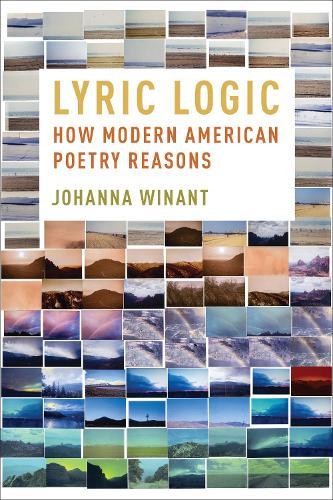
Between the Civil War and the Cold War, American literary modernism and philosophy both grappled with the challenge of novelty and the chance to make it new. Bringing together modern poetry's aesthetic experimentation and modern philosophy's attention to the problem of induction, Lyric Logic argues that poems use logical form as literary form. The modern poem can be characterized by its logic: details that appear fragmentary add up to sense-making. Johanna Winant recasts the poetics of central figures as modeling and defending inductive reasoning: Walt Whitman makes lists, Emily Dickinson constructs analogies, Gertrude Stein presents facts, Marianne Moore investigates predictions, Elizabeth Bishop draws inferences, and Gwendolyn Brooks tests the limits of deduction. Winant offers in-depth close readings of canonical poems that show the sophistication of their philosophic logic. Although philosophers tend to see induction as flawed and unreliable, these poets display its strengths. Their work demonstrates how to make sense of the unpredictable modern world.
Full Product Details
Author: Johanna Winant
Publisher: Columbia University Press
Imprint: Columbia University Press
ISBN: 9780231217460
ISBN 10: 0231217463
Pages: 272
Publication Date: 28 April 2026
Audience:
Professional and scholarly
,
College/higher education
,
Professional & Vocational
,
Postgraduate, Research & Scholarly
Format: Hardback
Publisher's Status: Active
Availability: Available To Order

We have confirmation that this item is in stock with the supplier. It will be ordered in for you and dispatched immediately.
Reviews
It seems intuitive that lyric poems proceed in inductive fashion, assembling particulars until the whole becomes greater than the sum of its parts. However, saying that inductive reasoning is the special work of lyric and a philosophical project in its own right, is an entirely new claim and a bold one. Winant turns our intuition about lyric into a research question. What are inductive reasoning’s special techniques? What is the nature of its validity? Are there moments when poetry actively borrows from philosophies defending induction? Winant answers these questions both directly and through powerful new readings of major U.S. poetries from Walt Whitman through Gwendolyn Brooks. And, by showing how poems themselves “close read the world,” Lyric Logic offers a compelling defense of that method without disparaging other critical approaches, a striking achievement all on its own. -- Marjorie Levinson, author of <i>Thinking through Poetry: Field Reports on Romantic Lyric</i> With philosophical precision and aesthetic sensitivity, Johanna Winant offers us a modern American poetry of explanation, in which the boundless novelty of experience meets the formal rigor of systematic thought. Technical and buoyant in equal measure, Lyric Logic vindicates an epistemic project for which art is an appropriate—perhaps the inevitable—vehicle. It is a pleasure to think with. -- Oren Izenberg, author of <i>Being Numerous: Poetry and the Ground of Social Life</i> Winant shows her readers a world in which contingent details reveal truth and literature yields rational claims. Lyric Logic maintains a dialogue between philosophical and poetic problems with exemplary precision. -- Theo Davis, author of <i> Ornamental Aesthetics: The Poetry of Attending in Thoreau, Dickinson, and Whitman</i> Finally, we're out of the language of ""the logic of"" and placed into actual logic. Poetry in Winant's account is something that imposes logical strictness on itself—even poetry that looks stranger than our wildest imagination. Such poetry still reasons by induction, a series of ""if this, then what."" Lyric Logic is a beautifully precise defense of close-reading as comprehension and comprehension as something that needs sound logic and that can follow sound logic quite far. -- Nan Z. Da, author of <i>Intransitive Encounter: Sino-U.S. Literatures and the Limits of Exchange</i>
It seems intuitive that lyric poems proceed in inductive fashion, assembling particulars until the whole becomes greater than the sum of its parts. However, saying that inductive reasoning is the special work of lyric and a philosophical project in its own right, is an entirely new claim and a bold one. Winant turns our intuition about lyric into a research question. What are inductive reasoning’s special techniques? What is the nature of its validity? Are there moments when poetry actively borrows from philosophies defending induction? Winant answers these questions both directly and through powerful new readings of major U.S. poetries from Walt Whitman through Gwendolyn Brooks. And, by showing how poems themselves “close read the world,” Lyric Logic offers a compelling defense of that method without disparaging other critical approaches, a striking achievement all on its own. -- Marjorie Levinson, author of <i>Thinking through Poetry: Field Reports on Romantic Lyric</i> With philosophical precision and aesthetic sensitivity, Johanna Winant offers us a modern American poetry of explanation, in which the boundless novelty of experience meets the formal rigor of systematic thought. Technical and buoyant in equal measure, Lyric Logic vindicates an epistemic project for which art is an appropriate—perhaps the inevitable—vehicle. It is a pleasure to think with -- Oren Izenberg, author of <i>Being Numerous: Poetry and the Ground of Social Life</i> Winant shows her readers a world in which contingent details reveal truth and literature yields rational claims. Lyric Logic maintains a dialogue between philosophical and poetic problems with exemplary precision. -- Theo Davis, author of <i> Ornamental Aesthetics: The Poetry of Attending in Thoreau, Dickinson, and Whitman</i> Finally, we're out of the language of ""the logic of"" and placed into actual logic. Poetry in Winant's account is something that imposes logical strictness on itself—even poetry that looks stranger than our wildest imagination. Such poetry still reasons by induction, a series of ""if this, then what."" Lyric Logic is a beautifully precise defense of close-reading as comprehension and comprehension as something that needs sound logic and that can follow sound logic quite far. -- Nan Z. Da, author of <i>Intransitive Encounter: Sino-U.S. Literatures and the Limits of Exchange</i>
Author Information
Johanna Winant is associate professor of English and humanities at Reed College. She is coeditor, with Dan Sinykin, of Close Reading for the Twenty-First Century (2025).