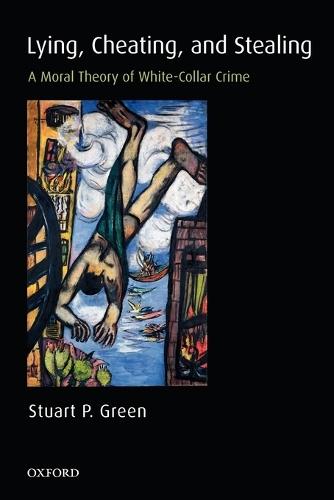
Full Product Details
Author: Stuart P. Green (, Professor of Law and Justice Nathan L. Jacobs Scholar, Rutgers School of Law, Newark)
Publisher: Oxford University Press
Imprint: Oxford University Press
Dimensions:
Width: 15.50cm
, Height: 1.50cm
, Length: 23.40cm
Weight: 0.469kg
ISBN: 9780199225804
ISBN 10: 019922580
Pages: 312
Publication Date: 15 March 2007
Audience:
Adult education
,
Professional and scholarly
,
Further / Higher Education
,
Professional & Vocational
Format: Paperback
Publisher's Status: Active
Availability: To order

Stock availability from the supplier is unknown. We will order it for you and ship this item to you once it is received by us.
Reviews
<br> Lucid and informative . . . Green's book admirably clears away much of the conceptual underbrush surrounding the idea of white-collar crime. It is a category of wrongdoing, he makes clear, less easily grasped by our ordinary intuitions of right and wrong than, for instance, violent crime. . . Lying, Cheating, and Stealing is strong on moral philosophy, not least in the way it illuminates the gray areas of business conduct. -- Andrew Stark, Wall Street Journal<p><br> Green is a legal scholar who is extremely well versed in moral philosophy as well as legal theory. . . . This book is clear, well-written, strongly argued, very well researched, and significantly original. Green's analyses of the concepts he discusses are particularly well-done. I recommend the book to anyone interested in the topics it addresses. -- Thomas L. Carson, Business Ethics Quarterly<p><br> Green has set down a fascinating and ground-breaking case for a close alignment between legal and everyday norms, and
Lucid and informative . . . Green's book admirably clears away much of the conceptual underbrush surrounding the idea of white-collar crime. It is a category of wrongdoing, he makes clear, less easily grasped by our ordinary intuitions of right and wrong than, for instance, violent crime. . . Lying, Cheating, and Stealing is strong on moral philosophy, not least in the way it illuminates the gray areas of business conduct. -- Andrew Stark, Wall Street Journal<br> Green is a legal scholar who is extremely well versed in moral philosophy as well as legal theory. . . . This book is clear, well-written, strongly argued, very well researched, and significantly original. Green's analyses of the concepts he discusses are particularly well-done. I recommend the book to anyone interested in the topics it addresses. -- Thomas L. Carson, Business Ethics Quarterly<br> Green has set down a fascinating and ground-breaking case for a close alignment between legal and everyday norms, and has presented an exploration of our thick moral concepts that is interesting in its own right. This is a fine text and one that deserves to be the focal point for future discussion. -- Tony Milligan, Criminal Law and Philosophy<br> Stuart Green's new book, Lying, Cheating, and Stealing: A Moral Theory of White-Collar Crime, is a superbly written book that will be of wide interest to criminal law scholars and practitioners alike. . . . [I]t illuminates a wide a range of criminal offenses . . . and merits careful attention and repeated readings by those with an interest in the field. -- Andrew E. Taslitz, Criminal Justice<br> [Lying, Cheating, and Stealing] is in many ways a Catherine Wheel of ideas on howto theorise [about white collar] offences and their moral content. It is a rich source of ideas for further discussion, and is likely to be a much cited book, providing as it does a collection of provocative perspectives with which to interrogate the boundaries of criminal law in general and to justify individual offences. -- Alex Steel, University of New South Wales Law Review<br> [In]tricately crafted, learned, and frequently illuminating . . . . Lying, Cheating, and Stealing is a wide-ranging and ambitious book. . . . [O]riginal . . . engaging [and] smart, it is well worth reading by anyone interested in white-collar crime, or in the relationship between conventional morality and crime more generally. -- Mitchell Berman, Ohio State Criminal Law Review<br> This is a long needed and pathbreaking consideration of white-collar crime from the perspective of a top-notch legal scholar. Stuart Green has absorbed knowledge in his own specialty and in the social sciences to provide a comprehensive and integrated understanding of behavior that has been capturing headlines in the American media. Tough issues, long bypassed, come in for sophisticated scrutiny. I am certain that Lying, Cheating and Stealing will come to stand as a classic contribution to the study of law-breaking by the privileged. -- Professor Gilbert Geis, University of California, Irvine<br> This is an important book, which opens up the vast field of 'white-collar crime' to deep normative theorising -- theorising that is informed by an acute grasp of the legal issues and by a thorough philosophical grounding. . . . Th[e] book marks a real advance in normative theorising about the moral foundations of the criminal law: itshould provoke theorists to think not just about murder, but about insider trading; not just about rape, but about tax evasion -- and about the wide range of 'regulatory offences' whose moral content has been so under-explored. -- Professor Antony Duff, University of Stirling<br>
Lucid and informative . . . Green's book admirably clears away much of the conceptual underbrush surrounding the idea of white-collar crime. It is a category of wrongdoing, he makes clear, less easily grasped by our ordinary intuitions of right and wrong than, for instance, violent crime. . . Lying, Cheating, and Stealing is strong on moral philosophy, not least in the way it illuminates the gray areas of business conduct. -- Andrew Stark, Wall Street Journal Green is a legal scholar who is extremely well versed in moral philosophy as well as legal theory. . . . This book is clear, well-written, strongly argued, very well researched, and significantly original. Green's analyses of the concepts he discusses are particularly well-done. I recommend the book to anyone interested in the topics it addresses. -- Thomas L. Carson, Business Ethics Quarterly Green has set down a fascinating and ground-breaking case for a close alignment between legal and everyday norms, and has presented an exploration of our thick moral concepts that is interesting in its own right. This is a fine text and one that deserves to be the focal point for future discussion. -- Tony Milligan, Criminal Law and Philosophy Stuart Green's new book, Lying, Cheating, and Stealing: A Moral Theory of White-Collar Crime, is a superbly written book that will be of wide interest to criminal law scholars and practitioners alike. . . . [I]t illuminates a wide a range of criminal offenses . . . and merits careful attention and repeated readings by those with an interest in the field. -- Andrew E. Taslitz, Criminal Justice [Lying, Cheating, and Stealing] is in many ways a Catherine Wheel of ideas on how to theorise [about white collar] offences and their moral content. It is a rich source of ideas for further discussion, and is likely to be a much cited book, providing as it does a collection of provocative perspectives with which to interrogate the boundaries of criminal law
Author Information
Stuart Green is Professor of Law and Justice Nathan L. Jacobs Scholar, Rutgers School of Law, Newark. A graduate of Yale Law School, he has served as a Fulbright Distinguished Scholar in the United Kingdom and as a Visiting Professor at the University of Michigan Law School. He is co-editor, along with R.A. Duff, of Defining Crimes: Essays on the Special Part of the Criminal Law, published by OUP in 2005.