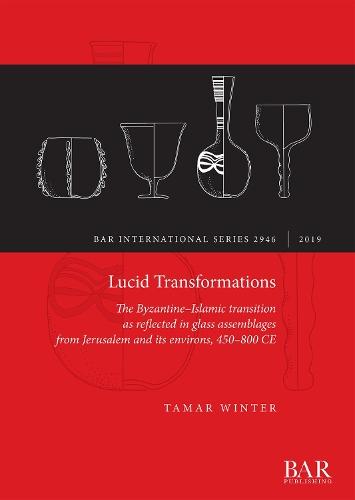
Lucid Transformations: The Byzantine-Islamic transition as reflected in glass assemblages from Jerusalem and its environs, 450-800 CE

Author:   Tamar Winter
Publisher:   BAR Publishing
ISBN:  

9781407316987


Pages:   236
Publication Date:   30 August 2019
Format:   Paperback
Availability:   Available To Order   Availability explained
We have confirmation that this item is in stock with the supplier. It will be ordered in for you and dispatched immediately.

Our Price $160.43 Quantity:  
Add to Cart

Share |

Lucid Transformations: The Byzantine-Islamic transition as reflected in glass assemblages from Jerusalem and its environs, 450-800 CE


Overview

The book investigates the contribution of glass finds to understanding the nature of the transition from Byzantine to Islamic rule in Syria-Palestine, by analysing numerous glass assemblages from Jerusalem and its environs. This original synthesis explores the nature of numerous types of glass objects, and their distinct distribution in various types of sites. Furthermore, the identification of trends of continuity and change in the fabrics, technologies, typologies and styles of the glass finds throughout this turbulent period, illuminates the nature of the processes undergone by the various communities in the Jerusalem area. The monograph comprises a newly established, comprehensive, up-to-date typo-chronology, based on hundreds of glass wares of the Byzantine and Early Islamic periods from scores of excavations, in and around Jerusalem and in neighbouring regions. Additionally, a holistic study of lighting devices, glass lamps and windowpanes, includes a novel assessment of Christian, Muslim and Jewish written sources regarding lighting in religious buildings in Jerusalem in the relevant periods.

Full Product Details

Author:   Tamar Winter
Publisher:   BAR Publishing
Imprint:   BAR Publishing
Weight:   0.941kg
ISBN:  

9781407316987


ISBN 10:   1407316982
Pages:   236
Publication Date:   30 August 2019
Audience:   Professional and scholarly ,  Professional & Vocational
Format:   Paperback
Publisher's Status:   Active
Availability:   Available To Order   Availability explained
We have confirmation that this item is in stock with the supplier. It will be ordered in for you and dispatched immediately.

Table of Contents

List of Figures List of Tables List of Maps List of Plans Abbreviations 1. Introduction 1.1 The Main Objectives and Scope of the Research 1.1.1 The Geographical and Chronological Scopes of the Research 1.1.2 The Structure of the Book and Its Reasoning 1.2 The State of Research 1.2.1 Research Pertaining to the Transition from Byzantine to Islamic Rule 1.2.2 Research of Glass Finds from the Byzantine and Early Islamic Periods 2. The Historical Setting of Jerusalem and Its Environs in the Byzantine and Early Islamic Periods 2.1 Early Developments 2.1.1 Christianity Gaining Recognition 2.1.2 Theological Controversies and Church Politics 2.1.3 The Jews and the Temple Mount 2.2 Establishing Christian Eminence 2.2.1 Sacred Sites and Churches 2.2.2 Early Pilgrimage and Monasticism 2.2.3 Founding Traditions of Sacredness and Memorial 2.2.4 A Thriving, Cosmopolitan, Predominately-Christian City 2.2.5 Prosperity and Urban Development 2.2.6 Extra-Mural Expansion 2.2.7 The Agricultural Hinterland 2.3 Under Persian Occupation 2.3.1 The Final Years of Byzantine Rule 2.4 The Arab Conquest 2.4.1 The Occupation of Jerusalem 2.5 Under the Umayyad Caliphate 2.5.1 A New Islamic Center 2.5.2 Jerusalem's Urban Zoning 2.6 Christians and Jews under Muslim Rule 2.7 Under the Abbasid Dynasty and Beyond 2.8 Continuity of Christian Life in Jerusalem during the Early Islamic Period 2.9 Epilogue 3. Typological-Chronological Study of the Glass Products from the Mid-Fifth to the Eighth Centuries 3.1 Introduction and Methodology 3.1.1 Introduction 3.1.2 Methodological Annotations and Considerations 3.2 Typological-Chronological Study of the Glass Vessels 3.2.1 Bowls 3.2.2 Wineglasses 3.2.3 Jars 3.2.4 Bottles 3.2.5 Jugs 3.2.6 Lamps 3.3 Typological-Chronological Study of the Major Decoration Schemes 3.3.1 Mold-Blown Decoration 3.3.2 Trail Decoration 3.3.3 Pinched Decoration 3.3.4 Tonged Decoration 3.3.5 Stain-Painted Decoration 3.3.6 Mosaic Glass 3.3.7 Marvered Decoration 3.4 Typological-Chronological Study of Exceptional Vessels and Artifacts 3.4.1 Goblets 3.4.2 Decorated Vessels 3.4.3 Exceptional Vessels 3.4.4 Artifacts 3.5 Typological-Chronological Study of Architecture-Associated Glass Products 3.5.1 Windowpanes 3.5.2 Tesserae and Tiles 4. Illumination Schemes in the Byzantine and Early Islamic Periods 4.1 Lighting and Glass Lighting Devices 4.1.1 Lighting Devices in the Byzantine Realm 4.1.2 Lighting Devices in the Islamic Realm 4.1.3 Lighting in Religious Public Buildings in Jerusalem in the Byzantine and Early Islamic Periods 4.2 Windows and Glass Windowpanes 4.2.1 Windows and Windowpanes in the Roman, Byzantine and Islamic Realms 4.2.2 Manufacture and Trade of Glass Windowpanes 5. Newly Studied Glass Finds from Archaeological Excavations in Jerusalem and Its Environs 5.1 Monastery North of Damascus Gate 5.1.1 The Site and the Finds 5.1.2 Summary and Discussion 5.2 Residential and Commercial Complex in the Mamilla Area 5.2.1 The Site and the Finds 5.2.2 Summary and Discussion 5.3 Structures at the Teddy Kollek Park Compound 5.3.1 The Site and the Finds 5.3.2 Summary and Discussion 5.4 Residential Quarter on the City of David Spur (Giv'ati Car Park) 5.4.1 The Site and the Finds 5.4.2 Summary and Discussion 5.5 Monastery on Mount Scopus 5.5.1 The Site and the Finds 5.5.2 Summary and Discussion 5.6 Monastery in the Kidron Valley 5.6.1 The Site and the Finds 5.6.2 Summary and Discussion 5.7 Monastery at Umm Tuba 5.7.1 The Site and the Finds 5.7.2 Summary and Discussion 5.8 The Kathisma Church Complex 5.8.1 The Site and the Finds 5.8.2 Summary and Discussion 5.9 Installations at Bet Ha-Kerem 5.9.1 The Site and the Finds 5.9.2 Summary and Discussion 5.10 Farmstead at Bet Zayit 5.10.1 The Site and the Finds 5.10.2 Summary and Discussion 6. Published Glass Finds from Archaeological Excavations in Jerusalem and Its Environs 6.1 Farmstead at Khirbat Adasa 6.2 Farmstead at Ras Abu Ma'aruf 6.3 Farmstead and Monastery at Deir Ghazali 6.4 Structures North of Damascus Gate 6.5 'House of the Menorot' Southwest of the Temple Mount 6.6 City of David Spur: Areas G, H, K 6.7 City of David Spur: Area M1 6.8 Monastery at Khirbat Tabaliya 6.9 Monastery at Khirbat Siyar el-Ghanam 6.10 Monastic Complex at the Compound of the Jerusalem International Convention Center 6.11 Churches at En Kerem 6.12 Tombs and Burial Caves 7. Synthesis 7.1 The Nature of the Glass Corpus from the Mid-Fifth to the Eighth Centuries 7.1.1 Roman Traditions 7.1.2 Byzantine-Natured Trends: Form and Function 7.1.3 Continuity and Innovation 7.1.4 Fabric, Color and Decoration 7.1.5 Change and Innovation 7.1.6 Production of Raw Glass and Vesse

Reviews

{\rtf1\ansi\ansicpg1252\deff0\deflang2057{\fonttbl{\f0\fswiss\fprq2\fcharset0 Calibri;}{\f1\fnil\fcharset0 Verdana;}} \viewkind4\uc1\pard\sa160\sl252\slmult1\f0\fs22\lquote This detailed study of glass assemblages from excavations in Jerusalem and its periphery provides a valuable addition to the study of material culture in Palestine and Jordan during this period and sets a new standard reference to future studies relating to cities in the Near East and beyond.\rquote Prof. Gideon Avni, Israel Antiquities Authority \par \par \lquote I learnt something from every part of the book\'85 This is a very significant contribution to the field. It will serve as an important point of reference for the investigation of glass in the region for many years due to the exceptionally large corpus of material that it brings together.\rquote Prof. Ian Freestone, UCL Institute of Archaeology \par \pard\f1\fs17\par }


{\rtf1\ansi\ansicpg1252\deff0\deflang2057{\fonttbl{\f0\fswiss\fprq2\fcharset0 Calibri;}{\f1\fnil\fcharset0 Verdana;}} \viewkind4\uc1\pard\sa160\sl252\slmult1\f0\fs22\lquote This detailed study of glass assemblages from excavations in Jerusalem and its periphery provides a valuable addition to the study of material culture in Palestine and Jordan during this period and sets a new standard reference to future studies relating to cities in the Near East and beyond.\rquote Prof. Gideon Avni, Israel Antiquities Authority \par \par \lquote I learnt something from every part of the book\'85 This is a very significant contribution to the field. It will serve as an important point of reference for the investigation of glass in the region for many years due to the exceptionally large corpus of material that it brings together.\rquote Prof. Ian Freestone, UCL Institute of Archaeology \par \pard\f1\fs17\par }


'This detailed study of glass assemblages from excavations in Jerusalem and its periphery provides a valuable addition to the study of material culture in Palestine and Jordan during this period and sets a new standard reference to future studies relating to cities in the Near East and beyond.' Prof. Gideon Avni, Israel Antiquities Authority 'I learnt something from every part of the book. This is a very significant contribution to the field. It will serve as an important point of reference for the investigation of glass in the region for many years due to the exceptionally large corpus of material that it brings together.' Prof. Ian Freestone, UCL Institute of Archaeology


Author Information

Tamar Winter (PhD) is a senior researcher of ancient glass at the Israel Antiquities Authority. She analyses glass corpora of the Roman, Byzantine and Islamic periods from numerous excavation sites, including Jerusalem, Caesarea Maritima and Bet She'an. Her studies focus on the contribution of glass assemblages to the understanding of cultural and ethno-religious aspects of historical processes.

Tab Content 6

Author Website:  

Countries Available

All regions
Latest Reading Guide

April RG 26_2


Shopping Cart
Your cart is empty
Shopping cart
Mailing List