Overview
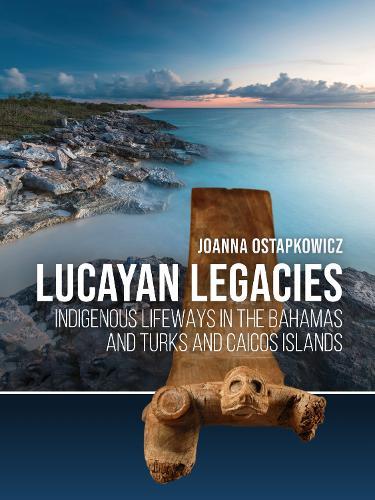
This book is about Lucayan legacies – the heritage of the people who made the Bahamas and Turks and Caicos Islands (the Lucayan archipelago) their home from the 8th to the 16th centuries. This legacy is not simply the surviving physical record, consisting of artefacts of stone, shell and wood – it is a history entangled in the early antiquarian and archaeological interests in the region, resulting in the museum and institutional collections both within and beyond the islands. Many of the collections now in museums were acquired between 1850 and 1950, before professional archaeology emerged as a field in the region, and are largely unknown even to many archaeologists working in the Bahamas and the wider Caribbean, let alone to local island communities and the wider public. In drawing together this widely dispersed corpus, this comprehensive, richly illustrated study aims to foreground the material culture of the Lucayans, making it more accessible and reinstating it as an important part of the region’s archaeological heritage. Development on the islands dating back to the 17th century has resulted in the loss of much of the earlier heritage, with a rate of destruction that has only increased in recent decades as a result of both human activity but also global climate change, seeing rising sea levels and ever-more violent storms. In this context, it is important to take stock of the islands’ surviving Lucayan heritage, and integrate it back into the narratives of the past. Many of the most elaborate artefacts ever found on the islands – including a number of wood carvings – have not been recovered from archaeological excavations, but rather as a result of early guano mining and cave exploration. This has led to them often being marginalised, reinforcing an impression of a comparatively ‘simple’ Lucayan society. A central tenet of the book is that this impression is mistaken, and that the Lucayans had a rich material culture and were active participants in social, economic and political exchanges with the larger islands of the Greater Antilles. By integrating these legacy collections with a historiography of archaeological investigation in the region, the volume addresses topics ranging from the first occupations on the islands, to an island-by-island review of finds and settlements, and a consideration of Lucayan lifeways. Further, it explores some of the new directions this heritage is taking through the work of contemporary Bahamian and TCI artists.
Full Product Details
Author: Joanna Ostapkowicz
Publisher: Sidestone Press
Imprint: Sidestone Press
ISBN: 9789464261028
ISBN 10: 9464261021
Pages: 400
Publication Date: 09 March 2023
Audience:
Professional and scholarly
,
Professional & Vocational
Format: Hardback
Publisher's Status: Active
Availability: In Print

This item will be ordered in for you from one of our suppliers. Upon receipt, we will promptly dispatch it out to you. For in store availability, please contact us.
Author Information
Joanna Ostapkowicz is Research Associate in Caribbean Archaeology at the School of Archaeology, University of Oxford. Her research focuses on bringing a wide span of analytical techniques to better understand the chronological range, materials and provenance of Caribbean artefacts in museum collections. She has been Principal Investigator on several international, multi-disciplinary research projects that focus on Caribbean sculpture and bridge the arts and sciences, including Pre-Hispanic Caribbean Sculptural arts in Wood (supported by the Getty Foundation and British Academy), Black Pitch, Carved Histories: Prehistoric wood sculpture from Trinidad’s Pitch Lake (the Arts and Humanities Research Council [AHRC], UK) and SIBA: Stone Interchanges in the Bahama Archipelago (AHRC). More broadly, her interests span the indigenous arts of the Americas, from the Northwest Coast of North America to Florida and, most recently, to north-eastern South America with the jagWARS project (Jaguars, Raptors and the Patterns of War, the Gerda Henkel Stiftung). Her two recent volumes are Iconography and Wetsite Archaeology of Florida’s Watery Realms (co-edited with Ryan Wheeler) and Real, Recent or Replica: Precolumbian Caribbean Heritage as Art, Commodity, and Inspiration (co-edited with Jonathan A. Hanna).