Overview
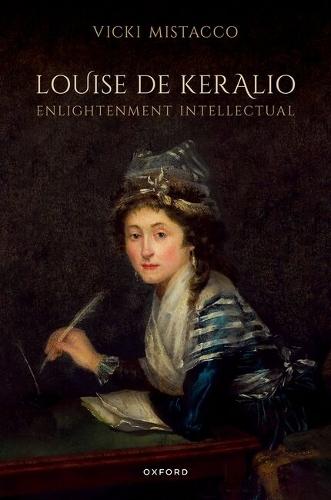
In this first booklength study of prolific polymath Louise de Keralio (1756–1822), Vicki Mistacco offers a comprehensive reading of her entire body of writing and a new understanding of Keralio as an Enlightenment intellectual and a modern feminist thinker. Mistacco adopts a fresh approach to Keralio's published and unpublished writing, undertaking close textual analysis informed by feminist literary criticism and French feminist theory, and carefully reconstructing the historical and cultural context, in order to challenge the critical commonplace that Keralio is a puzzling ""sexist republican."" She cautions against a piecemeal approach focused almost exclusively on Keralio's writings during the French Revolution. Reading literarily rather than literally, she argues against imposing modern definitions of feminist activism on Keralio and for considering instead the anti-patriarchal, anti-hierarchical, and anti-exclusionary paradigm at the core of her thinking, a both/and rather than either/or paradigm, which Keralio comes to envisage as a maternal one, reflected in the recurring motif of crossing boundaries. Through sustained analysis of works that have hitherto received only scant attention, Keralio's translations of John Carr's travelogues and her late novels (1808–1810), Mistacco sheds light on Keralio's use of ""double-voiced discourse"" to uphold her feminist ideals while ostensibly endorsing gender norms. The three parts of the book, ""Women's Writing: Negotiating a Space,"" ""Philosophizing in the Margins,"" and ""The Missing Mother,"" trace the evolution in Keralio's thinking about the importance of including a matrimoine or maternal legacy in cultural patrimony, whether it be the contributions of French women writers to national identity and French genius (Collection des meilleurs ouvrages français composés par des femmes), or those of Queen Elizabeth to the history of European sovereignty (Histoire d'Élisabeth, reine d'Angleterre), or her own annotations to her translations, or in her late novels the testimony of women to arrive at historical truth. Mistacco shows how the idea of maternal legacy evolves into that of maternal Enlightenment, arguing that Keralio elevates the maternal to the level of philosophy and theorizes a new social contract based on an ethics of care. Including unpublished and archival texts, this book offers an important contribution to the history of women intellectuals of the Enlightenment.
Full Product Details
Author: Vicki Mistacco (Professor Emerita of French, Professor Emerita of French, Wellesley College)
Publisher: Oxford University Press
Imprint: Oxford University Press
ISBN: 9780198988311
ISBN 10: 0198988311
Pages: 432
Publication Date: 04 June 2026
Audience:
College/higher education
,
Postgraduate, Research & Scholarly
Format: Hardback
Publisher's Status: Forthcoming
Availability: Not yet available

This item is yet to be released. You can pre-order this item and we will dispatch it to you upon its release.
Author Information
Vicki Mistacco earned a Ph.D. in French from Yale University in 1972. She taught French literature and language at Wellesley College, 1968-2013. She has been Professor Emerita of French, Wellesley College, since retiring in 2013. She has held grants from the National Endowment for the Humanities in support of sabbatical research (1982-1983, 1994), and as Project Director for an International Symposium: Breaking the Sequence: Women, Literature and the Future, at Wellesley College in 1981. In addition to a two-volume anthology of French women writers, Les femmes et la tradition littéraire she has published articles and essays on Gide, Robbe-Grillet, Camus, Mauriac, Marguerite Duras, George Sand, Riccoboni, Félicité de Genlis, Louise d'Alq, Keralio, the ""woman author"" stereotype, and women's literary history.