Overview
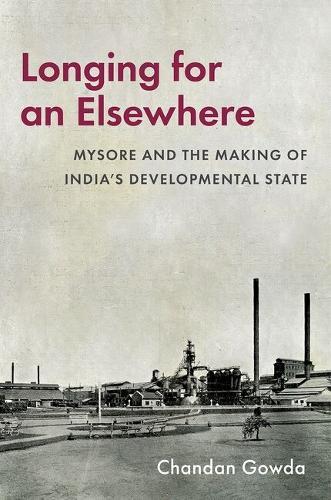
Longing for an Elsewhere is about the colonial ancestry of India's contemporary embrace of economic development. Unlike existing scholarship that traces the emergence of the developmental state to the mid-twentieth century process of decolonization, the book argues that these origins are anchored in the preoccupation of colonized Indian elites with emulating the industrial modernity of Europe and the United States and seeking civilizational recognition for attaining progress. Beyond re-periodizing the birth of development discourse, the book argues that culture actively shapes a putatively economic process such as development. Specifically, it examines the chief cultural factors that guided the ideas and endeavours of the princely state of Mysore for achieving development during its period of British indirect rule (1881-1947). Historians and social scientists have tended to overlook semiautonomous polities in colonial India like Mysore that were neither fully colonized nor independent. The Mysore state elite took advantage of their political semiautonomy afforded by British indirect rule to initiate a range of development schemes. Drawing on underexplored archival evidence, the book shows that the elite adopted a creative amalgam of diverse strands of European thought within a colonized milieu to forge practices of state development in colonial India. Analyzing the institutional dynamics of three elite-led state projects in Mysore, Gowda argues that the state's support for these projects can be explained by a belief in the inevitability of industrial modernity and a claim for recognition of Mysore's capacity for progress. A focus on the operation of this cultural logic allows us to arrive at a cultural theory of the developmental state. Gowda also examines an important episode of dissent against a development scheme in Mysore, underscoring the paramount value of epistemic introspection and democratic deliberation in state planning. Interdisciplinary in nature, the book draws from debates in sociology, history, and anthropology.
Full Product Details
Author: Chandan Gowda (Professor and Dean, Professor and Dean, School of Liberal Arts, Vidyashilp University, Bengaluru)
Publisher: Oxford University Press Inc
Imprint: Oxford University Press Inc
Dimensions:
Width: 16.70cm
, Height: 1.80cm
, Length: 23.60cm
Weight: 0.431kg
ISBN: 9780197836583
ISBN 10: 0197836585
Pages: 184
Publication Date: 30 April 2026
Audience:
College/higher education
,
Postgraduate, Research & Scholarly
Format: Hardback
Publisher's Status: Active
Availability: To order

Stock availability from the supplier is unknown. We will order it for you and ship this item to you once it is received by us.
Author Information
Chandan Gowda is Professor and Dean, School of Liberal Arts, Vidyashilp University, Bengaluru. After completing his PhD at the Department of Sociology at the University of Michigan, Ann Arbor, he took up the position of Associate Professor of Sociology at the National Law School of India, Bengaluru and later served as Professor of Sociology at Azim Premji University, Bengalur, and Ramakrishna Hegde Chair Professor of Decentralization and Development at the Institute for Social and Economic Change, Bengaluru. His areas of research include social theory, cultural and political sociology, Indian intellectual history, and modern Kannada literature and cinema.