Overview
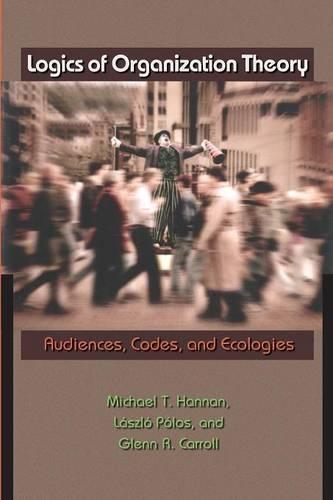
Building theories of organizations is challenging: theories are partial and ""folk"" categories are fuzzy. The commonly used tools--first-order logic and its foundational set theory--are ill-suited for handling these complications. Here, three leading authorities rethink organization theory. Logics of Organization Theory sets forth and applies a new language for theory building based on a nonmonotonic logic and fuzzy set theory. In doing so, not only does it mark a major advance in organizational theory, but it also draws lessons for theory building elsewhere in the social sciences. Organizational research typically analyzes organizations in categories such as ""bank,"" ""hospital,"" or ""university."" These categories have been treated as crisp analytical constructs designed by researchers. But sociologists increasingly view categories as constructed by audiences. This book builds on cognitive psychology and anthropology to develop an audience-based theory of organizational categories. It applies this framework and the new language of theory building to organizational ecology.It reconstructs and integrates four central theory fragments, and in so doing reveals unexpected connections and new insights.
Full Product Details
Author: Michael T. Hannan ,
László Pólos ,
Glenn R. Carroll
Publisher: Princeton University Press
Imprint: Princeton University Press
Dimensions:
Width: 15.20cm
, Height: 2.50cm
, Length: 23.50cm
Weight: 0.567kg
ISBN: 9780691134505
ISBN 10: 0691134502
Pages: 384
Publication Date: 22 July 2007
Audience:
Professional and scholarly
,
College/higher education
,
Professional & Vocational
,
Tertiary & Higher Education
Format: Paperback
Publisher's Status: Active
Availability: Manufactured on demand

We will order this item for you from a manufactured on demand supplier.
Language: English
Reviews
The book will appeal to different audiences, making the book itself an interesting case study for the theory developed in it. The broader message of the book, developing a new set of tools that aid theorizing in sociology and the administrative sciences, will appeal to those interested in social science methodology. But first and foremost, it is of interest to researchers working on organization theory in general and on organizational ecology in particular. It goes substantially beyond earlier formalizations of organizational ecology published in the last decade, with a radical shift in focus toward the whole process of theory building. -- Administrative Science Quarterly Logics of Organizational Theory deserves to be read and discussed by everyone interested in organizations and in the method of developing sociological theory. -- Michele Lamont, American Journal of Sociology
The book will appeal to different audiences, making the book itself an interesting case study for the theory developed in it. The broader message of the book, developing a new set of tools that aid theorizing in sociology and the administrative sciences, will appeal to those interested in social science methodology. But first and foremost, it is of interest to researchers working on organization theory in general and on organizational ecology in particular. It goes substantially beyond earlier formalizations of organizational ecology published in the last decade, with a radical shift in focus toward the whole process of theory building. -- Administrative Science Quarterly Logics of Organizational Theory deserves to be read and discussed by everyone interested in organizations and in the method of developing sociological theory. -- Michele Lamont, American Journal of Sociology
The book will appeal to different audiences, making the book itself an interesting case study for the theory developed in it. The broader message of the book, developing a new set of tools that aid theorizing in sociology and the administrative sciences, will appeal to those interested in social science methodology. But first and foremost, it is of interest to researchers working on organization theory in general and on organizational ecology in particular. It goes substantially beyond earlier formalizations of organizational ecology published in the last decade, with a radical shift in focus toward the whole process of theory building. Administrative Science Quarterly Logics of Organizational Theory deserves to be read and discussed by everyone interested in organizations and in the method of developing sociological theory. -- Michele Lamont American Journal of Sociology
Author Information
Michael T. Hannan is the Stratacom Professor of Management in the Graduate School of Business and professor of sociology at Stanford University. Lszl Plos is professor of organization theory at the Durham Business School in the United Kingdom. Glenn R. Carroll is the Laurence W. Lane Professor of Organizations in the Graduate School of Business and (by courtesy) professor of sociology at Stanford.