Overview
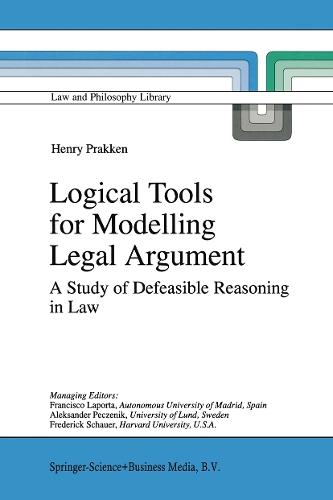
This book, the expanded and completely revised text of the author's renowned 1993 dissertation, studies the logical aspects of legal reasoning, in order to provide philosophical foundations for legal applications of Artificial Intelligence. It respects that legal reasoning often takes place in a disputational setting, and observes that the law leaves ample room for disagreement, which means that lawyers reason under the possibility of exceptions and with contradictory legal sources, and cannot do without non-deductive reasoning forms, such as analogical reasoning. The study shows that, contrary to what is often said, these features do not escape a logical analysis if recent developments in logic and Artificial Intelligence on so-called non-monotonic reasoning and defeasible argumentation are used, and if logic is regarded as a tool in, rather than as, a model of legal argument. This book is relevant for scholars in legal philosophy, artificial intelligence, logic and argumentation theory, and can also serve as a textbook for graduate courses in AI & Law, non-monotonic reasoning and legal argumentation.
Full Product Details
Author: H. Prakken
Publisher: Springer
Imprint: Springer
Edition: Softcover reprint of hardcover 1st ed. 1997
Volume: 32
Dimensions:
Width: 16.00cm
, Height: 1.70cm
, Length: 24.00cm
Weight: 0.522kg
ISBN: 9789048149285
ISBN 10: 9048149282
Pages: 314
Publication Date: 28 October 2010
Audience:
Professional and scholarly
,
Professional & Vocational
Format: Paperback
Publisher's Status: Active
Availability: Out of stock

The supplier is temporarily out of stock of this item. It will be ordered for you on backorder and shipped when it becomes available.
Reviews
`The main contribution of Prakken's work is its organization and expression of non-technical ideas. Prakken successfully makes the best possible case for logic as a tool for modeling legal reasoning. He has written the best, most technically detailed, and fairest survey of the formal work on argument and defeasible reasoning.' Ronald P. Loui, Artificial Intelligence and Law, 3 (1995) `... Prakken has written the best current text with which the interested logician can quickly study the main surviving applicable ideas of non-monotonic reasoning and can glimpse the themes that are shaping current research in defeasible reasoning.' The Journal of Symbolic Logic, 64:4 (1999)
'The main contribution of Prakken's work is its organization and expression of non-technical ideas. Prakken successfully makes the best possible case for logic as a tool for modeling legal reasoning. He has written the best, most technically detailed, and fairest survey of the formal work on argument and defeasible reasoning.' Ronald P. Loui, Artificial Intelligence and Law, 3 (1995) '... Prakken has written the best current text with which the interested logician can quickly study the main surviving applicable ideas of non-monotonic reasoning and can glimpse the themes that are shaping current research in defeasible reasoning.' The Journal of Symbolic Logic, 64:4 (1999)
'The main contribution of Prakken's work is its organization and expression of non-technical ideas. Prakken successfully makes the best possible case for logic as a tool for modeling legal reasoning. He has written the best, most technically detailed, and fairest survey of the formal work on argument and defeasible reasoning.' Ronald P. Loui, Artificial Intelligence and Law, 3 (1995) '... Prakken has written the best current text with which the interested logician can quickly study the main surviving applicable ideas of non-monotonic reasoning and can glimpse the themes that are shaping current research in defeasible reasoning.' The Journal of Symbolic Logic, 64:4 (1999)