Full Product Details
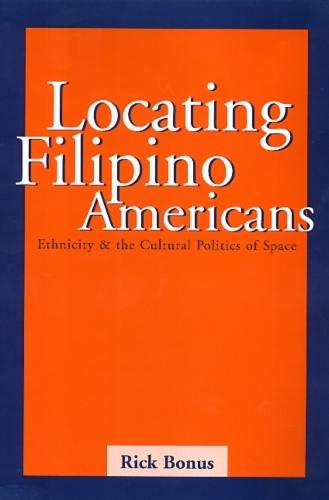
Author: Rick Bonus
Publisher: Temple University Press,U.S.
Imprint: Temple University Press,U.S.
Dimensions:
Width: 15.20cm
, Height: 2.30cm
, Length: 22.90cm
ISBN: 9781566397780
ISBN 10: 1566397782
Pages: 217
Publication Date: 31 August 2000
Audience:
Professional and scholarly
,
Professional & Vocational
Format: Hardback
Publisher's Status: Active
Availability: Temporarily unavailable

The supplier advises that this item is temporarily unavailable. It will be ordered for you and placed on backorder. Once it does come back in stock, we will ship it out to you.
Reviews
Bonus draws on contemporary insights of cultural studies while grounding its tendency toward idealism in a very material sense of power. His subjects are actors, not victims of narratives. He does an effective and sometimes elegant job of capturing their adjustment and resistance to being neither and both Filipino and American. --John Horton, Professor Emeritus of Sociology, UCLA Filipino Americans rank as the second largest Asian-American population in the USA, following Chinese Americans. This book draws from the author's ethnographic studies of Filipino-American communities in Los Angeles and San Diego,California, in the early 1990s. Bonus focuses on commercial establishments such as markets, community centers, and ethnic newspapers as sites where Filipino Americans publicly construct their ethnic identities in relation to the historical and contemporary conditions they face as members of US society. He contends that Filipino-American identity formation reflects two forces: a need to respond to and resist historical and institutional rendering of invisibility, exploitation, silencing and racial constructing, and a desire to claim 'space' within the category 'American' on their own terms. --SAGE Race Relations Abastracts Bonus combines oral interviews, multi-disciplinary theories, history and ethnographic fieldwork and provides sophisticated and through analyses of his findings. What is refreshing is not only the telling Taglish (i.e., a combination of Tagalog and English) responses by interviewees to his questions, but his scholarly commitment to the interviewees of the study. --Pacific Reader
Bonus draws on contemporary insights of cultural studies while grounding its tendency toward idealism in a very material sense of power. His subjects are actors, not victims of narratives. He does an effective and sometimes elegant job of capturing their adjustment and resistance to being neither and both Filipino and American. -John Horton, Professor Emeritus of Sociology, UCLA Filipino Americans rank as the second largest Asian-American population in the USA, following Chinese Americans. This book draws from the author's ethnographic studies of Filipino-American communities in Los Angeles and San Diego,California, in the early 1990s. Bonus focuses on commercial establishments such as markets, community centers, and ethnic newspapers as sites where Filipino Americans publicly construct their ethnic identities in relation to the historical and contemporary conditions they face as members of US society. He contends that Filipino-American identity formation reflects two forces: a need to respond to and resist historical and institutional rendering of invisibility, exploitation, silencing and racial constructing, and a desire to claim 'space' within the category 'American' on their own terms. -SAGE Race Relations Abastracts Bonus combines oral interviews, multi-disciplinary theories, history and ethnographic fieldwork and provides sophisticated and through analyses of his findings. What is refreshing is not only the telling Taglish (i.e., a combination of Tagalog and English) responses by interviewees to his questions, but his scholarly commitment to the interviewees of the study. -Pacific Reader
Author Information
Rick Bonus is an assistant professor of American Ethnic Studies at the University of Washington, Seattle.