Overview
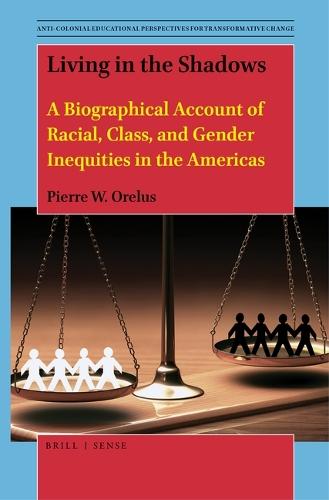
Using auto-ethnography as a methodological framework, this book captures two diametrical poles of the author’s experiences growing up poor and being educated in a colonial school system in a developing country and currently working as a university professor in the United States. The author begins by recollecting his mixed childhood and adolescence experiences, including being subjected to abject poverty, escaping a sexual predator as a teenager, witnessing class, gender, and sexual inequities, while at the same time being supported by family, neighbours, and friends in his community. Next, the author talks about the social class privileges that he has enjoyed as a result of becoming a university professor while juxtaposing such privileges to micro-aggression, systemic racism, xenophobia, linguicism, and elitism that he has been facing in society, including in the Ivy Halls of White America.
Full Product Details
Author: Pierre W. Orelus
Publisher: Brill
Imprint: Brill
Volume: 9
Dimensions:
Width: 15.50cm
, Height: 0.70cm
, Length: 23.50cm
Weight: 0.200kg
ISBN: 9789004430808
ISBN 10: 9004430806
Pages: 124
Publication Date: 10 September 2020
Audience:
Professional and scholarly
,
Professional & Vocational
Format: Paperback
Publisher's Status: Active
Availability: Manufactured on demand

We will order this item for you from a manufactured on demand supplier.
Reviews
Tracing his intellectual development from childhood in Port-au-Prince to adulthood in Massachusetts and thereafter, Pierre Orelus provides an historical account of self that is sure to haunt us. Despite ascending the U.S. class ladder through education, Orelus runs into the fact of race to remind us that the coloniality of whiteness in 'America' places limitations on black intellectuals. In this gripping, reflective narrative, Orelus lets us in to the trauma-inducing experience of striving, while surviving, under white supremacy. It engages the intellect simultaneously with intense emotion, quiet rage, and a sense of hope in the struggle for personhood. At once personal and analytical, Living in the Shadows is critical scholarship in the most meaningful sense of that phrase. - Zeus Leonardo, Professor and Associate Dean, Graduate School of Education and Faculty of the Critical Theory Designated Emphasis, University of California, Berkeley, author of Edward Said and Education Pierre Orelus' book, couched in an autobiographical, reflective idiom, can have a cathartic effect on us. The issues involved make their presence felt in our own life as people located differentially and hopefully as 'persons in process.' - Peter Mayo, PhD, University of Malta (from the Foreword) With uninhibited honesty and detail, Dr. Pierre Orelus takes us through his struggles and consternations. His is a story that is not fearful of contradictions, but is instead one that is willing to push the work forward in a place that was never meant for us. I am humbled by his candor and encouraged by his willingness to challenge notions of 'success' in the hallowed halls of academe. - David Stovall, PhD, University of Illinois at Chicago In a white world that demands that the black body surrender itself to the indignities of racism and de facto segregation, Pierre Orelus is a voice that needs to be urgently heard. - Peter McLaren, PhD, Chapman University (from the Afterword) In this book, Dr. Orelus writes a deeply personal story that addresses some of the childhood trauma as a child growing up in Haiti who immigrated to the United States as a college student. He went to complete a doctorate and became a successful scholar. As he tells his life story, he also elucidates how both oppression and privilege shaped his life experience. His reflection on his own positionality further strengthens his strong critique of the ways in which BIPOC scholars in the academy are treated. His accounts of being racially profiled in multiple contexts in the US - both on and off-campus - give readers incredible insight into what Black scholars experience before they enter the classroom. BIPOC scholars' experiences within the halls of the academy are equally problematic. Dr. Orelus's work is significant because it gives it clear insights into the experiences of Black immigrants in the US while also shedding significant light on what universities must do in order to create more inclusive communities for BIPOC scholars. - Marvin Lynn, PhD, Dean & Professor, College of Education, Portland State University
Tracing his intellectual development from childhood in Port-au-Prince to adulthood in Massachusetts and thereafter, Pierre Orelus provides an historical account of self that is sure to haunt us. Despite ascending the U.S. class ladder through education, Orelus runs into the fact of race to remind us that the coloniality of whiteness in 'America' places limitations on black intellectuals. In this gripping, reflective narrative, Orelus lets us in to the trauma-inducing experience of striving, while surviving, under white supremacy. It engages the intellect simultaneously with intense emotion, quiet rage, and a sense of hope in the struggle for personhood. At once personal and analytical, Living in the Shadows is critical scholarship in the most meaningful sense of that phrase. - Zeus Leonardo, Professor and Associate Dean, Graduate School of Education and Faculty of the Critical Theory Designated Emphasis, University of California, Berkeley, author of Edward Said and Education Pierre Orelus' book, couched in an autobiographical, reflective idiom, can have a cathartic effect on us. The issues involved make their presence felt in our own life as people located differentially and hopefully as 'persons in process.' - Peter Mayo, PhD, University of Malta (from the Foreword) With uninhibited honesty and detail, Dr. Pierre Orelus takes us through his struggles and consternations. His is a story that is not fearful of contradictions, but is instead one that is willing to push the work forward in a place that was never meant for us. I am humbled by his candor and encouraged by his willingness to challenge notions of 'success' in the hallowed halls of academe. - David Stovall, PhD, University of Illinois at Chicago In a white world that demands that the black body surrender itself to the indignities of racism and de facto segregation, Pierre Orelus is a voice that needs to be urgently heard. - Peter McLaren, PhD, Chapman University (from the Afterword) In this book, Dr. Orelus writes a deeply personal story that addresses some of the childhood trauma as a child growing up in Haiti who immigrated to the United States as a college student. He went to complete a doctorate and became a successful scholar. As he tells his life story, he also elucidates how both oppression and privilege shaped his life experience. His reflection on his own positionality further strengthens his strong critique of the ways in which BIPOC scholars in the academy are treated. His accounts of being racially profiled in multiple contexts in the US - both on and off-campus - give readers incredible insight into what Black scholars experience before they enter the classroom. BIPOC scholars' experiences within the halls of the academy are equally problematic. Dr. Orelus's work is significant because it gives it clear insights into the experiences of Black immigrants in the US while also shedding significant light on what universities must do in order to create more inclusive communities for BIPOC scholars. - Marvin Lynn, PhD, Dean & Professor, College of Education, Portland State University
Author Information
Pierre Wilbert Orelus is Associate Professor and Director of the Teaching Foundation program in the Educational Studies and Teacher Preparation Department in the Graduate School of Education at Fairfield University. His research involves intersectional examining of the various ways in which language, race, and gender intersect to influence people’s lives, including student learning and teachers’ teaching practices. His most recent books include Social Justice for the Oppressed: Educators and Intellectuals Speak out (Rowman and Littefield, 2017) and Race, Power, and the Obama Legacy (Routledge, 2015).