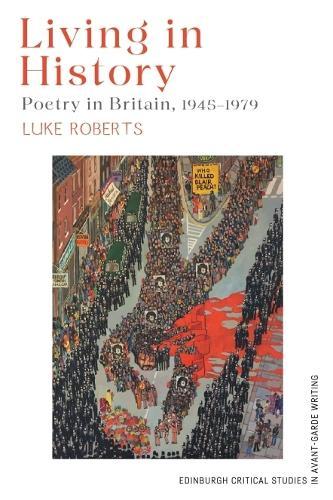
Full Product Details
Author: Luke Roberts (Senior Lecturer in Modern Poetry _x000D_, King’s College London_x000D_)
Publisher: Edinburgh University Press
Imprint: Edinburgh University Press
ISBN: 9781399519861
ISBN 10: 1399519867
Pages: 288
Publication Date: 01 January 2026
Audience:
Professional and scholarly
,
College/higher education
,
Professional & Vocational
,
Postgraduate, Research & Scholarly
Format: Paperback
Publisher's Status: Forthcoming
Availability: Not yet available

This item is yet to be released. You can pre-order this item and we will dispatch it to you upon its release.
Language: English
Reviews
Luke Roberts's Living in History is an important addition to scholarship about British poetry after World War II. Deftly weaving together archival research, personal reflection, and fresh interpretations of poems, Roberts significantly broadens our sense of the relationship between post-war British poetry and the myriad political movements that shaped it. --Chris Nealon, Johns Hopkins University This clear and well-documented study of post-WW II British poetry also provides insights into the politics of this period. [...] This expansive discussion includes various US poets and British poets, including Kamau Brathwaite--a Barbadian poet and academic widely considered one of the major voices in the Caribbean literary canon--and feminist poets. Class, gender, and identity politics are central to his study, as are some major conflicts, such as the Balkans war, the Vietnam War, and more recent events, including the George Floyd uprisings and the protests over the war in Gaza. Social movements like Black Lives Matter are approached with parallel emphasis on literary movements, including the avant-garde. There are also many references to modernist poets such as Yeats, Eliot, Williams, and Pound. Roberts's chosen poets all participate in what he calls ""social antagonism"" against capital and imperialist entities. Summing Up: Recommended. --B. Wallenstein, emeritus, CUNY City College ""CHOICE"" The signal achievement of Living in History is indicated by Roberts's subtitle: this is a study of Poetry in Britain, rather than British poetry, a demarcation that provides the book's guiding anti-state critique of colonial heritage, racist border policy, sexist and homophobic legislation, and carceral capitalism. It is a compelling organizational strategy that ensures Roberts's narrative flows with a freshness rarely afforded to the academic discussion of poetry. [...] Living in History is welcome not only in terms of its scholarly achievement, but in terms of its commitment to the 'inexhaustible and intractable demands' made by the poetry it cares about.--Joe Luna, University of Sussex ""The Review of English Studies""
Luke Roberts’s Living in History is an important addition to scholarship about British poetry after World War II. Deftly weaving together archival research, personal reflection, and fresh interpretations of poems, Roberts significantly broadens our sense of the relationship between post-war British poetry and the myriad political movements that shaped it. -- Chris Nealon, Johns Hopkins University This clear and well-documented study of post-WW II British poetry also provides insights into the politics of this period. [...] This expansive discussion includes various US poets and British poets, including Kamau Brathwaite—a Barbadian poet and academic widely considered one of the major voices in the Caribbean literary canon—and feminist poets. Class, gender, and identity politics are central to his study, as are some major conflicts, such as the Balkans war, the Vietnam War, and more recent events, including the George Floyd uprisings and the protests over the war in Gaza. Social movements like Black Lives Matter are approached with parallel emphasis on literary movements, including the avant-garde. There are also many references to modernist poets such as Yeats, Eliot, Williams, and Pound. Roberts’s chosen poets all participate in what he calls “social antagonism” against capital and imperialist entities. Summing Up: Recommended. -- B. Wallenstein, emeritus, CUNY City College * CHOICE * The signal achievement of Living in History is indicated by Roberts’s subtitle: this is a study of Poetry in Britain, rather than British poetry, a demarcation that provides the book’s guiding anti-state critique of colonial heritage, racist border policy, sexist and homophobic legislation, and carceral capitalism. It is a compelling organizational strategy that ensures Roberts’s narrative flows with a freshness rarely afforded to the academic discussion of poetry. [...] Living in History is welcome not only in terms of its scholarly achievement, but in terms of its commitment to the ‘inexhaustible and intractable demands’ made by the poetry it cares about. -- Joe Luna, University of Sussex * The Review of English Studies *
Author Information
Luke Roberts is Senior Lecturer in Modern Poetry at King’s College London. He is the author of Barry MacSweeney and the Politics of Post-War British Poetry: Seditious Things (2017), which was nominated for the University English first book prize. His writing has appeared in ELH, Textual Practice, The Journal of British and Irish Innovative Poetry, and elsewhere.He is co-editor, with Sam Ladkin, of the work of Mark Hyatt, including So Much For Life: Selected Poems (2023), and the novel Love, Leda (2023). He also edited Barry MacSweeney, Desire Lines: Unselected Poems: 1966–2000 (2018), and was co-editor of Certain Prose of the English Intelligencer (2014).His books of poetry include Home Radio (2021), and his poems have been published in Chicago Review, Ludd Gang, Cambridge Literary Review and many other little magazines. With Amy Tobin he edits the small press Distance No Object.