Overview
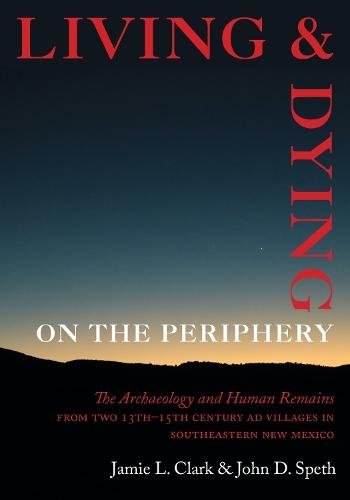
When one thinks about southwestern archaeology, multistoried villages and cliff-dwellings generally come to mind. But on the eastern periphery of the Southwest, where mesas and mountains give way to vast grasslands, other types of villages once thrived. In this volume, archaeologists Jamie Clark and John Speth document the lives and lifeways of the people who inhabited two of these villages—Henderson and Bloom Mound. The villagers hunted bison on the plains and exchanged meat and hides with Puebloan peoples for pottery, turquoise, marine shells, and other goods. The origins of these close social and economic ties between bison hunters and village farmers, often referred to as “Plains-Pueblo interaction,” have intrigued anthropologists for generations. The excavations at Henderson and Bloom Mound provide fascinating new insights into when, how, and why these relationships came about. Summarizing results from eight seasons of research, Clark and Speth document human burials and associated grave offerings from the two sites. In so doing, they discuss evidence for pathologies and trauma, raising questions about the nature and causes of violence that led not only to the demise of Henderson and Bloom Mound, but also to the abandonment of many other farming-hunting communities in the surrounding region.
Full Product Details
Author: Jamie L. Clark ,
John D. Speth
Publisher: University of Utah Press,U.S.
Imprint: University of Utah Press,U.S.
Dimensions:
Width: 18.00cm
, Height: 2.70cm
, Length: 25.60cm
Weight: 0.430kg
ISBN: 9781647690533
ISBN 10: 1647690536
Pages: 370
Publication Date: 30 September 2022
Audience:
Professional and scholarly
,
Professional & Vocational
Format: Hardback
Publisher's Status: Active
Availability: Out of stock

The supplier is temporarily out of stock of this item. It will be ordered for you on backorder and shipped when it becomes available.
Reviews
"""This is a severely understudied region that has a fascinating but enigmatic place in the prehistory of the southwestern US/northwestern Mexico. Clark and Speth provide an intriguing synthesis of the current state of knowledge, stitching together more than two decades of excavation to place both sites into local and regional context. The synthesis is thoughtful, original, and provocative."" -- Thomas R. Rocek, professor of anthropology, University of Delaware"
This is a severely understudied region that has a fascinating but enigmatic place in the prehistory of the southwestern US/northwestern Mexico. Clark and Speth provide an intriguing synthesis of the current state of knowledge, stitching together more than two decades of excavation to place both sites into local and regional context. The synthesis is thoughtful, original, and provocative. -- Thomas R. Rocek, professor of anthropology, University of Delaware
Author Information
Jamie L. Clark is assistant professor of anthropology in the Department of Sociology and Anthropology at George Mason University. She is coeditor (with John D. Speth) of Zooarchaeology and Modern Human Origins: Human Hunting Behavior During the Later Pleistocene. John D. Speth is Arthur F. Thurnau Professor emeritus of Anthropology in the Department of Anthropology at the University of Michigan. His books include Zooarchaeology and Modern Human Origins: Human Hunting Behavior During the Later Pleistocene (coedited with Jamie L. Clark); The Paleoanthropology and Archaeology of Big-Game Hunting: Protein, Fat, or Politics?; and Human Paleoecology in the Levantine Corridor (coedited with Naama Goren-Inbar).