|
|
|||
|
||||
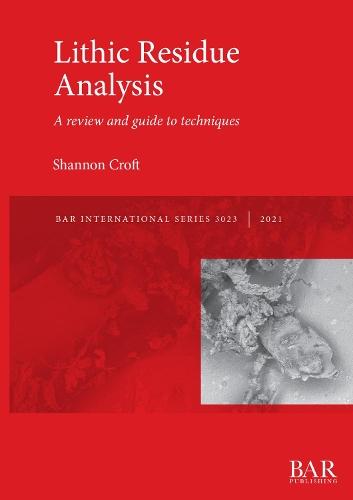
OverviewArchaeological lithic residue analysis investigates the microscopic and chemical traces left behind by people on stone tools. These lithic residues provide detailed and compelling evidence of specific food and technological activities, and tool manufacturing choices. Interest in the study of lithic residues has grown substantially in the past decade, reflected by an increasing number of publications and a proliferation of techniques applied to their study. This monograph offers a recent and critical review of these technical advances to help archaeologists determine best practice today. The book focuses on the development of appropriate methods for improving the identification and interpretation of residues on stone tools. Over 40 techniques are reviewed, including transmitted and reflected visible light microscopy (VLM), scanning electron microscopy-energy dispersive X-ray spectroscopy (SEM-EDS), Raman microspectroscopy, gas chromatography-mass spectrometry (GC-MS), and Fourier transform infrared microspectroscopy (FTIRM). Full Product DetailsAuthor: Shannon CroftPublisher: BAR Publishing Imprint: BAR Publishing Weight: 0.475kg ISBN: 9781407358024ISBN 10: 1407358022 Pages: 119 Publication Date: 09 April 2021 Audience: Professional and scholarly , Professional & Vocational Format: Paperback Publisher's Status: Active Availability: Available To Order We have confirmation that this item is in stock with the supplier. It will be ordered in for you and dispatched immediately. Table of ContentsList of Figures List of Tables List of Abbreviations 1. Introduction 1.1. Why review lithic residue analysis? 1.2. Who is this monograph for? 1.3. What types of archaeological residues can be found on stone tools? 1.4. Brief history 2. Current Issues in Lithic Residue Analysis 2.1. Formation mechanisms 2.2. Preservation mechanisms 2.3. Identification 2.4. Contamination 3. Visual Microscopy Techniques 3.1. Microscopy: in situ 3.1.1. Reflected visible light microscopy (VLM) 3.1.2. Laser scanning confocal microscopy (LSCM) 3.1.3. Scanning electron microscopy (SEM) 3.1.4. Combined microscopic approaches 3.2. Microscopy: extraction 3.2.1. Transmitted visible light microscopy 3.2.2. Stains 3.2.2.1. Iodine potassium iodide 3.2.2.2. Phloroglucinol 3.2.2.3. Safranin 3.2.2.4. Congo red 3.2.2.5. Picrosirius red (PSR) 3.2.2.6. Trypan blue 3.2.2.7. Rhodamine B 3.2.2.8. Eosin 3.2.2.9. Sudan III 3.2.2.10. Sudan IV 3.2.2.11. Orange G 3.2.2.12. Toluidine blue 3.2.2.13. Methylene blue 3.2.2.14. Wright's stain 3.2.3. Presumptive tests 3.2.3.1. Haemoglobin (Hb) crystallisation 3.2.3.2. Dot blot test 3.2.3.3. Urinalysis test strips 3.2.3.4. Luminol 4. Chemical Characterisation Techniques 4.1. Chemical characterisation: elemental analysis techniques 4.1.1. Scanning electron microscopy-energy dispersive X-ray spectroscopy (SEM-EDS) 4.1.2. Rutherford backscattering spectrometry (RBS) 4.1.3. Particle-induced X-ray emission spectroscopy (PIXE) 4.1.4. X-ray fluorescence spectroscopy (XRF) 4.1.5. Energy dispersive X-ray fluorescence spectroscopy (EDXRF) 4.1.6. Microscopic X-ray diffraction spectroscopy coupled with microscopic X-ray fluorescence spectroscopy (µ-XRD-µ-XRF) 4.1.7. Inductively coupled plasma atomic emission spectroscopy (ICP-AES) 4.1.8. Laser ablation inductively coupled plasma mass spectrometry (LA-ICP-MS) 4.2. Chemical characterisation: molecular analysis techniques 4.2.1. Light-based spectroscopy techniques 4.2.1.1. Fourier transform infrared spectroscopy (FTIR) 4.2.1.2. Fourier transform infrared microspectroscopy (FTIRM) 4.2.1.3. Raman spectroscopy 4.2.2. Chromatographic separation-based techniques 4.2.3. Mass spectrometry-based techniques 4.2.3.1. Gas chromatography-mass spectrometry (GC-MS) 4.2.3.2. Other mass spectrometry-based techniques 4.2.4. DNA techniques 4.3. Chemical characterisation: crystal structure 4.3.1. X-ray diffraction spectroscopy (XRD) 4.4. Chemical characterisation: immunological techniques for proteins 4.4.1. Crossover immunoelectrophoresis (CIEP) 4.4.2. Enzyme linked immunosorbent assay (ELISA) 4.4.3. Radioimmunoassay (RIA) 4.4.4. Concerns and limitations of immunological methods 4.4.5. Future work on ancient proteins 4.5. Chemical characterisation: summary 5. Methodological Critique and Possible Solutions 5.1. Improving the impact of lithic residue studies 5.2. Sampling 5.3. Use of artefacts from insecure contexts 5.4. Collection of sediment samples for comparison 5.5. Storage 5.6. In situ versus extractive approach 5.7. Cleaning 5.8. Residue distribution mapping 5.9. Problems with microscopic identification of residues by analogy 5.10. Presentation of visual results 5.11. Best practice guide for lithic residue analysis 5.11.1. Essential planning 5.11.2. Excavation 5.11.3. Sample selection 5.11.4. Storage 5.11.5. Prior to analysis 5.11.5.1. Test consumables and lab spaces 5.11.5.2. Artefact photography 5.11.5.3. Artefact cleaning (or not) 5.11.6. Analysis 5.11.6.1. Visual examination of in situ residues 5.11.6.2. Chemical characterisation 5.11.6.3. Experimental controls 6. Conclusion Appendix ReferencesReviews{\rtf1\ansi\ansicpg1252\deff0\deflang2057{\fonttbl{\f0\fswiss\fprq2\fcharset0 Calibri;}{\f1\fnil\fcharset0 Calibri;}{\f2\fnil\fcharset0 Verdana;}} \viewkind4\uc1\pard\f0\fs22\lquote\f1 This book will be very useful for those new learners who want to understand residue techniques as well as lithic analysts looking to find new options for stone tools studies. Asian scholars will be interested in this new field of lithic study.\f0\rquote\f1 \par \i Dr Hong Chen, Zhejiang University\i0\par \f2\fs17\par } 'This book will be very useful for those new learners who want to understand residue techniques as well as lithic analysts looking to find new options for stone tools studies.' Dr Hong Chen, Zhejiang University 'This book will be very useful for those new learners who want to understand residue techniques as well as lithic analysts looking to find new options for stone tools studies.' Dr Hong Chen, Zhejiang University Author InformationShannon Croft is an archaeology curator and laboratory supervisor working in cultural resource management in Vancouver, Canada. She has investigated methods to reliably identify microscopic and chemical trace residues on stone tools at archaeological sites in the United Kingdom and Canada. Tab Content 6Author Website:Countries AvailableAll regions |
||||