Overview
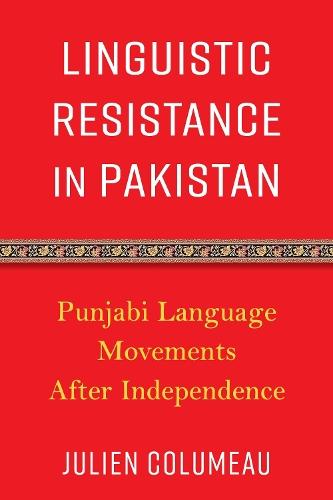
Soon after independence in 1947, the Pakistani government adopted a language policy that promoted the use of Urdu. This provoked a strong reaction in provinces where languages such as Bengali, Sindhi, Punjabi, Pashto, and Balochi were spoken by the majority, giving rise to movements that sought to protect them. In Punjab, provincial authorities decreed that Urdu would be the sole language of administration and education. In response, intellectuals launched three separate movements between 1947 and 1960 for the defense and promotion of Punjabi, divided along the lines of their political and literary affiliations: Marxists, conservatives, and modernists. Linguistic Resistance in Pakistan examines these three movements, taking an interdisciplinary perspective that combines sociological, historical, political, and literary approaches. Drawing on previously unexplored archival sources in Punjabi and Urdu as well as interviews conducted with activists and intellectuals, Julien Columeau analyzes the trajectories of the movements and key figures within them. He explores the context in which language movements emerged, considering the status of Punjabi before and after independence, the policy of Urdu imposition led by the central and provincial authorities, and the postindependence intellectual landscape. Columeau traces the history of the three Punjabi language movements, assessing their influence and the factors leading to success or failure. Shedding new light on the politics of language in Pakistan, this book is an important contribution to South Asian intellectual history.
Full Product Details
Author: Julien Columeau
Publisher: Columbia University Press
Imprint: Columbia University Press
ISBN: 9780231219815
ISBN 10: 0231219814
Pages: 288
Publication Date: 31 March 2026
Audience:
Professional and scholarly
,
Professional & Vocational
Format: Hardback
Publisher's Status: Forthcoming
Availability: Awaiting stock

Reviews
Detailing a history that has been largely unexamined in the literature, Columeau shows us the complexity of the various movements that emerged in support of Punjabi in Pakistan in the two decades after Partition/Independence, providing a rich account not only of key figures in these movements, but a detailed account of the writings, ideologies, and activities associated with them. -- Anne Murphy, coeditor of <i>Bhai Vir Singh (1872–1957): Religious and Literary Modernities in Colonial and Post-Colonial Indian Punjab</i> Columeau’s groundbreaking book fills a gap in the study of South Asian languages and literatures. He brilliantly demonstrates how Punjabi ceased to be a marginal language in Pakistan, although Urdu remained dominant. Reckoning the lasting impact of the communalization of Punjabi society during the colonial period, Columeau unravels “the spirit of Linguistic Resistance” that scholars of Punjabi language and literature have largely underscored. -- Michel Boivin, author of <i>Devotion, Religious Authority and Social Structures in Sindh: Khojas, Vaniyos and Faqirs</i>
Columeau’s groundbreaking book fills a gap in the study of South Asian languages and literatures. He brilliantly demonstrates how Punjabi ceased to be a marginal language in Pakistan, although Urdu remained dominant. Reckoning with the lasting impact of the communalization of Punjabi society during the colonial period, Columeau unravels the ""spirit of linguistic resistance"" that scholars of Punjabi language and literature have largely neglected. -- Michel Boivin, author of <i>Devotion, Religious Authority and Social Structures in Sindh: Khojas, Vaniyos and Faqirs</i> Detailing a history that has been largely unexamined in the literature, Columeau shows us the complexity of the various movements that emerged in support of Punjabi in Pakistan in the two decades after Partition/Independence, providing a rich account not only of key figures in these movements but also of the writings, ideologies, and activities associated with them. -- Anne Murphy, University of British Columbia
Detailing a history that has been largely unexamined in the literature, Columeau shows us the complexity of the various movements that emerged in support of Punjabi in Pakistan in the two decades after Partition/Independence, providing a rich account not only of key figures in these movements, but a detailed account of the writings, ideologies, and activities associated with them. -- Anne Murphy, University of British Columbia Columeau’s groundbreaking book fills a gap in the study of South Asian languages and literatures. He brilliantly demonstrates how Punjabi ceased to be a marginal language in Pakistan, although Urdu remained dominant. Reckoning the lasting impact of the communalization of Punjabi society during the colonial period, Columeau unravels “the spirit of Linguistic Resistance” that scholars of Punjabi language and literature have largely underscored. -- Michel Boivin, author of <i>Devotion, Religious Authority and Social Structures in Sindh: Khojas, Vaniyos and Faqirs</i>
Author Information
Julien Columeau holds a PhD in history from the École des hautes études en sciences sociales (EHESS) and is currently affiliated with the Centre d’études sud-asiatiques et himalayennes (CESAH). He has published five books of fiction in Urdu, and his short story “Derrida in Lahore” received the Susannah Hunnewell Prize from the Paris Review.