Overview
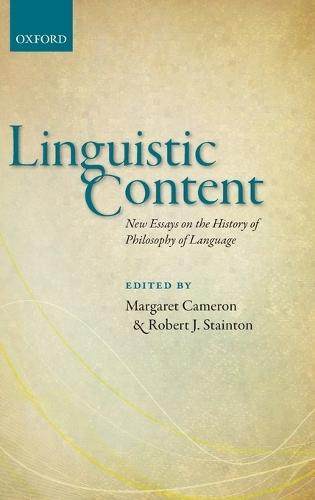
Philosophy of language has a rich and varied history stretching back to the Ancient Greeks. Twelve specially written essays explore this richness, from Plato and Aristotle, through the Stoics, to medieval thinkers, both Islamic and Christian; from the Renaissance and the early modern period, all the way up to the twentieth Century. Among the many topics that arise across this 2500-year trajectory are metaphysical questions about linguistic content. A first focal point of the volume is the issue of which broad ontological family linguistic contents belong to. Are linguistic contents mental ideas, physical particulars, abstract Forms, social practices, or something else again? And do different sorts of linguistic contents belong to different ontological categories-e.g., might it be that names stand for ideas, whereas logical terms stand for mental processes? The second focal point is the metaphysical grounding of linguistic content: that is, in virtue of what more basic facts do content facts obtain? Do words mean what they do because of natural resemblances? Because of causal relations? Because of arbitrary conventional usage? Or because of some combination of the above?
Full Product Details
Author: Margaret Cameron (University of Victoria) ,
Robert J. Stainton (University of Western Ontario)
Publisher: Oxford University Press
Imprint: Oxford University Press
Dimensions:
Width: 16.20cm
, Height: 2.30cm
, Length: 24.00cm
Weight: 0.582kg
ISBN: 9780198732495
ISBN 10: 019873249
Pages: 282
Publication Date: 19 March 2015
Audience:
College/higher education
,
Professional and scholarly
,
Tertiary & Higher Education
,
Professional & Vocational
Format: Hardback
Publisher's Status: Active
Availability: Manufactured on demand

We will order this item for you from a manufactured on demand supplier.
Reviews
Fascinating collection * Max Rabie, Australasian Journal of Philosophy. * I recommend this volume and hope that it will spur further research into what has been, until very recently, the invisible history of the philosophy language. * Walter Ott, Notre Dame Philosophical Reviews Online *
I recommend this volume and hope that it will spur further research into what has been, until very recently, the invisible history of the philosophy language. Walter Ott, Notre Dame Philosophical Reviews Online
Author Information
Margaret Cameron completed her PhD in the Collaborative Program in Ancient and Medieval Philosophy at the University of Toronto in 2005. She is currently Associate Professor and Canada Research Chair in the Aristotelian Tradition at the University of Victoria. Robert Stainton first studied Philosophy and Linguistics as an undergraduate in his home town of Toronto, at Glendon College, part of York University. He completed the Ph.D. at MIT in 1993, and took up his first academic job at Carleton University in Ottawa, where he was Canada Research Chair in Cognitive Science. Presently he is Distinguished University Professor in the Department of Philosophy at the University of Western Ontario in London.