Overview
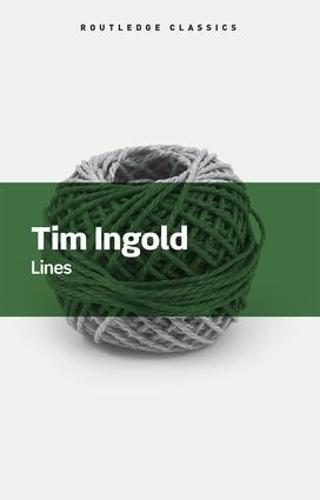
What do walking, weaving, observing, storytelling, singing, drawing and writing have in common? The answer is that they all proceed along lines. In this extraordinary book Tim Ingold imagines a world in which everyone and everything consists of interwoven or interconnected lines and lays the foundations for a completely new discipline: the anthropological archaeology of the line. Ingold’s argument leads us through the music of Ancient Greece and contemporary Japan, Siberian labyrinths and Roman roads, Chinese calligraphy and the printed alphabet, weaving a path between antiquity and the present. Drawing on a multitude of disciplines including archaeology, classical studies, art history, linguistics, psychology, musicology, philosophy and many others, and including more than seventy illustrations, this book takes us on an exhilarating intellectual journey that will change the way we look at the world and how we go about in it. This Routledge Classics edition includes a new preface by the author.
Full Product Details
Author: Tim Ingold (University of Aberdeen, UK)
Publisher: Taylor & Francis Ltd
Imprint: Routledge
Weight: 0.280kg
ISBN: 9781138640399
ISBN 10: 1138640395
Pages: 190
Publication Date: 11 April 2016
Audience:
College/higher education
,
Tertiary & Higher Education
,
Undergraduate
Format: Paperback
Publisher's Status: Active
Availability: In Print

This item will be ordered in for you from one of our suppliers. Upon receipt, we will promptly dispatch it out to you. For in store availability, please contact us.
Reviews
‘Ingold’s eventual incorporation of anthropological examples from eastern Peru is really where we begin to see a master at work – Ingold intimately understands the data and interpretation flows in an engaging way … this is a vibrant read – at times when reading I shouted aloud, ‘Yes spot on!’ at other times I paced the room and exclaimed in frustration ‘No!’. That Ingold’s writing can produce such dramatic effects is a testament to the quality of his argument. Do I recommend reading this book? Definitely.’ Cambridge Archaeological Journal 'The author's ambition, to take a virgin piece of interdisciplinary territory and ""write on it a bit"", has been fascinatingly achieved.' Steven Poole, The Guardian ""As alluded to in the quote on the book's cover, it is difficult to see the world the same way after reading this book. And that may be the larger meaning to take away: as Ingold (Univ. of Aberdeen) shows, earlier conceptions of speech and writing were intimately interconnected with movement, and as wayfarers journey through the world, neither they nor the book's reader are the same as when they started… Highly recommended."" M. Ebert, CHOICE, April 2008 Vol. 45
`Ingold's eventual incorporation of anthropological examples from eastern Peru is really where we begin to see a master at work - Ingold intimately understands the data and interpretation flows in an engaging way ... this is a vibrant read - at times when reading I shouted aloud, `Yes spot on!' at other times I paced the room and exclaimed in frustration `No!'. That Ingold's writing can produce such dramatic effects is a testament to the quality of his argument. Do I recommend reading this book? Definitely.' Cambridge Archaeological Journal 'The author's ambition, to take a virgin piece of interdisciplinary territory and write on it a bit , has been fascinatingly achieved.' Steven Poole, The Guardian As alluded to in the quote on the book's cover, it is difficult to see the world the same way after reading this book. And that may be the larger meaning to take away: as Ingold (Univ. of Aberdeen) shows, earlier conceptions of speech and writing were intimately interconnected with movement, and as wayfarers journey through the world, neither they nor the book's reader are the same as when they started... Highly recommended. M. Ebert, CHOICE, April 2008 Vol. 45
'Ingold's eventual incorporation of anthropological examples from eastern Peru is really where we begin to see a master at work - Ingold intimately understands the data and interpretation flows in an engaging way ... this is a vibrant read - at times when reading I shouted aloud, 'Yes spot on!' at other times I paced the room and exclaimed in frustration 'No!'. That Ingold's writing can produce such dramatic effects is a testament to the quality of his argument. Do I recommend reading this book? Definitely.' Cambridge Archaeological Journal 'The author's ambition, to take a virgin piece of interdisciplinary territory and write on it a bit , has been fascinatingly achieved.' Steven Poole, The Guardian As alluded to in the quote on the book's cover, it is difficult to see the world the same way after reading this book. And that may be the larger meaning to take away: as Ingold (Univ. of Aberdeen) shows, earlier conceptions of speech and writing were intimately interconnected with movement, and as wayfarers journey through the world, neither they nor the book's reader are the same as when they started... Highly recommended. M. Ebert, CHOICE, April 2008 Vol. 45
Author Information
Tim Ingold is Professor of Social Anthropology at the University of Aberdeen, UK.