|
|
|||
|
||||
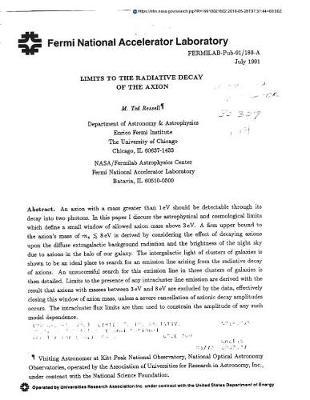
OverviewAn axion with a mass greater than 1 eV should be detectable through its decay into two photons. The astrophysical and cosmological limits which define a small window of allowed axion mass above 3 eV are discussed. A firm upper bound to the axion's mass of M(sub a) less than or equal to 8 eV is derived by considering the effect of decaying axions upon the diffuse extragalactic background radiation and the brightness of the night sky due to axions in the halo of the Milky Way galaxy. The intergalactic light of clusters of galaxies is shown to be an ideal place to search for an emission line arising from the radiative decay of axions. An unsuccessful search for this emission line in three clusters of galaxies is then detailed. Limits to the presence of any intracluster line emission are derived with the result that axions with masses between 3 and 8 eV are excluded by the data, effectively closing this window of axion mass, unless a severe cancellation of axionic decay amplitudes occurs. The intracluster flux limits are then used to constrain the amplitude of any such model dependence. Ressell, M. Ted Unspecified Center NAGW-1340... Full Product DetailsAuthor: National Aeronaut Administration (Nasa)Publisher: Createspace Independent Publishing Platform Imprint: Createspace Independent Publishing Platform Dimensions: Width: 21.60cm , Height: 0.30cm , Length: 27.90cm Weight: 0.132kg ISBN: 9781722340490ISBN 10: 1722340495 Pages: 46 Publication Date: 05 July 2018 Audience: General/trade , General Format: Paperback Publisher's Status: Active Availability: Available To Order We have confirmation that this item is in stock with the supplier. It will be ordered in for you and dispatched immediately. Table of ContentsReviewsAuthor InformationTab Content 6Author Website:Countries AvailableAll regions |
||||