Awards
- Capitol Choices: Noteworthy Books for Children
- Children's Book Committee at Bank Street College Best Children's Book of the Year
- Cooperative Children's Book Center (CCBC) Choices
- New York Public Library Best Books for Kids
Overview
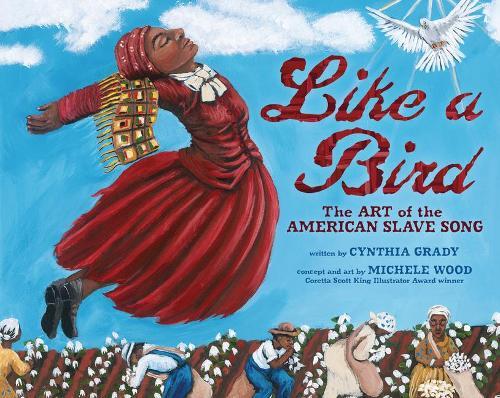
Enslaved African Americans longed for freedom, and that longing took many forms—including music. Drawing on biblical imagery, slave songs both expressed the sorrow of life in bondage and offered a rallying cry for the spirit. Like a Bird brings together text, music, and illustrations by Coretta Scott King Award–winning illustrator Michele Wood to convey the rich meaning behind thirteen of these powerful songs.
Full Product Details
Author: Cynthia Grady ,
Michele Wood
Publisher: Lerner Publishing Group
Imprint: Lerner Publishing Group
Dimensions:
Width: 27.00cm
, Height: 0.30cm
, Length: 21.60cm
Weight: 0.181kg
ISBN: 9781728466989
ISBN 10: 1728466989
Pages: 40
Publication Date: 01 January 2022
Recommended Age: From 9 to 10 years
Audience:
Children/juvenile
,
Primary & secondary/elementary & high school
,
Children / Juvenile
,
Educational: Primary & Secondary
Format: Paperback
Publisher's Status: Active
Availability: Available To Order

We have confirmation that this item is in stock with the supplier. It will be ordered in for you and dispatched immediately.
Reviews
""This is an excellent resource for music and art teachers as well as for social studies and U.S. history lessons.""—starred, School Library Journal ""Beautiful illustrations and short, informative paragraphs come together. . . . While excellent for music classes, the wealth of historical context makes this a good pick for lessons on the history of U.S. slavery as well.""—Booklist ""An important work that gives new life to old and important songs.""—Kirkus Reviews
Beautiful illustrations and short, informative paragraphs come together to tell the history of songs that became American slave songs. The book opens by introducing readers to slave songs and describing how they transformed into spirituals. Thirteen spirituals are featured here, and the descriptions, which include historical, biographical, and biblical context, are all accompanied by evocative paintings. Each paragraph invites readers to notice themes in the paintings that are repeated in the lyrics and raises questions to encourage critical engagement with the text. Wood's gorgeous paintings are full of saturated colors and evocative imagery--such as luminous blue water resembling stained glass--that tie together the concepts at hand. Sheet music and lyrics are included for each tune, and the back matter contains more lyrics, a comprehensive glossary, and lots of suggestions for further reading. A brief note explains that although slaves sang these songs, that does not mean that they felt happy. While excellent for music classes, the wealth of historical context makes this a good pick for lessons on the history of U.S. slavery as well.--Booklist -- Journal (7/1/2016 12:00:00 AM) 'Slaves sing most when they are most unhappy. The songs of the slave represent the sorrows of his heart.' These words by Frederick Douglass are offered in an endnote to provide context for the 13 spirituals included in this volume. Readers will learn how the book began, with Wood's acrylic paintings inspired by the songs; the author then studied the paintings and researched the songs before writing the text. Each spread features a painting on the recto and one or two paragraphs of text along with the music and verses on the verso. There is also a full-spread painting of a group of slaves riding a metaphorical railroad conducted by Harriet Tubman preceding the spread for the song 'Get on Board--the Gospel Train, ' which also includes an archival photo of Tubman. Some of the songs will be familiar, such as 'Michael, Row the Boat Ashore' and 'Swing Low, Sweet Chariot, ' while others, like 'Ain't Gonna Study War No More, ' 'Go Down, Moses, ' and 'Nobody Knows the Trouble I've Seen, ' will resonate with older readers. The vibrant paintings often incorporate quilting motifs and historical events. Original lyrics are featured in the back matter. An archival photo of the Jubilee Singers of Fisk University in Nashville, TN, who popularized the spiritual as a musical form in the 1870s, appears in the introduction. VERDICT: This is an excellent resource for music and art teachers as well as for social studies and U.S. history lessons.--starred, School Library Journal -- Journal (9/1/2016 12:00:00 AM) When children see Harriet Tubman on the new U.S. postage stamp, they can learn of her legacy from this literary homage to 'the Moses of her people.' A compilation of 13 Negro spirituals that originated in American slavery, this volume offers sheet music for each song alongside a brief commentary about its biblical and/or historical origins. Wood accompanies each song with colorful images that echo the slave past and both identify some of the hardships faced and also point to rays of hope that existed for them. In several of these commentaries, Grady asks readers questions to encourage them to explore the images more closely or to think more deeply about what it might have meant to be enslaved. On nearly every page appears a white dove, which echoes Harriet Tubman's dreams of flying 'over the landscape 'like a bird' ' to freedom. Unlike the portrayal of slaves in a few recent controversial picture books, the slaves depicted here rarely smile and often look distraught and somber--except on the page accompanying the final freedom song. In addition to learning about Tubman, readers will glean important historical tidbits about others such as Nat Turner, James Lafayette, abolitionist John Rankin, and Abraham Lincoln. Backmatter offers further reading suggestions, a glossary of relevant terms, and websites. An important work that gives new life to old and important songs.--Kirkus Reviews -- Journal (7/1/2016 12:00:00 AM)
Author Information
Cynthia Grady is an author as well as a former middle school librarian and teacher. She lives in New Mexico where she plays music for her two rabbits, Finoa and Banjo. Visit her at www.cynthiagrady.com. Michele Wood is an illustrator, painter, and designer living in Indianapolis. Her first book, Going Back Home, was honored with an American Book Award. Wood’s second book, I See the Rhythm, written by Toyomi Igus, received the Coretta Scott King Award for Illustration. After illustrating Cynthia Grady's I Lay My Stitches Down, Wood was honored with the Ashley Bryan Award for Illustration and in 2016, she was nominated for an NAACP Image Award for the book Chasing Freedom. Her most recent work, BOX: Henry Brown Mails Himself to Freedom, won a Newbery Honor. Wood's work continues to be exhibited in major art spaces across the country.