Overview
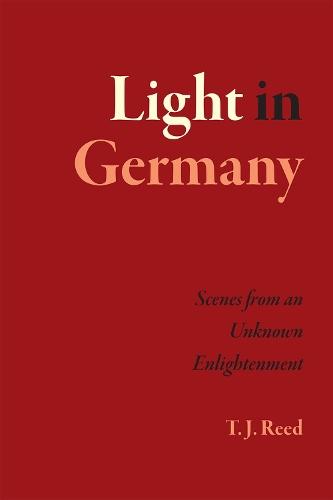
Germany’s political and cultural past from ancient times through World War II has dimmed the legacy of its Enlightenment, which these days is far outshone by those of France and Scotland. In this book, T. J. Reed clears the dust away from eighteenth-century Germany, bringing the likes of Kant, Goethe, Friedrich Schiller, and Gotthold Lessing into a coherent and focused beam that shines within European intellectual history and reasserts the important role of Germany’s Enlightenment. Reed looks closely at the arguments, achievements, conflicts, and controversies of these major thinkers and how their development of a lucid and active liberal thinking matured in the late eighteenth century into an imaginative branching that ran through philosophy, theology, literature, historiography, science, and politics. He traces the various pathways of their thought and how one engendered another, from the principle of thinking for oneself to the development of a critical epistemology; from literature’s assessment of the past to the formulation of a poetic ideal of human development. Ultimately, Reed shows how the ideas of the German Enlightenment have proven their value in modern secular democracies and are still of great relevance—despite their frequent dismissal—to us in the twenty-first century.
Full Product Details
Author: T. J. Reed
Publisher: The University of Chicago Press
Imprint: University of Chicago Press
Dimensions:
Width: 1.70cm
, Height: 0.20cm
, Length: 2.30cm
Weight: 0.454kg
ISBN: 9780226421834
ISBN 10: 022642183
Pages: 304
Publication Date: 28 July 2016
Audience:
College/higher education
,
Postgraduate, Research & Scholarly
Format: Paperback
Publisher's Status: Active
Availability: Available To Order

We have confirmation that this item is in stock with the supplier. It will be ordered in for you and dispatched immediately.
Reviews
Reed has done it again. With Light in Germanyhe has rendered invaluable service to all of those who cannot stop pondering the enigma of modern Germany. His wonderfully concrete and informed scenes from an unknown Enlightenment compel us to reconsider the widespread disparagement of its philosophical, literary, and practical achievements by so many skeptics in the Anglophone world and in Germany itself. No small accomplishment! --Hans Rudolf Vaget, author of Thomas Mann s The Magic Mountain
Reed has done it again. With Light in Germany he has rendered invaluable service to all of those who cannot stop pondering the enigma of modern Germany. His wonderfully concrete and informed scenes from an unknown Enlightenment compel us to reconsider the widespread disparagement of its philosophical, literary, and practical achievements by so many skeptics in the Anglophone world and in Germany itself. No small accomplishment! --Hans Rudolf Vaget, author of Thomas Mann s The Magic Mountain
R. pursues this vision with an energy, clarity, and precision of formulation...this is a tour de force. -- This Year's Work in Modern Language Studies In beautifully formulated language, Reed, a distinguished scholar, expands on definitions of literature and culture in 18th-century Germany. Using Kant's essay 'What Is Enlightenment?' (1784), enriched by many other references, Reed offers a well-documented argument for wider acceptance of the idea that German contributions to this crucial decade are more rational than previously noted. Dealing with epistemology, history, politics, religion, cosmopolitanism, education, and more, the author offers new views of both canonical and neglected texts by authors such as Lessing, Goethe, and Schiller, while affirming their groundbreaking influence on European style and thought. . . . . Highly recommended. -- Choice Remarkably generous to the writers who are under its spotlight. Erudite in its exposition of them, it is a helpful, timely and, not least, a punchy book, all of which make it well worth reading. -- History Today From philosophy to politics, and from literature to theology, from science to pedagogy, and from jurisprudence to historiography, Reed dazzles and instructs with his examples of liberal ideas. There is perhaps no other book on the subject, and certainly none so brief, which affords so fully rounded a picture of the age. Every page affords fresh insights. Enlightened rulers such as Frederick the Great and Joseph II are discussed alongside proselytizing writers like Christoph Martin Wieland and Karl Philip Moritz, or innovative thinkers such as the pedagogue Johann Bernhard Basedow and the inventor of the modem university, Wilhelm von Humboldt. Against the view that the Enlightenment failed, Reed amasses overwhelming testimony that it succeeded. Indeed, one of the great virtues of his book lies in its demonstrating the credibility of the Enlightenment's goals, by means of which he disposes of the mantra that the subsequent German catastrophe was inevitable. -- Times Literary Supplement Set out in vigorous prose which combine incisiveness with nuance. Light in Germany is written with all the combative trenchancy which distinguished the author's twenty-year editorship of this magazine. It is based on deep familiarity with the literature of the period, and it is intellectually exhilarating to read. -- Oxford Magazine
Author Information
T. J. Reed is an emeritus fellow at Queen's College, Oxford, a Fellow of the British Academy, and President of the English Goethe Society. He is the author of many books.